


Deep Cryogenic Treatment: What It Is and When It Pays
Deep cryogenic treatment cools metal parts in nitrogen gas to about minus 196°C, holds them there, then returns them slowly to room temperature, changing the steel's internal structure without changing its size. Whether it pays comes down to one question: does the part fail by wear? Where it does, a University of Sheffield doctoral study measured wear rates 5 to 31 per cent lower across three tool steels after a deep cycle.
The advice you'll hear most often is looser than that. Freeze it, the claim goes, and it comes back harder, tougher and longer lasting, so treat everything you own. Buy on hardness and you'll usually be disappointed, because hardness is the number that moves least.
So here's the rule. Match the reported gain to your material and your failure mode, then prove it on a pilot batch against untreated controls before you commit a full set of parts.
Table of Contents
When Will Deep Cryogenic Treatment Not Help or Not Be Worth It?
What Should You Check Before Sending Parts for Treatment? - Does deep cryogenic treatment change the size of a part? - Do the parts touch liquid nitrogen? - How often do you run a cycle, and will you take a single item? - Which evidence should I trust for my steel? - References
What Is Deep Cryogenic Treatment?
The phrase sounds more dramatic than the process. Deep cryogenic treatment is a slow, computer controlled excursion to about minus 196°C, a hold at that temperature, then a controlled return to room conditions. The value sits in the ramps: slow temperature changes avoid thermal shock and let the whole section reach temperature, so the effect runs through the part rather than sitting on it. It is not a coating, and the change survives regrinding.
The cycle is short to describe and long to run, roughly three days end to end. There is a fuller walk through of how deep cryogenic treatment works step by step for the sequence.
“Cryogenic” is a loose label. The literature draws the line below 193 K, about minus 80°C, so cycles with very different physics get marketed under the same word.
Process | Temperature | Typical cycle |
|---|---|---|
Shallow cryogenic treatment | below 193 K (about minus 80°C) | A shorter hold at a higher subzero temperature; hold time and ramp rate still decide the result |
Deep cryogenic treatment, Sheffield study | 93 K (about minus 180°C) | Slow cool, hold, warm; used to test tool steels, brake disc steel and carbide inserts |
Deep cryogenic treatment, liquid nitrogen | about minus 196°C | Around three days in a computer controlled cycle |
The rows differ mainly by lowest temperature and by how tightly the ramps are controlled. Transformation and carbide formation are temperature driven, so a “cryogenic” result quoted at one temperature does not automatically transfer to another.
Sequence matters more than slogans. For many steels, deep treatment is most effective as an additional stage after conventional heat treatment, with the exact gain depending on alloy, prior hardening and the failure mode under test.
The useful buying test follows from that: name the material, name whether the part fails by abrasive wear, adhesive wear, cracking or instability, and run a small treated batch against untreated controls before releasing a full order. One naming trap: cryogenic machining delivers cold at the cutting zone while the tool works, which is different economics from treating a finished part.
Which Materials Respond and by How Much?
The honest answer is a short list. Published gains cluster in a few material groups, and each one attaches to a specific failure mode rather than to the metal in general.
Material group | Reported result | Evidence source |
|---|---|---|
Tool steels A2, D6 and M2 | wear rate 5 to 31 per cent lower, M2 about 26 to 31 per cent | Thornton (2014), PhD thesis, University of Sheffield |
Grey cast iron brake discs | wear-rate improvement of 9.1 to 81.4 per cent, bulk hardness unchanged | Thornton, Slatter, Jones and Lewis (2011), Wear 271 |
Tungsten carbide turning inserts | better abrasive wear resistance, greater crack propagation risk | Thornton (2014), PhD thesis, University of Sheffield |
Aluminium and copper | stress relief and a more stable structure, no percentage published | Cryogenix shop experience, no published figure |
Tool steels carry the strongest documentation. The Sheffield work measured 5 to 31 per cent lower wear rates across A2, D6 and M2, with the largest and most significant reduction in M2 at roughly 26 to 31 per cent (Thornton, 2014). That gain applies to abrasive and adhesive wear in hardened steel. It says nothing about toughness or fatigue life.
Grey cast iron brake discs show the widest spread in the literature. Pin on disc testing of SAE J431 G10 discs reported wear-rate improvements of 9.1 to 81.4 per cent, while bulk hardness, matrix hardness and the optically visible microstructure showed no significant change (Thornton, Slatter, Jones and Lewis, Wear 271). A wear gain with no hardness change is the useful detail here. If a supplier sells you cryogenic treatment on a hardness promise for discs, that study is the one to read twice. In our customers' experience, treated discs typically last two, three or four times longer. Treat that as field feedback and a reason to run your own trial, since disc compound, pad choice and duty cycle all move the result.
Carbide is the edge case. The same Sheffield programme found better abrasive wear resistance in tungsten carbide inserts alongside a greater risk of crack propagation. One failure mode improved and a different one got worse, which is exactly why a material group label is never enough on its own.
Aluminium and copper come back stress relieved and dimensionally more stable. No published percentage exists for that effect. The slow, computer controlled ramps avoid thermal shock, which is why finished non-ferrous parts reach minus 196°C without cracking.
Practical rule: a reported percentage only transfers to your part if the alloy, the failure mode and the test method all match. Before a full order, run a pilot batch with untreated controls under the same service load and compare them on the single failure mode that costs you money. Scale up only if the treated parts beat the controls on that measurement.
One boundary worth drawing. Nitriding services add a hard compound layer at the surface, while a deep cryogenic cycle changes the structure through the whole section. Treating the two as interchangeable is a category error, and the right choice depends on whether your wear problem lives at the surface or through the part.
What Changes Inside the Metal and How Sure Is the Science?
Retained austenite is the soft phase left in steel after quenching. It hasn't transformed into martensite, and it can move over time as it eventually does, which is why it matters for dimensional stability. A deep cycle pushes most of that transformation to completion and encourages fine carbides to precipitate, which you can picture as a denser, more even packing of hard particles through the matrix.
The clearest measured example is H11 hot-work tool steel. The quench and temper condition held 6.5 per cent retained austenite, shallow treatment cut that to 3 per cent, and deep treatment in liquid nitrogen at minus 196°C took it below 1 per cent. Against the quench and temper condition, deep treatment also raised hardness by 9 per cent and improved wear resistance by 36 per cent at ambient temperature and 40 per cent at high temperature (a study of H11 hot-work tool steel in Springer's materials literature).
That change is visible at the scale that matters.
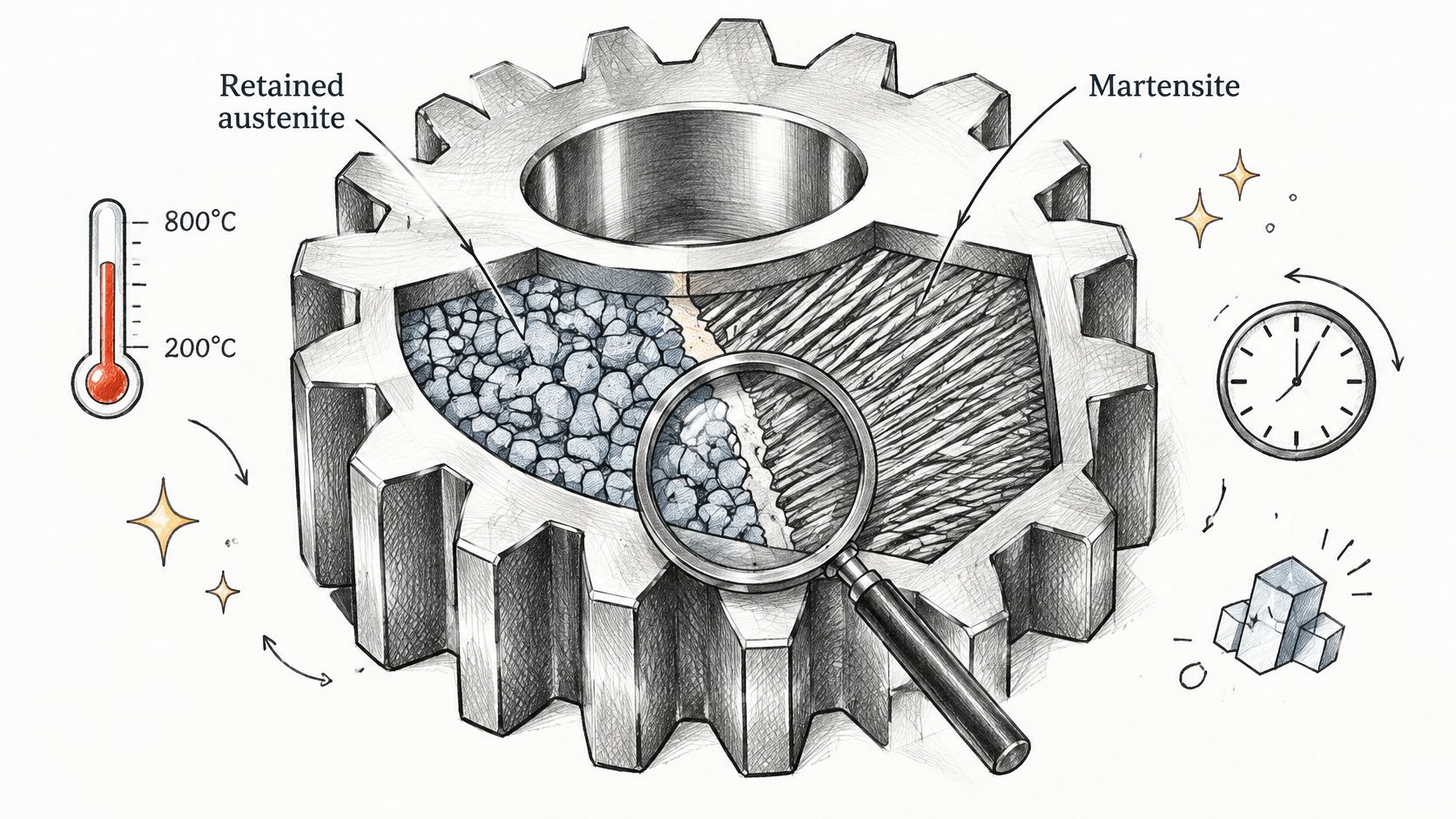
That is a measured mechanism in one steel, not a universal law. The literature still argues over how much of any gain comes from carbide precipitation, how much from austenite conversion, and how much from plain stress relief, and reported results vary widely between grades and cycles. Baldissera and Delprete's bibliographic review set out that disagreement years ago and it hasn't closed (The Open Mechanical Engineering Journal).
For non-ferrous metals the story is simpler and quieter: stress relief and a more stable structure, with no phase change to point at. Our academic research library collects the papers if you want to read them yourself.
Which Cycle Settings Decide the Result?
Five settings decide whether a cycle does anything: target temperature, hold time, ramp down, ramp up, and the tempering that follows. The literature gives concrete starting points for named materials.
Material | Hold temperature and time | Tempering |
|---|---|---|
AISI 52100 bearing steel | minus 185°C for 24 hours, or minus 195°C for 36 hours | Tempering after the hold, matched to the grade |
AISI D2 tool steel | 36 hours in liquid nitrogen | 210°C for 2 hours |
Quenched steel, Warwick study | Liquid nitrogen soak at around minus 196°C, typically 24 to 36 hours | Tempering follows the cryogenic stage |
Those bearing and D2 schedules sit in a review by Jurči and Dlouhý, which reports a substantial drop in wear rate for AISI 52100 at those settings and maximum abrasive wear resistance for AISI D2 after the 36 hour cycle and the 210°C temper.
Read a provider's cycle sheet in the same order you'd read that table. Target and hold come first, because too warm a target or too short a hold leaves transformation unfinished. Ramp rates come next, and they're the part buyers skip. Fast cooling puts a thermal gradient through the section, and thermal shock is the risk the slow cycle exists to avoid.
Tempering comes last and is not optional. Skip it, or run the wrong schedule for the grade, and you can waste the whole treatment. Large sections need particular care, because the core may not transform fully, so check dimensions and hardness or retained austenite content before the part goes back into service.
Each of those figures also belongs to one material and one failure mode. A lower wear rate reported for AISI 52100 under abrasive wear tells you little about a different grade failing by fatigue. The sensible check before a full order is a pilot batch: split identical parts into treated and untreated sets, run them in the same service, and compare them on the failure mode that costs you money. If the treated set doesn't show the gain on your parts, the schedule on paper hasn't transferred.
Our own cycle is a single computer controlled programme lasting about three days: slow cooling to around minus 196°C, a hold, then a slow return to room temperature, with the ramp rates doing the work.
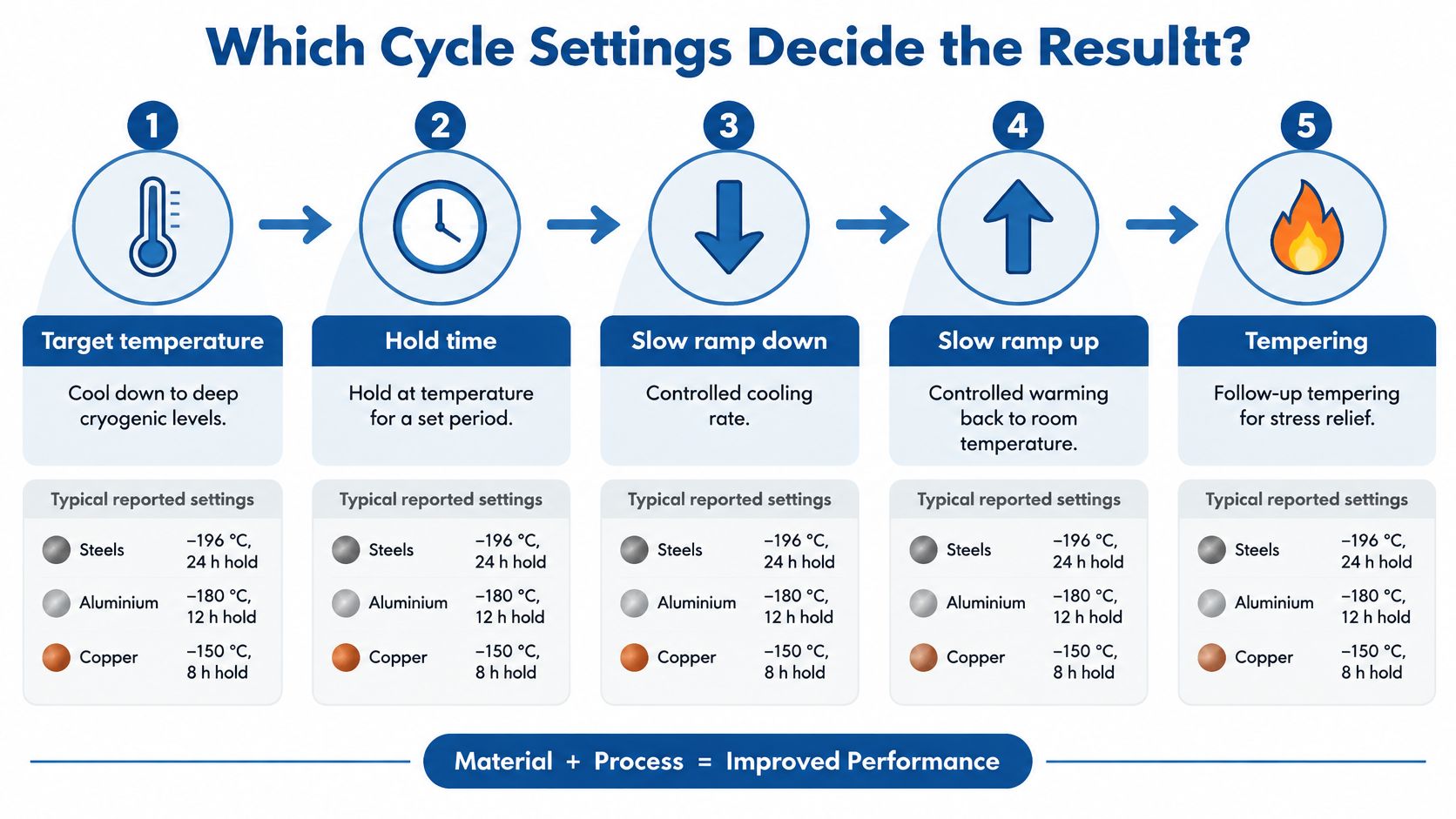
Results vary by material, prior heat treatment and application. No setting on any sheet is a promise of an outcome.
Which Parts and Applications Use Deep Cryogenic Treatment?
Group the work by what fails, because that's what the treatment can influence.
Motorsport. Brake discs, crankshafts, camshafts, pistons, connecting rods, gear sets and differentials all live under repeated thermal or fatigue load. Discs are the most evidence-backed of these, and only on wear performance, not hardness, so any claim needs checking against wear behaviour on the disc itself. More on that sits under motorsport component treatment and in this note on performance brake discs.
Machining and tooling. Drills, end mills, saw blades, guillotine blades, carbide tips, and steel and aluminium stock. The machining pages cover the shop floor side. Coated tools deserve their own test: a 2024 University of Warwick study found nanoindentation hardness up 5.2 per cent and elastic modulus up 14.8 per cent on PVD-TiN-coated AISI M2 high-speed steel against non-treated samples (Warwick repository). We helped support that work. A coated tool's wear surface is still the coating, so the gain has to be measured on the coated part, not assumed from the substrate.
Audio. Copper cable and components, where customers report changes in sound. That's listener reported and we don't present it as measured. Copper parts and finished cables are covered under audio treatment.
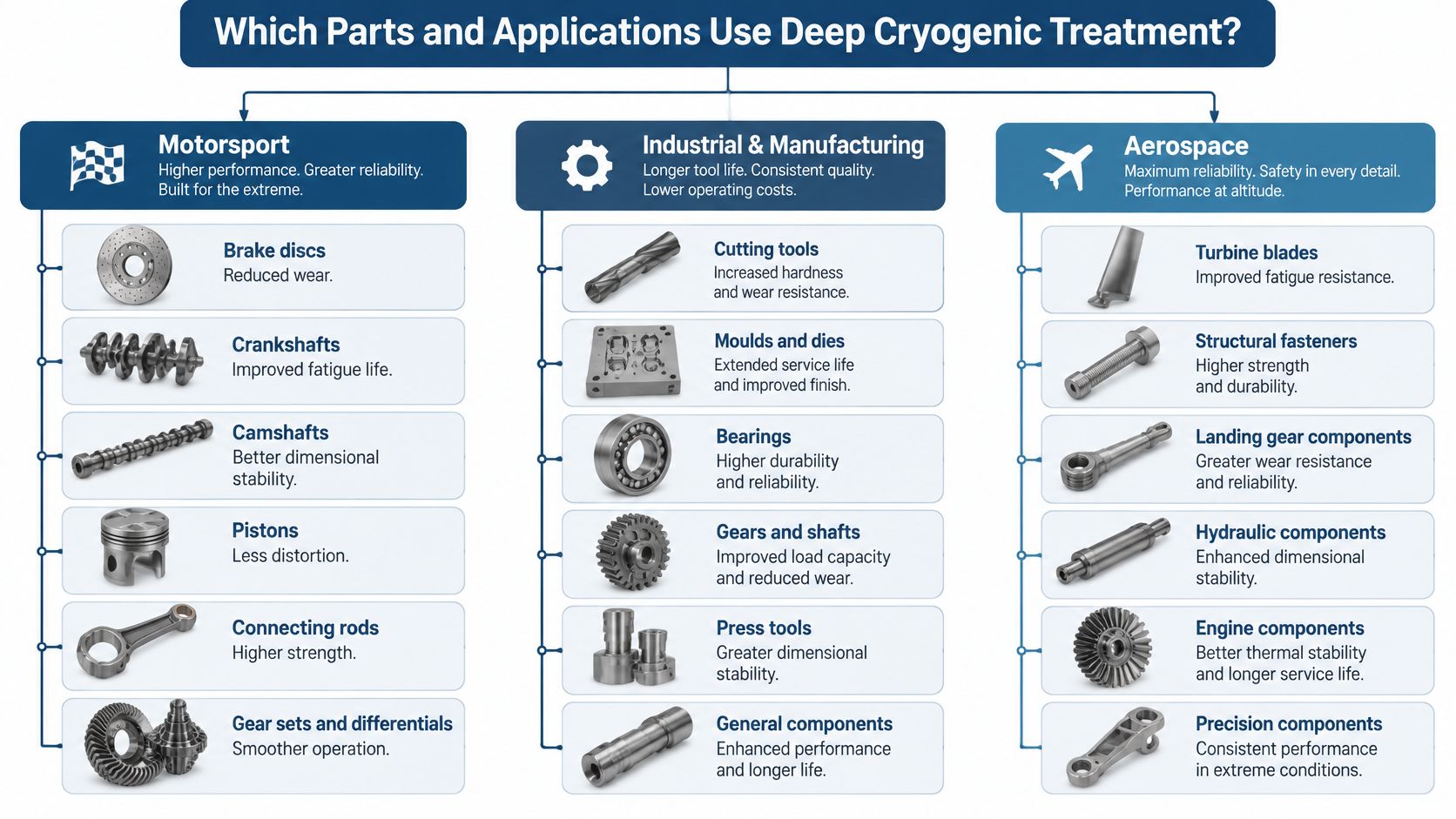
Whether your part belongs in any of those groups depends on whether it fails by wear, by fatigue, or by neither.
When Will Deep Cryogenic Treatment Not Help or Not Be Worth It?
Start with an honest split.
It can address wear on suitable steels, dimensional stability over time on steels, and stress relief in copper.
It cannot address cracked or damaged parts, plastic deformation, or corrosion.
It won't help where a coating is doing the wearing, where the material is already at the right hardness for the job, or where the main bottleneck is fixturing, lubrication or operator error.
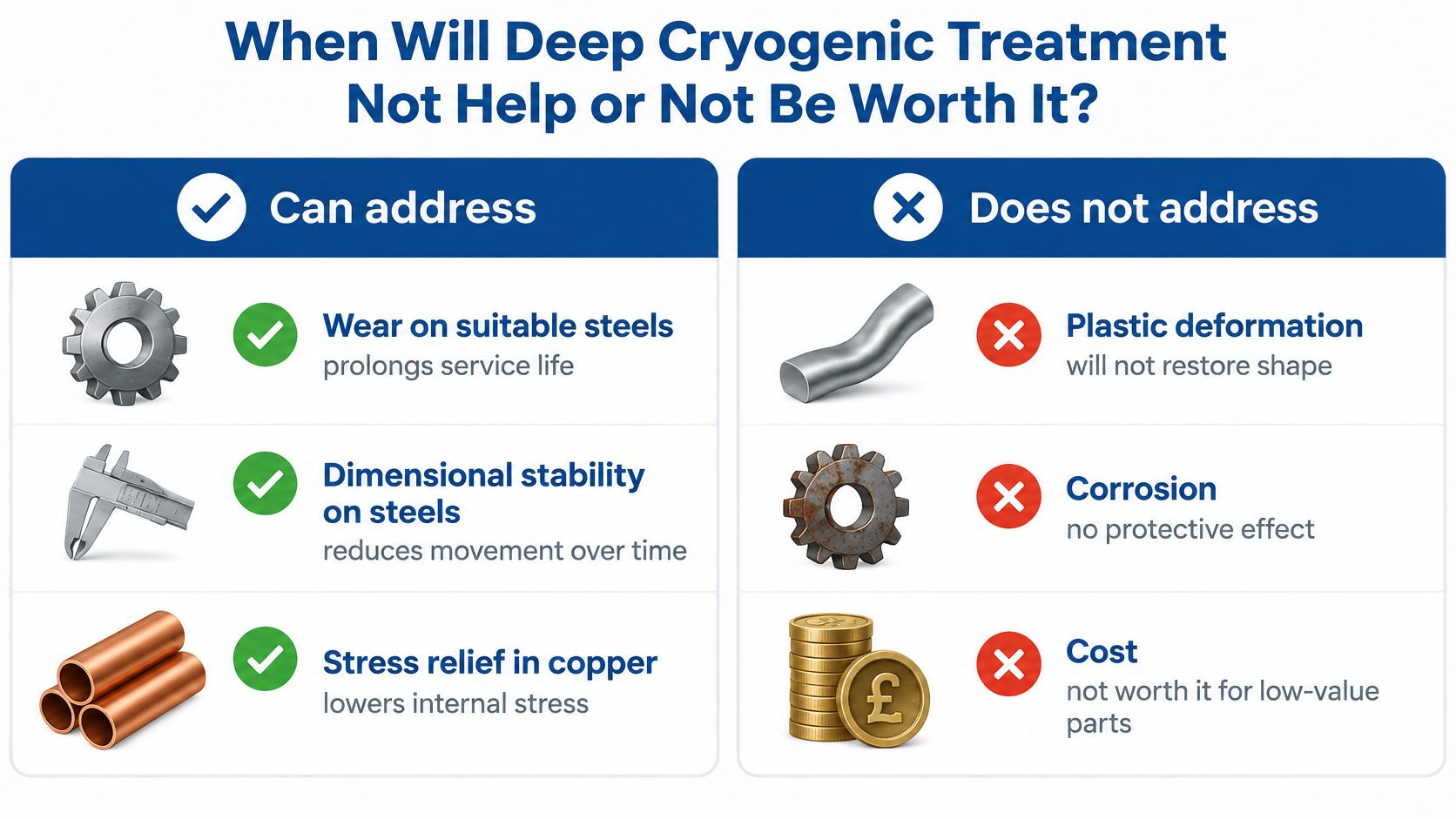
The carbide trade-off is the clearest cautionary example. A University of Sheffield doctoral study at 93 K, about minus 180°C, found treated cobalt-bonded tungsten carbide turning inserts resisted grain removal better, and were more vulnerable to crack propagation (Thornton, Wear). Better wear resistance and worse cracking resistance in the same part. Any tool life claim that doesn't name the material, the application and the failure mode isn't a claim you can use.
Worth separating coolant from treatment, too. A University of Bath study of aerospace-grade Ti-6Al-4V found conventional flood emulsion gave 30 minutes of tool life, while the best cryogenic option tested, CO2 with minimum-quantity lubrication, gave 18.5 minutes (Bath research repository). Same adjective, opposite commercial answer.
There's no published method for costing nitrogen, ventilation, logistics or whole-life impact per part, so the buyer has to do that arithmetic. UK work on cryogenic machining framed it as an environmental route but stops short of a customer-ready carbon or cost per component figure (CRYOSIS project).
What Should You Check Before Sending Parts for Treatment?
Does deep cryogenic treatment change the size of a part?
Parts remain dimensionally unchanged and visually identical: nothing is added to the surface and nothing is machined away. A dimensional check before and after is still worth doing on tight-tolerance parts, because measurement costs little and assumptions cost a lot.
Do the parts touch liquid nitrogen?
No. The chamber contains only nitrogen gas. Nitrogen is the working medium, not a bath the parts are dunked into, so finished and assembled parts go in without being stripped. The computer controlled cycle ramps temperature slowly enough to avoid thermal shock, which is also why plastic parts in an assembly survive the process without permanent damage.
How often do you run a cycle, and will you take a single item?
A full deep cycle runs roughly every four weeks, and single items are fine. Orders are pooled into one process, so the three-day cycle is shared across many customers rather than carried by one part; that is what makes small volumes commercially sensible. Heavy orders, such as a complete engine, may qualify for more cost-effective pricing.
Which evidence should I trust for my steel?
The wear test run on that exact material against an untreated control, with the reported percentage read in its original context. A figure from another alloy is a hypothesis about yours, not a result. Judge claims on the material tested and the failure mode measured, then prove the number on your own parts: a pilot batch of two or three, run against matching untreated controls, settles the question before a full order.
Before you commit a full set, ask for: recorded ramp rates, hold time and soak temperature; post cycle hardness or retained austenite results; the cycle sheet read against the settings table above; and a pilot batch of two or three parts with matching untreated controls.
References
Thornton (2014), PhD thesis, University of Sheffield. Thornton, Slatter, Jones and Lewis (2011), The effects of cryogenic processing on the wear resistance of grey cast iron brake discs, Wear 271. Jurči and Dlouhý (2024), Cryogenic Treatment of Martensitic Steels, Materials. Baldissera and Delprete (2008), Deep cryogenic treatment: a bibliographic review, The Open Mechanical Engineering Journal.
Cryogenix Ltd treats motorsport, machining, audio and aerospace parts at Yaxley, near Peterborough, cooling them in nitrogen gas to around minus 196°C in a computer controlled cycle of about three days, with orders pooled so a single set is worth sending. Ask for a quote at info@cryogenix-uk.com or through the contact page, and check the next processing date before you box anything up. The service is set out at Cryogenix Ltd.
Comments