


Tool Steel Types: Grades, Uses and Properties Explained
Your punch is chipping, but the replacement catalogue offers a harder grade. That isn't necessarily the answer. Tool steel types are families of alloy steels built for different jobs. We'd start with what ends your tool's life, wear, chipping, heat or impact, then choose the family and treatment route.
Table of Contents
Which tool steel family does my job need?
A drawing calls for D2, the mill certificate reads 1.2379 and the stockholder's catalogue lists BD2. All three point at the same steel. UK workshops work across three naming systems at once: British BS names, American AISI names and European material numbers. The labels get the right material delivered to the door. The job decides whether it survives once it gets there.
So start from the duty: how hot the tool runs, and how it is loaded. Then confirm the grade within the family.
Main tool steel families with standard names and strengths
Family | BS 4659 example | EN number | Main strength | Typical hardness |
|---|---|---|---|---|
Cold-work, oil-hardening | BO1 (AISI O1) | 1.2510 | Easy grinding and good room-temperature wear resistance | 58 to 62 HRC |
Cold-work, high-carbon high-chromium | BD2 (AISI D2) | 1.2379 | Wear resistance and dimensional stability | 58 to 62 HRC |
Shock-resisting | BS1 (AISI S1) | 1.2542 | Toughness under impact and repeated loading | 50 to 55 HRC |
Hot-work | BH13 (AISI H13) | 1.2344 | Strength and toughness at elevated temperature | 40 to 50 HRC |
High-speed | BM2 (AISI M2) | 1.3343 | Edge hardness under cutting heat | 63 to 66 HRC |
High-speed with cobalt | BM42 (AISI M42) | 1.3247 | Higher hot hardness, lower toughness | 66 to 70 HRC |
Plastic-mould | BP20 (AISI P20) | 1.2311 | Machinability and polishing for mould cavities | 28 to 36 HRC, supplied pre-hardened |
Read each row from left to right: family identifies the duty, the EN number lets you check the mill certificate, and the strength tells you which failure the steel resists. The hardness column gives typical working ranges because the same grade finishes higher or lower depending on tempering, the controlled reheating after hardening that trades some hardness for toughness. A D2 punch tempered for edge retention sits near the top of its range; the same grade needing to absorb shock is drawn back toward the bottom.
The BS 4659 specification for tool and die steels, first published in 1971, groups tool steels into cold-work, hot-work and high-speed categories. It also specifies composition, dimensional tolerances, maximum functional decarburisation depth and recommended heat-treatment ranges. Decarburisation means loss of carbon near the surface, which can leave a working skin softer than the certificate suggests.
In practice the categories describe where the tool works. Cold-work tools run at or near room temperature. Hot-work dies keep their strength against repeated contact with heated material. High-speed steels hold an edge that resists softening as cutting generates heat. Match the dominant failure to the family's strength: chipping under impact points toward shock-resisting grades, abrasion points toward the high-carbon high-chromium family, and softening in service points toward hot-work or high-speed.
Selection rule: Name the failure that will end the tool before choosing the steel family.
What makes one tool steel behave differently from another?
Tool steel covers a family of alloy combinations, each tuned to resist a different kind of failure. Two punches can reach the same hardness after heat treatment, then fail in opposite ways in service, one slowly wearing to a rounded edge, the other chipping at a corner under shock. The UK Trade Tariff distinguishes tool steels by composition because that recipe is what shapes the response to wear, chipping, heat and impact.
The illustration shows how composition changes the internal structure.
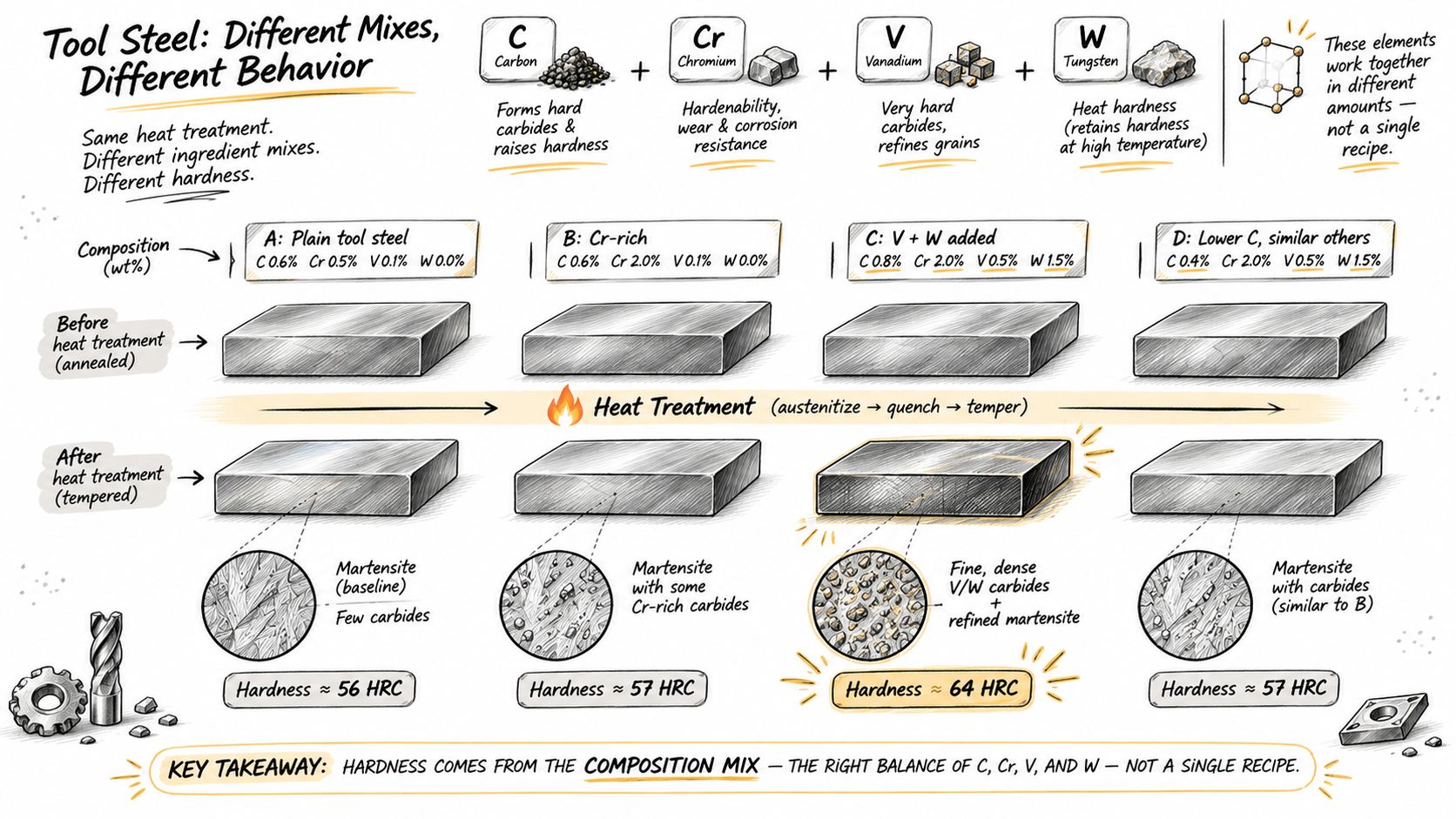
Inside the steel, carbides carry much of the load. These hard particles, formed where carbon combines with other alloying elements, act like gravel in concrete, resisting abrasion, although a heavy carbide population can reduce toughness, the ability to absorb impact without cracking. Each element pushes that balance in a different direction:
Carbon controls attainable hardness after suitable heat treatment.
Chromium supports carbide wear resistance and hardenability.
Vanadium forms hard carbides that resist edge wear.
Tungsten and molybdenum support hot hardness, meaning resistance to softening during hot service.
Cobalt improves hot hardness and resistance to tempering.
Composition sets the potential; heat treatment, section size and carbide distribution settle the result. Matching hardness figures never guarantee matching fracture behaviour, which is why selection works best when it starts from the failure that will end the tool: wear, chipping, heat or impact.
Surface processes answer a different question altogether. A guide to nitriding services explains how hardening only the surface layer differs from choosing the bulk grade beneath it.
This video provides additional context for tool-steel selection.
When is high-speed steel the right choice?
A drill's edge heats during cutting. A simpler high-carbon steel can soften, even though it was adequately hard before entering the workpiece. High-speed steel addresses that loss of working hardness, not merely the need for a high room-temperature reading.
According to West Yorkshire Steel's history of high-speed steel, these grades retain useful hardness up to approximately 500°C. M2 is commonly hardened to about 64 HRC, while M42 is commonly treated to approximately 66 to 68 HRC. HRC is the Rockwell C hardness scale.
M2 combines tungsten and molybdenum and offers high wear resistance after hardening. M42 contains cobalt, improving hot hardness and tempering resistance at a cost in toughness.
That trade-off matters in a drill crossing an intersecting hole or a cutter repeatedly entering an interrupted surface. A harder edge isn't automatically more durable if each re-entry chips it.
Choose for the conditions at the edge, not the highest hardness available in the catalogue.
Before specifying a high-speed grade, establish the temperature the edge encounters, whether engagement is continuous or interrupted, and how much impact the tool takes. Don't use alloy selection to compensate for poor chip evacuation or an unstable setup.
Which grade should I choose for a given failure?
Say a blanking punch starts chipping after a production run. Buying a more wear-resistant steel might make matters worse if the immediate problem is insufficient toughness, poor clearance or misalignment.
Inspect the damaged edge before ordering. Record the stroke count, workpiece material, clearance and damage location. A rounded edge and a missing fragment need different investigations.
Applications, likely failure modes and starting families
Application | Starting family | Failure to watch | Priority property |
|---|---|---|---|
Blanking or shearing punch | Cold-work BD2 or shock-resisting BS1 | Edge wear or chipping | Wear resistance for wear, toughness for chipping |
Hot forging or extrusion die | Hot-work BH13 | Heat cracking and thermal fatigue | Toughness at elevated temperature |
Drill or end mill | High-speed BM2 | Edge softening under cutting heat | Hot hardness |
Cold heading die | Shock-resisting BS1 | Impact cracking | Toughness under repeated loading |
Injection mould | Plastic-mould BP20 | Surface wear and dimensional drift | Machinability and polishability |
This is a starting point, not a purchasing specification. Thermal fatigue means damage from repeated heating and cooling. Finish grinding, machining method and heat treatment can alter the result enough to change the recommendation.
Check the BS name against the EN designation and mill certificate rather than accepting an equivalents table alone. The British Stainless Steel Association's machinability guidance also explains why machining behaviour involves more than the steel family.
We treat drills, end mills, guillotine blades, slitters, perforation tools, disc cutters, band saw blades and carbide tips. Our machining service covers these applications; our carbide cutting tools guide addresses that distinct tool material.
Which tool steel types respond to cryogenic treatment?
A punch that dies by slow edge wear and a drill that loses its edge once the cut gets hot are not asking the same thing of the steel. Cryogenic treatment is a deep-cold stage added after ordinary hardening and tempering. It has the most room to help when the steel still holds retained austenite, the softer structure left behind after quenching. Reviewers describe that austenite changing toward harder martensite, with fine carbides forming as well. Jurči and Dlouhý examine martensitic steels, Baldissera and Delprete survey deep cryogenic treatment, and Podgornik and colleagues look at tool steels. The mechanism is still debated, and results vary widely by grade.
Retained austenite works like an unfinished pocket in an otherwise baked loaf: the quench did not complete the change. A steel with little of it left has less of that particular change available, so the heat-treatment record matters. So does the failure that will end the tool. Wear and heat softening give treatment a clearer case than a grade chosen only because its hardness number looks high.
The diagram separates cooling, holding and warming.
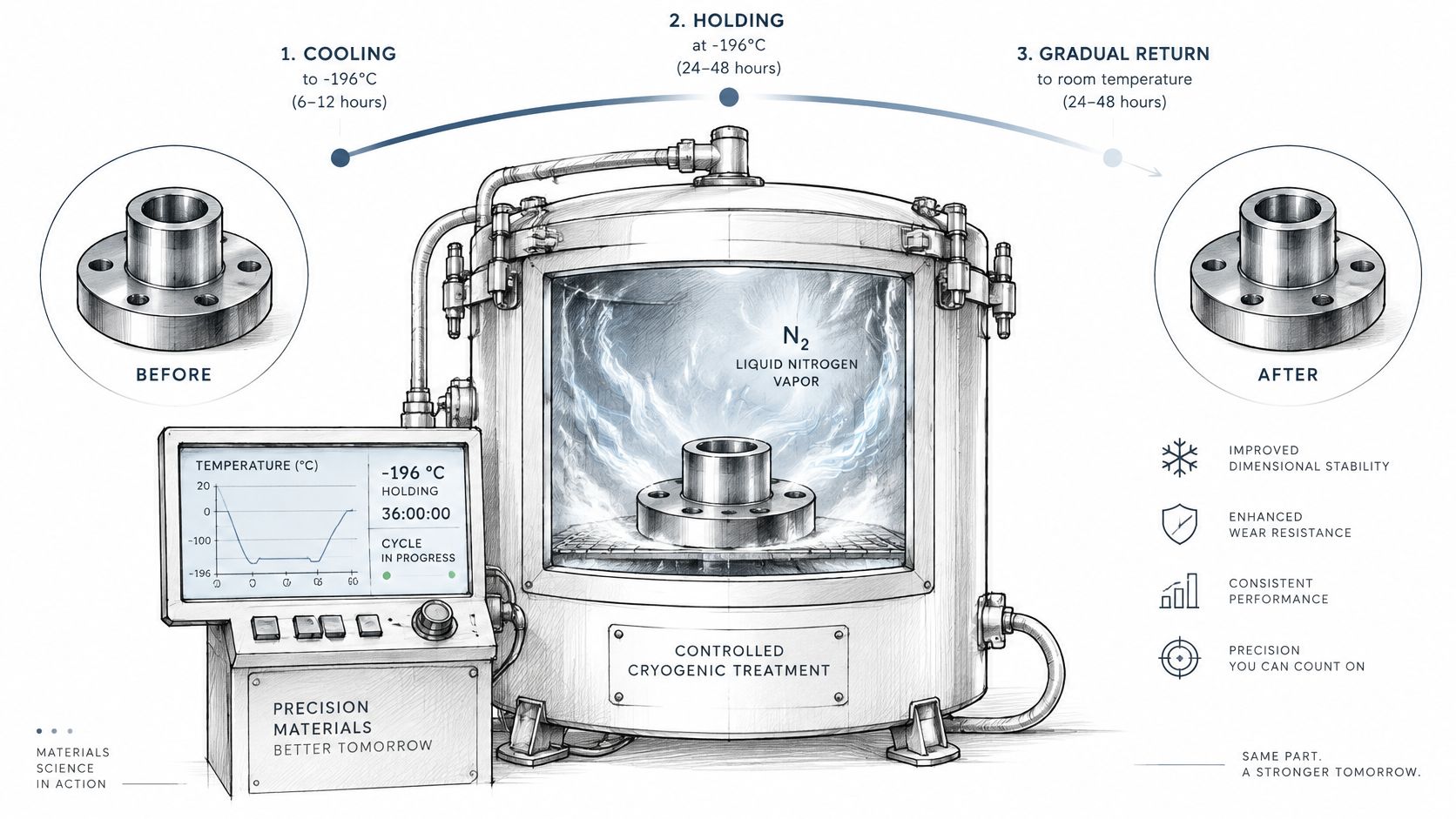
For many steels, cryogenic treatment is most effective as an additional stage after conventional heat treatment. In most cases it is best carried out after machining, because machining can introduce extra stresses. Treated parts come back dimensionally unchanged and visually identical, with no coating, plating or added surface layer. The deep cryogenic treatment overview sets out where Cryogenix applies this, and the full processing steps describe the cycle.
Treated cutting tools can have their productive life increased many fold, staying sharper for longer and being less prone to failure. That outcome still depends on the grade, the prior heat treatment and the job. It is not a result every tool steel will repeat.
Bulk treatment of the steel is separate from decorative surface colouring. Everti on safe titanium colouring covers that different subject, not tool-steel wear.
When is cryogenic treatment not worth doing?
Damaged tooling needs repair or replacement first. Cryogenic treatment won't rebuild a chipped edge or close a crack. Inadequate conventional heat treatment needs metallurgical investigation, not a cold soak intended to rescue it.
Gross overload, unsuitable geometry and the wrong grade need correcting at source. Likewise, a loose fixture or inadequate coolant supply isn't a material problem that treatment can solve.
Trial criterion: There must be a plausible metallurgical cause to address and a useful production measure to compare.
Use matched tools from the same grade and manufacturing condition. Keep untreated controls, maintain comparable cutting conditions and record accepted components, edge condition and reasons for withdrawal.
Results vary by material, prior heat treatment and application. The sensible decision rests on the failure mode, the actual grade and whether the likely benefit is worth testing, not on treating every tool automatically.
What should I check before sending tools for treatment?
Identify the failure: wear, chipping, heat or impact.
Confirm the material: obtain the grade and EN designation from supplier documents.
Check manufacturing records: include heat treatment and finish-machining status.
Inspect condition: exclude cracked or chipped tools.
Plan the comparison: retain untreated tools and record equivalent production measures.
Don't torque parts together. Lightly oil corrosion-prone ferrous metals and remove pressed-in bearings where possible.
You can post parts from anywhere in the UK or drop them off in person. We accept single items and pool orders into scheduled runs. Pricing is by weight and quotation. Runs take place roughly every four weeks; most customers have parts back within a week to ten days of a run.
What do readers ask about tool steel types?
Is a harder tool steel always better?
No. Hardness resists indentation, while toughness resists fracture. Choose the balance that suits the failure ending your tool's useful life.
Can cryogenic treatment fix a chipped punch?
No. A chipped punch needs repair or replacement by other means. Treatment doesn't repair damaged parts.
Is M42 always better than M2 for drills?
No. M42's cobalt supports higher hot hardness but reduces toughness. Interrupted cuts and heavy shock can favour the tougher option.
Does treatment change the size of a tool?
Our treated parts remain dimensionally unchanged and visually identical. There's no added surface layer to accommodate in the tool's dimensions.
Where does the published evidence come from?
Jurči and Dlouhý (2024), Cryogenic Treatment of Martensitic Steels, review.
Baldissera and Delprete (2008), Deep cryogenic treatment: a bibliographic review, The Open Mechanical Engineering Journal.
Podgornik and others (2016), Deep cryogenic treatment of tool steels, Journal of Materials Processing Technology, 229.
Further reading, Cryogenix research library.
At Cryogenix Ltd, we offer deep cryogenic treatment for tooling once you've established the grade and failure mode. Weigh your parts and ask for a quote at info@cryogenix-uk.com or through our contact page, and check the next processing date.
Comments