


Cryogenic Machining Explained: Cooling vs Treatment
The advice to use cryogenic machining for longer tool life skips the decisive question: compared with what? Cryogenic machining delivers a cryogen, usually liquid nitrogen or carbon dioxide, to the cutting zone while the tool works. It can reduce wear and improve finish, but the material, speed and baseline determine whether it helps.
Table of Contents
What Is Cryogenic Machining?
A cryogen is a substance used to produce very low temperatures, commonly supplied as a liquefied gas. In cryogenic machining, it cools the contact between the cutting tool and workpiece during metal removal. That's different from deep cryogenic treatment, which processes a complete tool or component separately.
Cooling a cutting tool is like running cold water over a hot tool while it works. Treatment aims to make a lasting change to the part itself.
Cryogenic machining compared with cryogenic treatment
Aspect | Cryogenic machining | Cryogenic treatment |
|---|---|---|
What is cooled | The cutting zone, where tool meets workpiece | The whole part in a separate cycle |
When it happens | While the tool cuts | Once, before service |
Cryogen used | Liquid nitrogen or carbon dioxide delivered by nozzle | Nitrogen gas in a chamber; parts never touch liquid |
Length of process | Minutes of cutting time | Several days, about three days at Cryogenix |
What changes | Cutting temperature, tool wear and surface finish | Metal structure, permanently, surviving regrinding |
Typical users | Shops cutting titanium, aluminium and difficult alloys | Race teams, toolmakers and component manufacturers |
Machining results aren't evidence for treatment results. One changes conditions during a cut. The other changes the material being put into service.
How Does Liquid Nitrogen Cool the Cutting Zone?
Take a cut through Ti-6Al-4V, an aerospace-grade titanium alloy. Titanium conducts heat poorly, so most of the heat generated in the shear zone stays concentrated at the tool tip instead of spreading into the workpiece and chip. That localised heat is the target liquid nitrogen delivery aims at.
The diagram shows the intended cooling path.
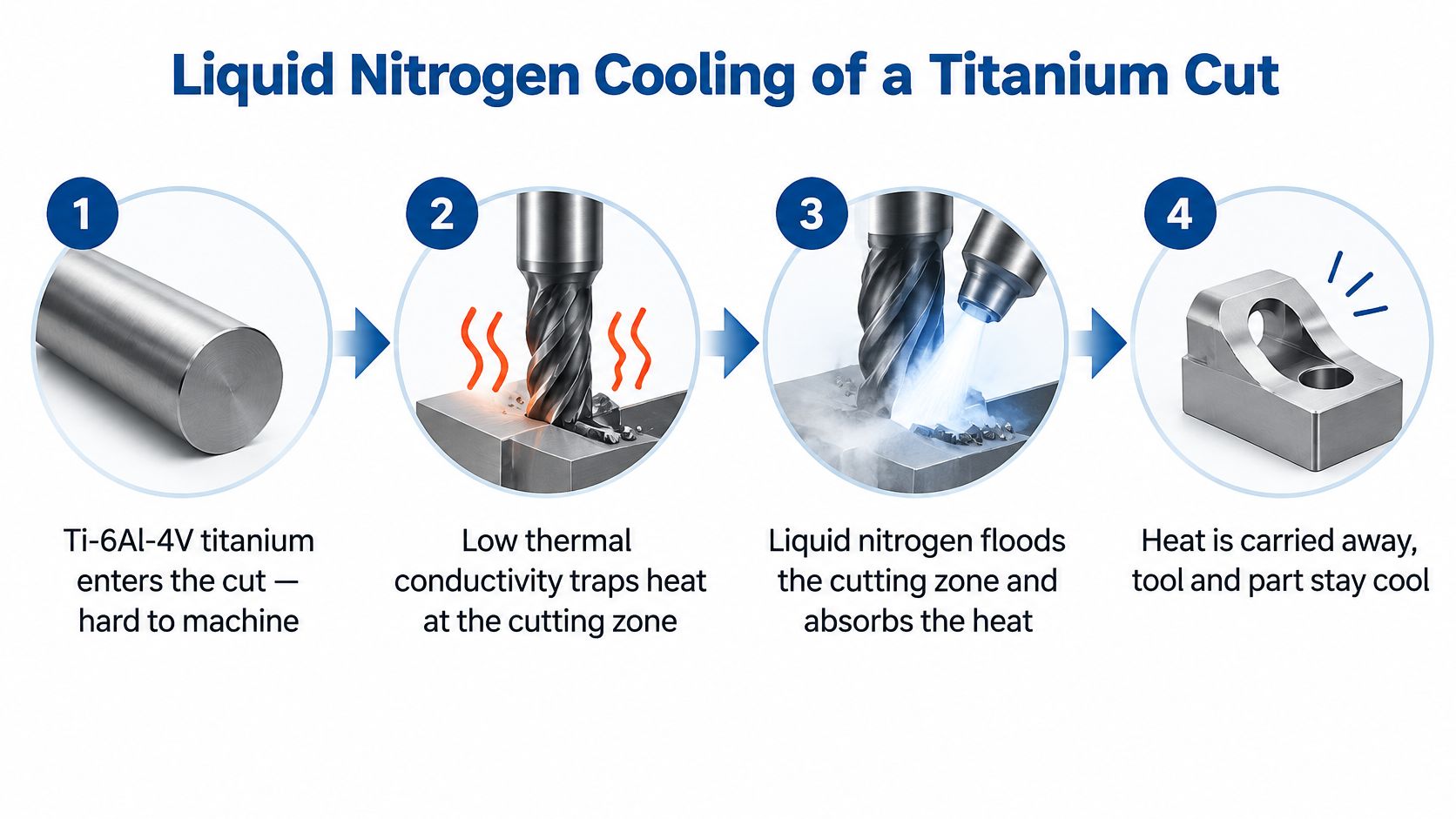
The delivery sequence runs as follows:
Supply: Liquid nitrogen travels from its vessel through a delivery line.
Aim: A nozzle directs the jet at the tool and the emerging chip.
Extract heat: The University of Bath surface-integrity investigation describes nitrogen supplied at approximately minus 197°C pulling heat out of the contact.
Limit adhesion: A cooler interface reduces titanium's chemical affinity for the tool material, the mechanism behind built-up edge.
Protect the surface: Less adhesion and less thermal damage can leave fewer microscopic defects on the finished part.
This is a thermal and tribological mechanism: it changes temperature, friction and wear at the interface during the cut. A plausible mechanism, however, says nothing about the result on your machine. Whether cryogenic delivery helps depends on what it replaces, and at higher cutting speeds a well-directed flood system can cool comparably.
Nozzle position and delivery rate decide whether the jet reaches the useful contact area or flashes to gas on the way in. Check both, along with chip movement, before changing any cutting parameters.
Carbon dioxide is the main alternative, alone or combined with minimum-quantity lubrication, or MQL, which meters a small amount of lubricant into the cut.
For moving footage alongside the process diagram:
Hardware sourcing sits upstream of the process question. Choosing a cryogenic delivery kit is a separate purchasing decision from the cutting equipment itself, whether that means nozzles and lines or Value Tools Co's open-box cut off saw deals.
How Much Do Surface Finish and Tool Life Improve?
The reported gains look large until you check what they were measured against.
Reported results from UK titanium and aluminium studies
Study | Comparison | Reported result | Limit on the figure |
|---|---|---|---|
Liquid nitrogen against dry and wet machining | Roughness down by up to 62% | Experimental maximum | |
Same Bath study, aluminium T6 | Liquid nitrogen against dry and wet machining | Roughness down by up to 50% | Alloy condition and setup matter |
Liquid nitrogen against flood cooling | Nearly three times the tool life and 40% lower roughness | Controlled experiments | |
Bath surface-integrity investigation, Ti-6Al-4V | Liquid nitrogen against dry machining | Up to 39% lower roughness, fewer microscopic defects | Nozzle position and speed require control |
Same investigation | Liquid nitrogen against flood cooling | Up to 31% lower roughness | Process-specific result |
Read the comparison column first, because it sets the size of the gain. The last two rows make this concrete: within a single investigation, the same nitrogen delivery produced a 39% roughness reduction against dry machining and a 31% reduction against flood cooling. Dry cutting is a weak baseline. Flood emulsion is the system your process already runs, and the advantage shrinks against it. At higher cutting speeds the gap can narrow further and even reverse, which is why a percentage quoted without its baseline tells you almost nothing.
The earlier Bath work also reported significantly reduced tool wear. Reduced wear and longer usable tool life are different measurements, and one only supports the other when the trial defines its rejection criterion. Nor should maxima from separate experiments be combined into a single expected improvement.
A smoother surface matters commercially only if it meets the drawing more reliably or removes a finishing operation.
Measure surface roughness, tool life and cutting power against your current process. Keep alloy condition, feed, tooling and coolant delivery controlled, otherwise you won't know which change produced the result.
Which Cutting Speed and Cryogen Give the Best Tool Life?
Tool life under different cutting conditions
Condition | Cutting speed | Reported result |
|---|---|---|
Bath cutting-tool design study, liquid nitrogen, 14° rake and 10° primary clearance | 110 m/min | 91 minutes tool life and up to 83% higher productivity |
Ti-6Al-4V cooling comparison, carbon dioxide added to MQL against MQL alone | 70 m/min | 29% longer tool life |
Same comparison, carbon dioxide added to MQL | 80 m/min | 32% longer tool life |
Same comparison, flood emulsion against carbon dioxide with MQL | 100 m/min | Flood emulsion outlasted the carbon dioxide and MQL combination |
Flood emulsion beat the cryogenic combination at the highest speed tested. One pairing at 100 m/min proves nothing about cryogenic delivery in general; it does show that cooling method and cutting speed interact, so a gain measured at 70 or 80 m/min cannot be assumed at 100 m/min. None of these rows share a baseline, so their percentages cannot be merged into a single cryogenic advantage.
The Bath result came from a tool-design study funded by the Engineering and Physical Sciences Research Council and Innovate UK, and the geometry deserves attention in its own right. The 14° rake sets the slope of the face across which the chip leaves; the 10° primary clearance keeps the flank from rubbing the fresh surface. The 91-minute tool life belongs to that edge at that speed and does not transfer automatically to other tools.
Treat the tested geometry as a starting candidate for a trial, then record flank wear, roughness and nitrogen consumption over a complete tool life. Consumption per cutting pass is what turns a wear result into a cost result.
For wider context on parameters and coolant choice, System Engineering & Automation discuss how to improve titanium tool life; treat it as background rather than evidence for a specific cryogenic gain. The tooling side is a separate question, covered in our guide to carbide cutting tools, where treatment of the tool itself replaces coolant delivery as the variable.
What Does Deep Cryogenic Treatment Change in the Metal?
We cool parts slowly to around minus 196°C, hold them, then return them slowly to room temperature in a computer-controlled cycle lasting about three days, with gradual changes that avoid thermal shock. The chamber contains only nitrogen gas, and parts never touch liquid; our step-by-step treatment guide explains the cycle.
Treatment affects the whole part. It isn't a coating or a replacement for conventional heat treatment, and dimensions and appearance remain unchanged. For many steels, it supplements conventional heat treatment; retained austenite can convert to martensite, and fine carbides can form.
The illustration needs a material-specific caveat: its austenite-to-martensite description applies to steels, not a demonstrated transformation of the titanium alloy named in its caption.
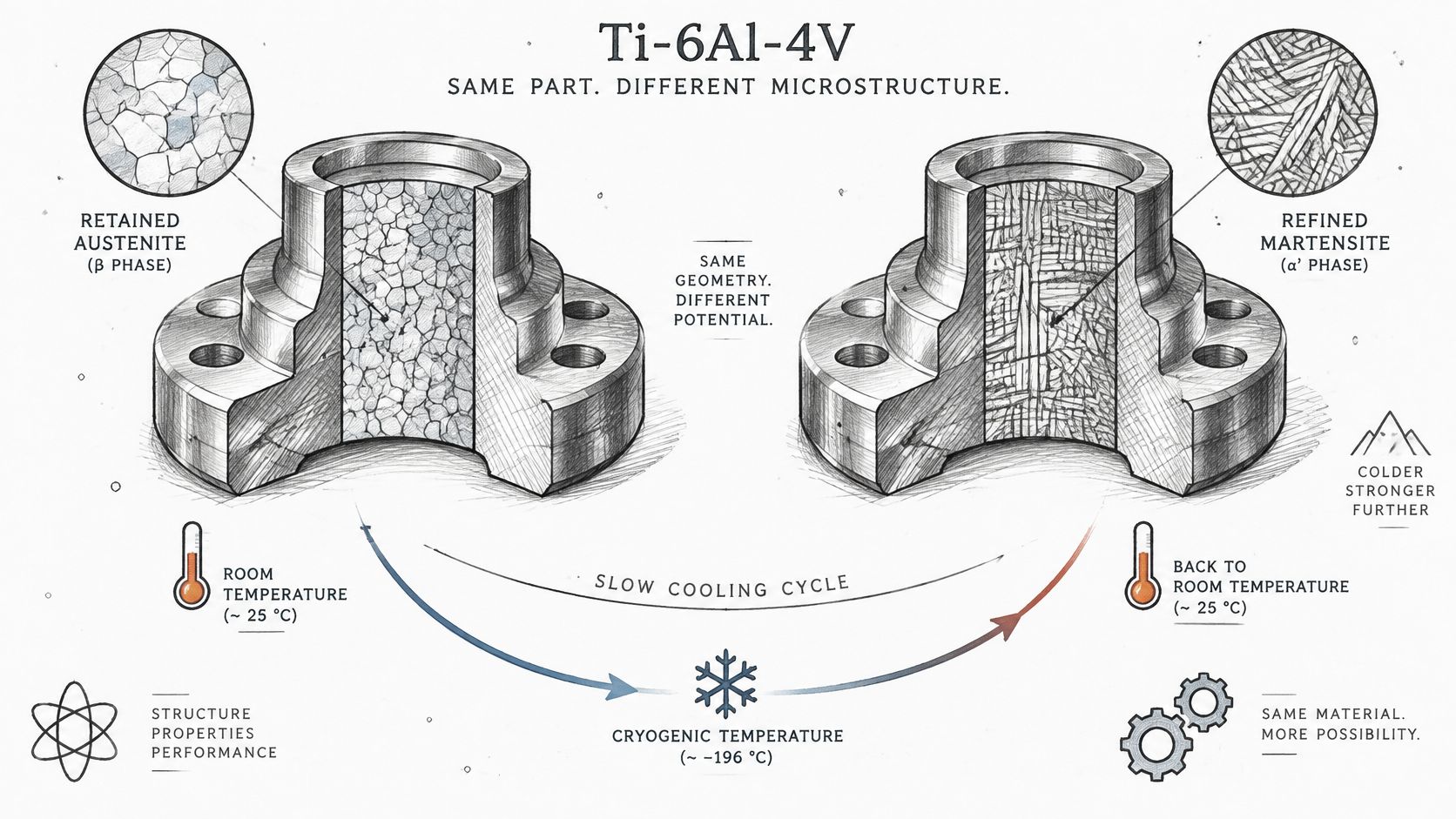
For non-ferrous materials, the intended benefits concern stress relief and structural stability. Results vary by material, prior heat treatment and application, and mechanisms remain debated. Sub-zero treatment shouldn't be treated as a single interchangeable specification.
What evidence supports treatment?
Thornton, Slatter, Jones and Lewis's 2011 study in Wear 271 reported wear rate improvements of 9.1 to 81.4 per cent, without significant bulk-hardness change, in pin-on-disc testing of grey cast iron brake discs. That isn't a measured disc-life multiple.
Separately, our own customer experience is that treated brake discs typically last two to four times longer. That's not a research finding or guarantee; results vary by material, prior heat treatment and application.
When Is Cryogenic Machining Not Worth It?
A well-run conventional process can outperform cryogenic cooling. The flood-emulsion result makes that clear without requiring an argument about whether nitrogen or carbon dioxide is superior.
Check these limits before spending:
Wear isn't your bottleneck: Longer tool life may have little value if inspection, handling or another operation limits output.
The batch is too small: Include setup and gas supply costs, not just saved tool life.
The nozzle can't reach: Cooling the surrounding space isn't the same as cooling the tool contact.
The part is damaged: Treatment won't repair cracks, restore a chipped edge or correct a distorted shape.
Longer life alone doesn't prove lower environmental impact.
A whole-life comparison must include nitrogen production, liquefaction, transport, storage losses, electricity, lubricants and replacement tooling. The EPSRC-funded supercritical carbon dioxide and MQL project record includes lifecycle assessment, heat transfer and tool wear for titanium, steels and composite stacks. It doesn't establish a universal environmental winner.
Treatment also needs a specific purpose. If your existing component already meets its service requirement economically, an unmeasured structural change isn't a business case. Run a controlled comparison before committing.
Should You Trial Cryogenic Machining or Book Treatment?
Start with the failure mechanism, not the word cryogenic.
Heat limits the cut: Trial cutting-zone cooling against the current process. Confirm machine compatibility and delivery access before buying equipment.
The component wears in service: Consider treatment, with a matched untreated comparison. Don't assume a machining study predicts component durability.
You need a titanium machining benchmark: Compare your existing tool with the tested geometry and speed. Measure through to the same wear rejection limit.
You're planning treatment: We normally recommend treating after machining because machining can introduce additional stresses.
Your schedule matters: We run roughly every four weeks. Most customers have parts back within a week to ten days of a run; check the next processing date.
We provide deep cryogenic treatment for motorsport, audio, machining and aerospace parts. Our machining page covers tooling applications, while our guide to choosing a cryogenic treatment company explains practical selection criteria.
The answer for one setup won't necessarily transfer to another. Specify the material, prior treatment and operating conditions before deciding what success would mean.
What Do Readers Ask Before Trying Cryogenic Machining?
Which materials have the UK studies tested?
The milling results discussed here concern Ti-6Al-4V titanium and aluminium T6 alloy. They don't establish equivalent gains for steels or composites, even though other cooling programmes investigate those materials.
Can a standard CNC mill run cryogenic cooling?
Only with a compatible delivery arrangement that reaches the cutting zone. Check the proposed installation with the machine builder, including gas handling and machine protection, before running a controlled trial.
Can cooling and treatment be used together?
They act at different times, so they aren't the same intervention. The studies discussed here don't establish the combined benefit, so test the combination rather than multiplying separate improvement figures.
Our frequently asked questions cover further treatment practicalities. The Cryogenix research library provides additional reading, with published findings kept separate from customer experience.
References
Thornton, Slatter, Jones and Lewis (2011), Wear 271. Grey cast iron brake-disc wear investigation, linked in the treatment discussion.
Jurči and Dlouhý (2024), Cryogenic Treatment of Martensitic Steels. Review of material-dependent treatment mechanisms.
Baldissera and Delprete (2008), Deep cryogenic treatment: a bibliographic review, The Open Mechanical Engineering Journal. Review documenting the breadth and variability of treatment findings.
At Cryogenix Ltd, we offer deep cryogenic treatment of tools and components, not cutting-zone coolant installations. Weigh your parts and ask for a quote at info@cryogenix-uk.com or through our contact page, and check the next processing date before arranging delivery.
Comments