


Aerospace Components Water Pump: Does Treatment Help?
Fitting a higher-flow pump or treating its metal isn't automatically an improvement. An aerospace water pump must move the correct fluid within its approved system limits. We start with the pump category and the recorded failure, because cryogenic treatment changes the metal, not the component's approval status or the circuit's design.
Table of Contents
Pump Parts, Materials and Where Durability Is Lost - Separate metal wear from seal deterioration
What Cryogenic Treatment Changes in Each Material - Published research versus Cryogenix experience
Approval Checks Before Any Pump Leaves the Workshop - Workshop go or no-go checks
Questions Engineers Ask Before Sending a Pump Part - How long until treated parts come back? - Can you send a single pump part? - Does treatment change dimensions or appearance? - How do you get a part to Cryogenix? - References
What an Aerospace Water Pump Does
In a cooling circuit, an aerospace water pump circulates coolant so heat can leave the components it protects. Thermal management means holding component and fluid temperatures inside approved limits. Other aircraft water pumps supply drinking water, move waste or support engine water injection, so the name alone doesn't define the duty.
Say a cooling pump produces acceptable flow on a workshop rig. On the aircraft, hot coolant, restrictive pipework and reduced reservoir pressure can leave it short of the required performance. The pump works with reservoirs, heat exchangers, valves and controls, not independently.
The CAA's British Civil Airworthiness Requirements require powerplant cooling provisions to keep component and engine-fluid temperatures within approved limits across ground and flight conditions. For a cooling-pump investigation, record:
Flow margin: delivery above the system's minimum requirement at the demanding operating condition.
Inlet pressure: measured at the pump, including suction-line losses.
Maximum fluid temperature: including hot soak, when heat remains after operation.
That's the working picture you need before assessing a replacement or proposing treatment. A bench pass alone doesn't establish installation suitability.
Which Water Pump Category You Are Working With
Start with the category. It sets the fluid, likely failure modes and evidence needed before return to service. A search for aerospace components water pump can otherwise mix unrelated systems.
The UK occupational standard for maintaining aircraft water and waste systems distinguishes potable-water, waste and engine water-injection duties, with specific maintenance checks.
Aerospace water pump categories compared
Category | Working fluid | Main durability concern | Evidence before return to service |
|---|---|---|---|
Potable-water pump | Potable water | Leakage and pressure control | Leak testing, pressure adjustment and filter checks |
Toilet and waste pump | Waste fluid | Leakage and seal wear | Leak checks and the maintenance manual procedure |
Engine water-injection pump | Water-based injection fluid | Pressure, flow and control faults | Leak, pressure, flow and built-in-test checks |
Electrified aircraft liquid-cooling pump | Water-glycol coolant | Cavitation, heat load and transient loading | System-level validation under thermal load, not a bench flow test |
Use the table for the water-system decision. The diagram also shows neighbouring fluid-system categories, which mustn't be treated as interchangeable.
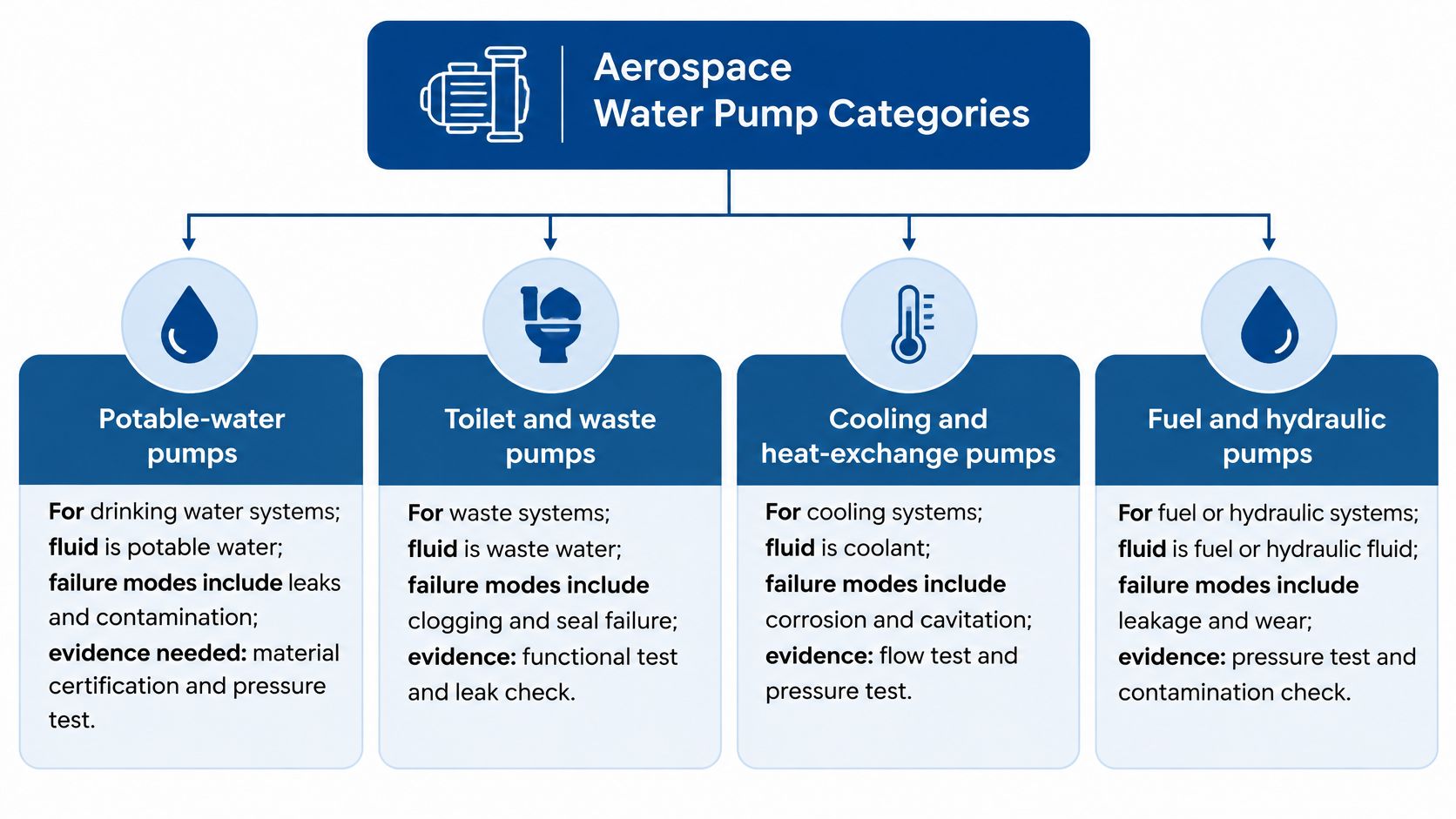
Ask what fluid the pump moves, whether acceptance requires maintenance checks or thermal-load validation, and whether you're proposing a like-for-like replacement or a changed design. Water-injection investigations must include the tanks, valves, regulators, solenoids and controls, not just the pump.
Practical rule: Higher flow isn't an improvement if it defeats pressure regulation, increases leakage or puts the installation outside its approved configuration.
Pump Parts, Materials and Where Durability Is Lost
Main pump parts, materials and durability risks
Component | Typical material | Main durability risk | Treatment relevance |
|---|---|---|---|
Pump housing | Aluminium alloy such as 7075 or 6082, subject to the drawing | Wear and dimensional drift under thermal cycling | Non-ferrous structural stability may be relevant; results vary |
Impeller | Aluminium alloy or stainless steel, according to design | Erosion and cavitation damage | Existing damage remains; design and fluid conditions still govern |
Shaft | Steel | Fatigue under torsion and bending | Steel structure can change; approval still applies |
Bearings | Hardened steel | Rolling-contact wear and surface fatigue | Material response requires application-specific assessment |
Seals | Elastomer or polymer | Hardening, compression set and leakage | Metal treatment doesn't establish seal suitability |
Read these as inspection starting points, not a substitute for the material specification. Check the drawing, material certificate, previous processing and removal report before selecting a candidate. An alloy designation alone doesn't tell you whether treatment is worthwhile.
For a housing, measure bearing bores, seal seats and mounting faces against drawing limits. On an impeller, inspect the inlet edges and passages for pitting or material loss. Cavitation is the formation and collapse of vapour bubbles where local pressure falls too low; stronger metal doesn't remove that hydraulic cause.
Separate metal wear from seal deterioration
A hardened or swollen seal needs a compatibility investigation, not a metal-treatment proposal. Compression set means a seal retains deformation rather than recovering sufficiently to maintain contact. Polymerize's guide to environmental degradation for R&D is useful background for organising questions about exposure and polymer deterioration, not aircraft acceptance evidence.
Likewise, don't confuse a whole-part process with a surface-engineering specification. Our nitriding services explanation provides context for that distinction; neither route should be substituted into an approved drawing without engineering assessment.
Start with the component that ends the pump's service life. If removal records consistently identify seals, treating the shaft doesn't address the recorded problem.
What Cryogenic Treatment Changes in Each Material
The cycle is simple to describe: parts are cooled slowly to around minus 196°C, held at that low temperature, then returned gradually to room temperature. The chamber contains only nitrogen gas, so parts never come into contact with liquid nitrogen; our step-by-step process explanation gives the full sequence.
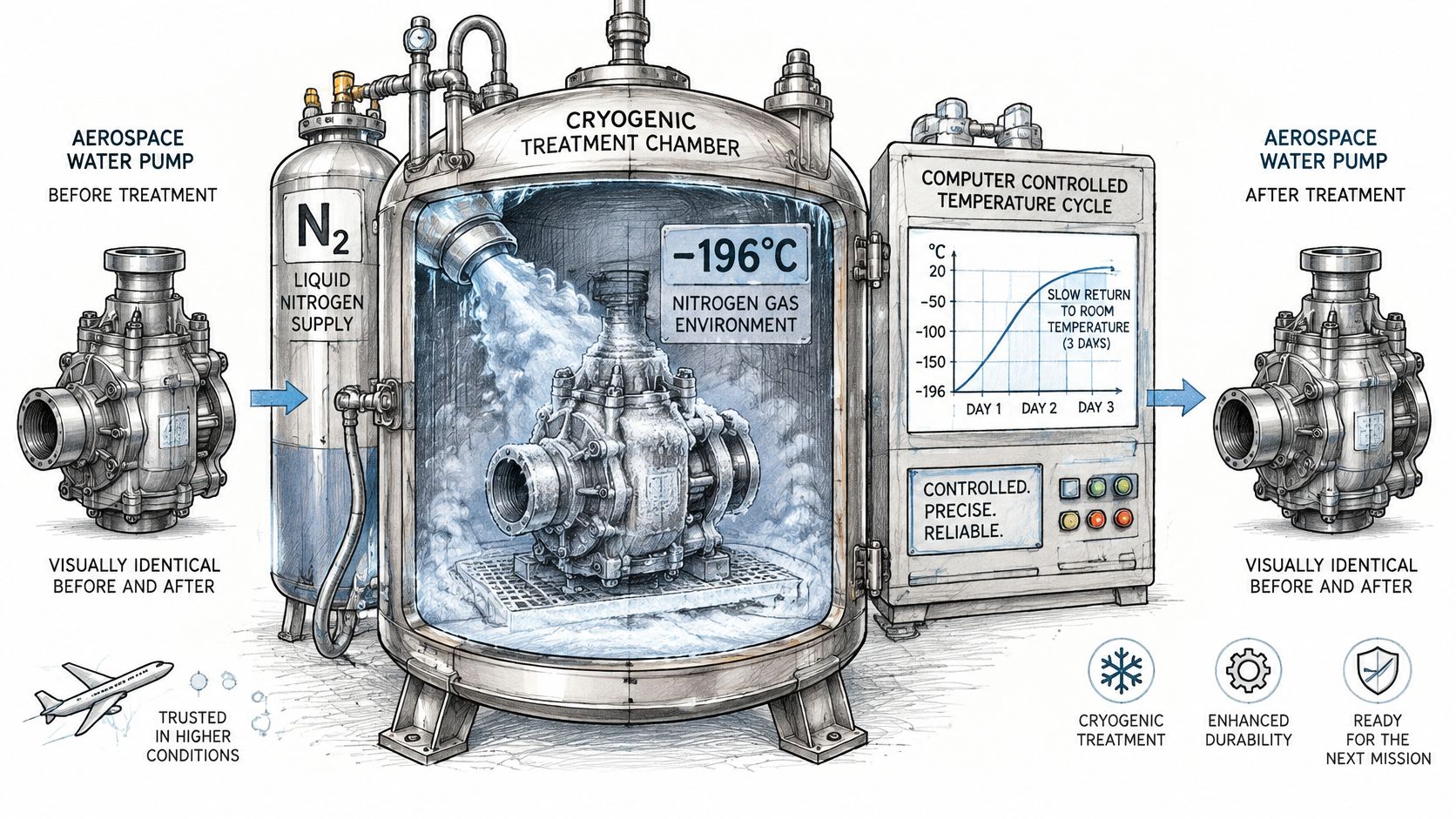
In responsive steels, retained austenite, a steel microstructure remaining after hardening, converts to martensite, and fine carbides form. Non-ferrous metals gain stress relief and a more stable structure. Aluminium alloys such as 7075 and 6082 can show improved dimensional stability and wear resistance, but results vary by material, prior heat treatment and application. The alloy designation on a material certificate is a starting point for the decision, not a promise of the outcome.
Our deep cryogenic treatment overview describes a permanent whole-part process. It isn't a coating or conventional heat treatment. The change runs through the section thickness of the part, and treated components come out dimensionally unchanged and visually identical. That matters for pump parts, because the effect can't be confirmed by looking at the returned component. Confidence has to come from process records and post-treatment measurement, not surface appearance.
Published research versus Cryogenix experience
Published research: Thornton, Slatter, Jones and Lewis (2011), Wear, reported wear-rate improvements of 9.1 to 81.4 per cent, with no significant bulk-hardness change, in a pin-on-disc study of grey cast iron brake discs. That's cast iron wear evidence, not a pump-life prediction.
Jurči and Dlouhý (2024), Materials, reviewed martensitic steels; Baldissera and Delprete (2008), The Open Mechanical Engineering Journal, reviewed the broader literature. Mechanisms remain debated and study results vary widely.
Cryogenix experience: We don't present those studies as evidence of aircraft-pump service life. No gain is guaranteed; the Cryogenix research library separates published work from application decisions. Treatment changes the metal. It changes nothing about what the pump is approved to do.
The video provides further process context.
Operating Limits and Acceptance Tests
For a hydraulic-pump drive, CAA certification data record a 0.1835:1 speed ratio to engine N2, 9.15 daNm continuous torque, 18.64 daNm overload torque, 40.67 daNm static torque and a 1.97 daNm overhung-moment limit. The cited certification material also includes a fuel-system pump-inlet range from minus 54°C to 54°C, with inlet pressure at least 34.4 kPa above kerosene vapour pressure.
Neither set is a water-pump limit. They illustrate the method: assess a bounded operating envelope rather than one nominal rating. An overhung moment is the bending load produced when a force acts beyond the shaft support.
For water or water-glycol circuits, establish adequate suction pressure above the coolant's vapour pressure at maximum fluid temperature. MA Hydraulics Ltd's explanation of what causes pump cavitation provides useful hydraulic background, not an aircraft-specific acceptance limit.
Build testing from the pump's approved data and installation:
Hydraulic conditions: hot coolant, minimum tank pressure and inlet-line losses.
Mechanical conditions: maximum speed, torque transients and specified overhung load.
Acceptance evidence: required flow, pressure, leakage and condition checks.
A flow-and-discharge-pressure test can miss seal distress or shaft fatigue. Treatment doesn't authorise different operating limits or relaxed acceptance criteria.
When Cryogenic Treatment Will Not Help
Cracked, eroded or cavitation-damaged parts need an approved disposition, not treatment as a repair. Cryogenic processing doesn't replace missing material, close cracks or restore worn dimensions.
It also won't correct inadequate flow margin, restrictive inlet plumbing, poor alignment or an unsuitable impeller design. If seal chemistry or coolant compatibility caused the failure, changing the metal structure doesn't resolve it.
A sound part with a measurable wear problem is a more sensible candidate than a damaged part needing rescue.
Scheduled replacement can make treatment uneconomic, particularly where little permitted service remains. If the engineering authority won't approve the proposed processing, there's no installation case to pursue.
With engineering agreement, measure wear on untreated parts before committing a batch. Use consistent inspection locations, comparable duty and recorded removal reasons. Results vary by material, prior heat treatment and application, so a controlled comparison is more useful than an assumed life extension.
A defensible decision not to treat still saves handling, testing and workshop time.
Approval Checks Before Any Pump Leaves the Workshop
For installation on a UK-registered aircraft, establish traceability to an approved design. CAA component approval guidance states that almost all aircraft components require UK design approval, normally through UK Part 21 certification or bilateral validation, and identifies UKPA markings for certain approved changes.
Matching dimensions, mounting holes and flow isn't enough.
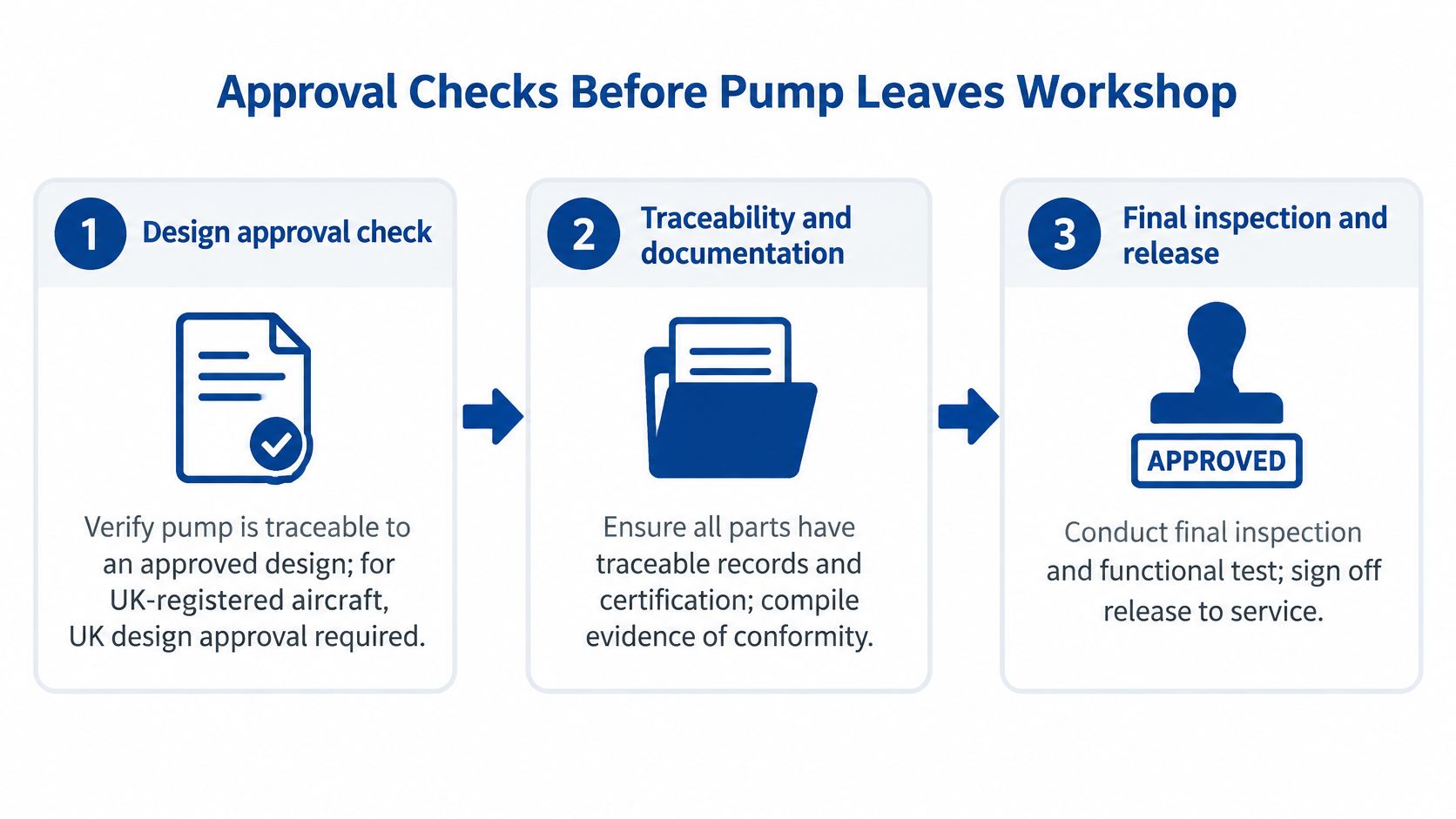
Workshop go or no-go checks
Confirm the category. Establish the applicable fluid-system procedures and evidence.
Check identification and records. Reconcile part identity, design status and production or maintenance history with the approved configuration, including applicable UKPA markings.
Obtain an engineering decision. Ask whether processing constitutes a design or configuration change. Treatment itself implies no approval.
Review continuing-airworthiness requirements. The CAA continuing-airworthiness material places maintenance within the aircraft's controlled system, including inspection access, schedules and wear-based replacement recommendations.
Confirm the release organisation. CAA guidance on used-component certification requires appropriately authorised release staff. Its cited serviceability conditions include no fault in the component or related system during the last flight, alongside full compliance with the applicable requirements. An A-rated organisation may remove a component; release must fall within the appropriately rated organisation's scope.
Secure written sign-off before dispatch. Record the permitted work, required inspections and release route.
We provide deep cryogenic treatment for motorsport, audio, machining and aerospace, but that service description isn't an aerospace approval. Our guide to choosing a cryogenic treatment company supports supplier assessment, not airworthiness authorisation.
Questions Engineers Ask Before Sending a Pump Part
How long until treated parts come back?
Runs are scheduled rather than continuous, so confirm the published next processing date before dispatch. Most customers have their parts back within a week to ten days of a scheduled run, including shipping time at each end.
Can you send a single pump part?
Yes. Single items are accepted and are processed in the chamber alongside other customers' parts on the next scheduled run. Pricing is still by weight and by quote, so identify the pump category, fluid handled, material, part condition and weight before asking for a number.
Does treatment change dimensions or appearance?
Parts remain dimensionally unchanged and visually identical after processing. The chamber contains gas only, so components are never exposed directly to liquid nitrogen, and plastic parts in a component do not suffer permanent negative transformations. None of that removes inspection or documentation requirements: treatment changes the metal, not the approval status.
How do you get a part to Cryogenix?
Post parts from anywhere in the UK or deliver them to Unit 2 Slater Court, Harrier Way, on the Enterprise Business Park in Yaxley, Peterborough, PE7 3SE. FedEx next day is the recommended trackable service. Agree dismantling and preservation before dispatch: do not torque parts together, lightly oil ferrous metals that could corrode, and remove pressed-in bearings where possible.
References
Thornton, Slatter, Jones and Lewis (2011): The effects of cryogenic processing on the wear resistance of grey cast iron brake discs, Wear.
Jurči and Dlouhý (2024): Cryogenic Treatment of Martensitic Steels, Materials.
Baldissera and Delprete (2008): Deep cryogenic treatment: a bibliographic review, The Open Mechanical Engineering Journal.
Cryogenix research library: published literature on cryogenic processing.
Cryogenix Ltd offers deep cryogenic treatment for metal components, including aerospace applications where the engineering authority has agreed the processing route. Weigh your pump parts and ask for a quote at info@cryogenix-uk.com or through our contact page, and check the next processing date before sending them.
Comments