


High Speed Steel Tools: Uses, Wear and Cryo Treatment
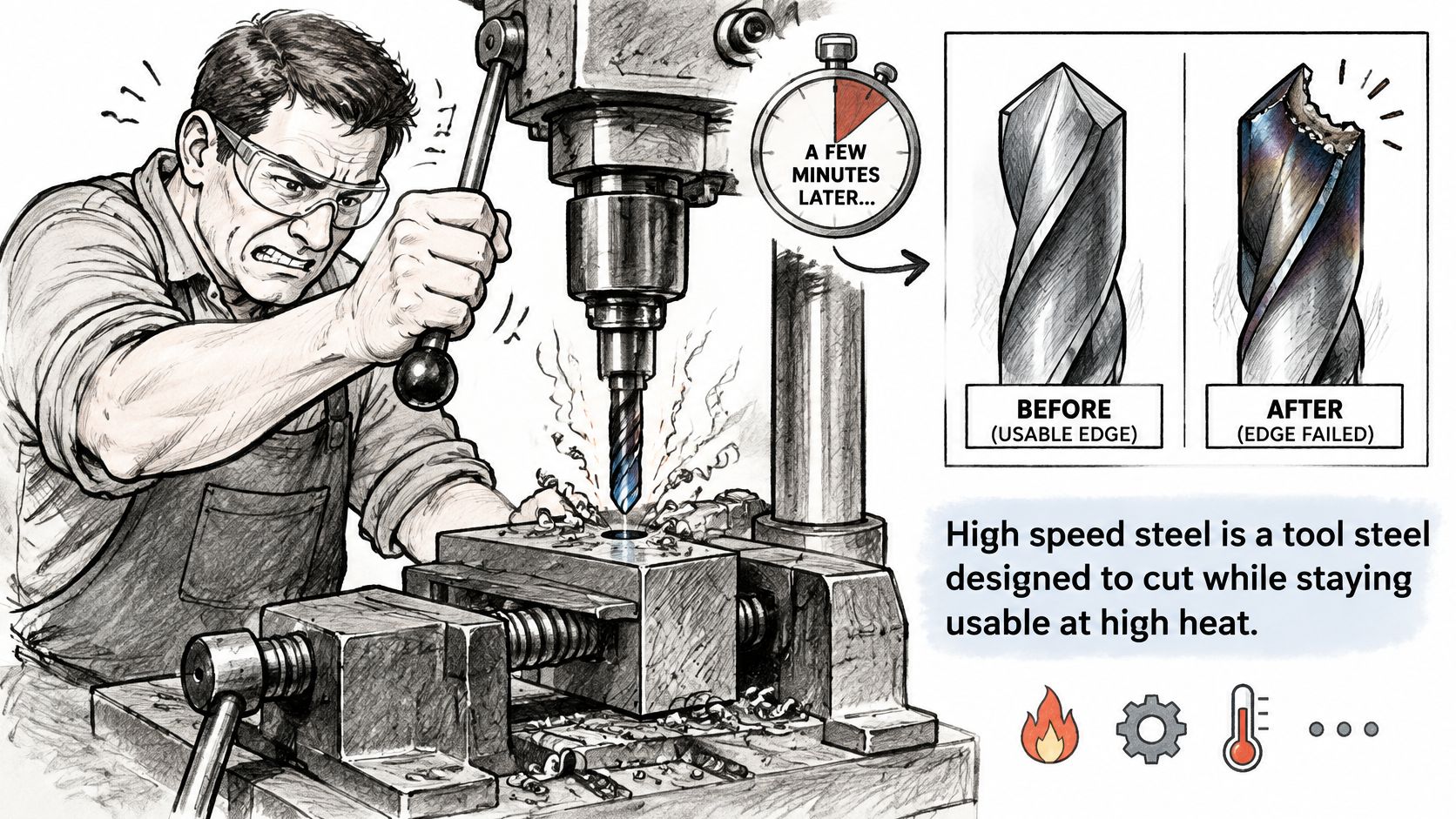
A drill squeals, the tip turns straw, then blue, and the edge that was shearing metal two minutes ago is now rubbing it. The hole tightens, the finish tears, and the tool is finished. Nothing was wrong with the steel. Heat beat it.
High speed steel is a tool steel alloyed with tungsten, molybdenum, chromium and vanadium. It holds its hardness when the edge runs hot, so high speed steel tools cut faster than carbon steel tools and survive temperatures that would soften carbon steel to uselessness. That hot hardness is why drills, taps, reamers, milling cutters and saws are still made from it.
Table of Contents
What Is High Speed Steel and Why Is It Still Used?
Tool steel means steel made for cutting and forming other materials, not for holding up a structure. High speed steel is the branch of tool steel that keeps working when the cut gets hot, and that one property explains why it still fills tool cabinets more than a century after it arrived.
Historical accounts split cutting-tool development into three stages: carbon steel up to 1894, self-hardening steels such as Robert Mushet's steel up to about 1900, and modern high speed steel after that. The gain was measurable. Cutting speed rose from roughly 12 metres per minute with carbon steel tools in 1850 to about 37 metres per minute with HSS in 1900, a threefold increase, as this history of high speed steel in the UK records. Sheffield was already a centre for specialised steels, so British toolmakers sat close to that change rather than reading about it later.
Those are historical figures. The working question now is narrower: which jobs still suit HSS, why the edges fail, and whether treatment earns its place. The Cryogenix research library collects the published work, and our comparison of tool steel types explains how the grades in your drawer differ.
How Does High Speed Steel Stay Hard When It Gets Hot?
Hot hardness is the property that paid for high speed steel's name. A carbon steel edge loses its temper as the cutting zone heats, while HSS keeps enough hardness at the tip to keep shearing metal instead of smearing it.
The structure is hard grit held in a tougher binder. Carbide particles resist abrasion; the steel matrix around them absorbs shock and keeps the edge from crumbling. Neither part works alone, and the balance between them is what you choose when you pick a grade.
Three layers build that structure. The alloying elements come first: tungsten, molybdenum, chromium and vanadium. During hardening and tempering they form carbides that resist wear. Around those carbides sits tempered martensite, the tough but slightly softened structure left when steel is quenched hard and then tempered back.
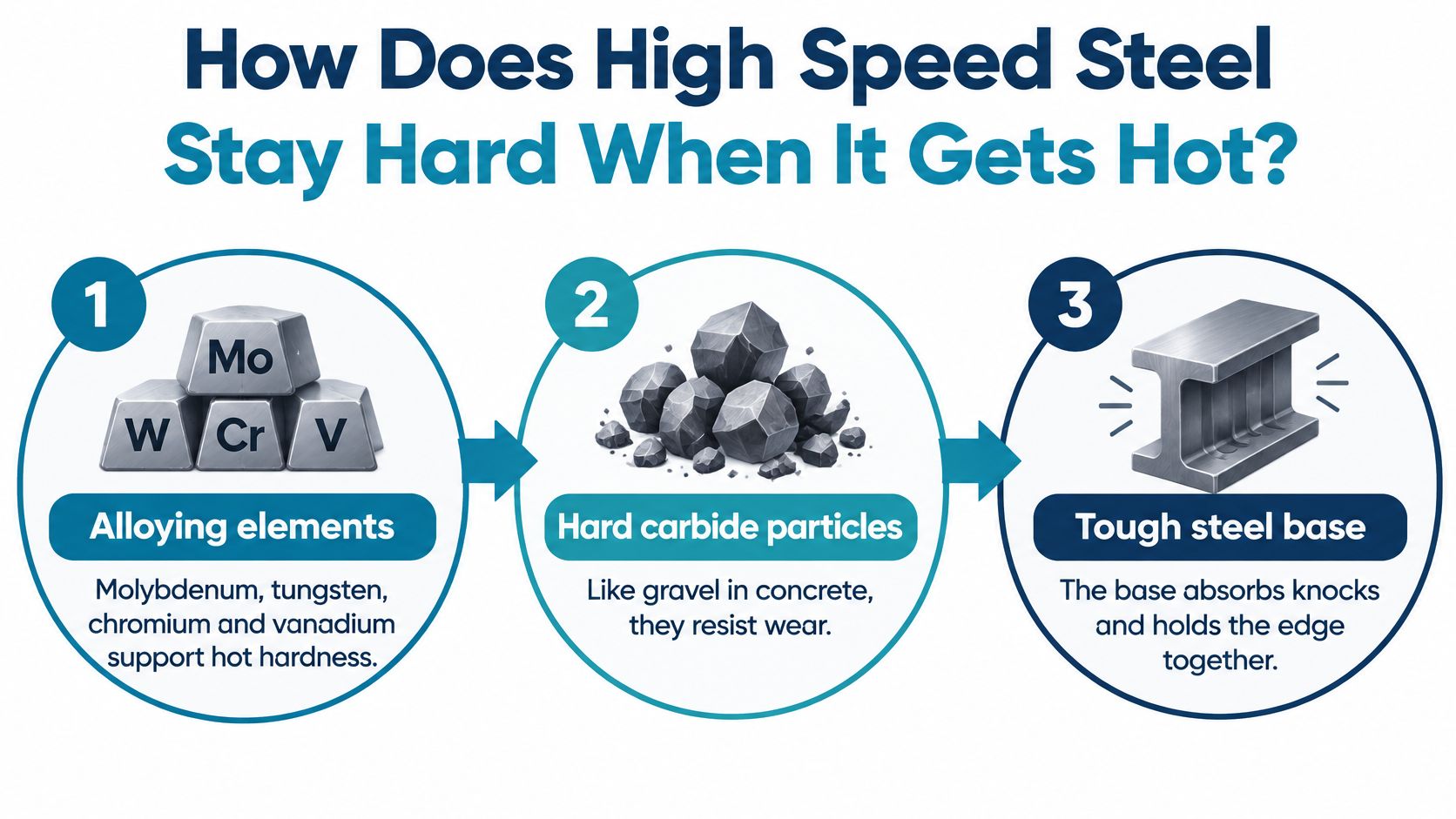
Take grade 1.3343, the common European designation used for twist drills, reamers, taps, milling cutters and saws. Its nominal chemistry runs about 0.86 to 0.94 per cent carbon, 3.80 to 4.50 per cent chromium, 4.70 to 5.20 per cent molybdenum, 1.70 to 2.10 per cent vanadium and 5.90 to 6.70 per cent tungsten, according to the 1.3343 grade specification. Tungsten, molybdenum and vanadium form the wear-resistant carbides. The martensitic matrix supplies the toughness that stops the carbides falling out.
Hardness is measured on the Rockwell C scale (HRC), where a higher number means greater resistance to indentation. The useful figure is hardness at the temperature the cut generates, not the room-temperature headline printed on the box. For a correctly hardened and tempered grade such as 1.3343, hot hardness stays high well beyond the point where ordinary carbon steel would soften, then falls as service temperature pushes past the steel's tempering stability. Exact values depend on austenitising, quench and temper; the same chemistry treated badly will not reach the datasheet curve.
That distinction matters when judging any added treatment, including cryogenic processing. If an edge fails because heat has softened the martensite, a treatment has to show improved hot hardness or temper resistance to be relevant. If it fails by abrasion, micro-chipping or adhesive pickup, the mechanism to test is different. Keep published studies in one column and a supplier's shop experience in another; they answer related questions, not the same one.
Practical rule: read a tool datasheet by finding the hardness at the temperature your cut actually generates, not the room-temperature headline figure printed on the box.
Which Tools Are Made from High Speed Steel?
Common HSS tools and why HSS suits them
Tool | Typical role | Why HSS suits it |
|---|---|---|
Twist drills | general drilling | toughness and regrinding |
Taps and reamers | sizing and threading holes | repeated resharpening |
Milling cutters and end mills | slotting and profiling | tolerance of interrupted cuts |
Broaches and form tools | complex profiles | toughness at moderate speed |
Saws | cutting stock | toughness under impact |
Tapping shows the logic best. A tap reverses at the bottom of a blind hole and breaks the chip as the spindle changes direction, so the edge takes a shock load with the tool buried in the workpiece. HSS shrugs that off. It's why thread-cutting taps for metalwork are ground from HSS rather than made from a harder, more brittle material.
Carbide is harder and removes metal faster. It also fractures when the setup flexes or the cut stutters. A review of HSS and carbide tool behaviour puts the trade-off plainly: HSS has greater toughness than carbide, typically reaches about 62 to 68 HRC after heat treatment, and is limited by heat rather than by hardness, which generally keeps cutting speeds near 50 metres per minute.
So HSS stays the sensible pick for interrupted cuts, small workshops, complex profiles, low-volume work and any tool you resharpens repeatedly. Carbide earns its price on rigid machines, continuous cuts and volume. Neither choice is obsolete, and which one wins depends on your workpiece, your machine's rigidity, your coolant and your geometry.
Why Do High Speed Steel Tools Wear Out and Fail?
A pencil point is a fair model for an HSS edge. Push it gently and it wears into a flat you can see and measure. Push it hard and it snaps. Run it hot and it smears instead of cutting.
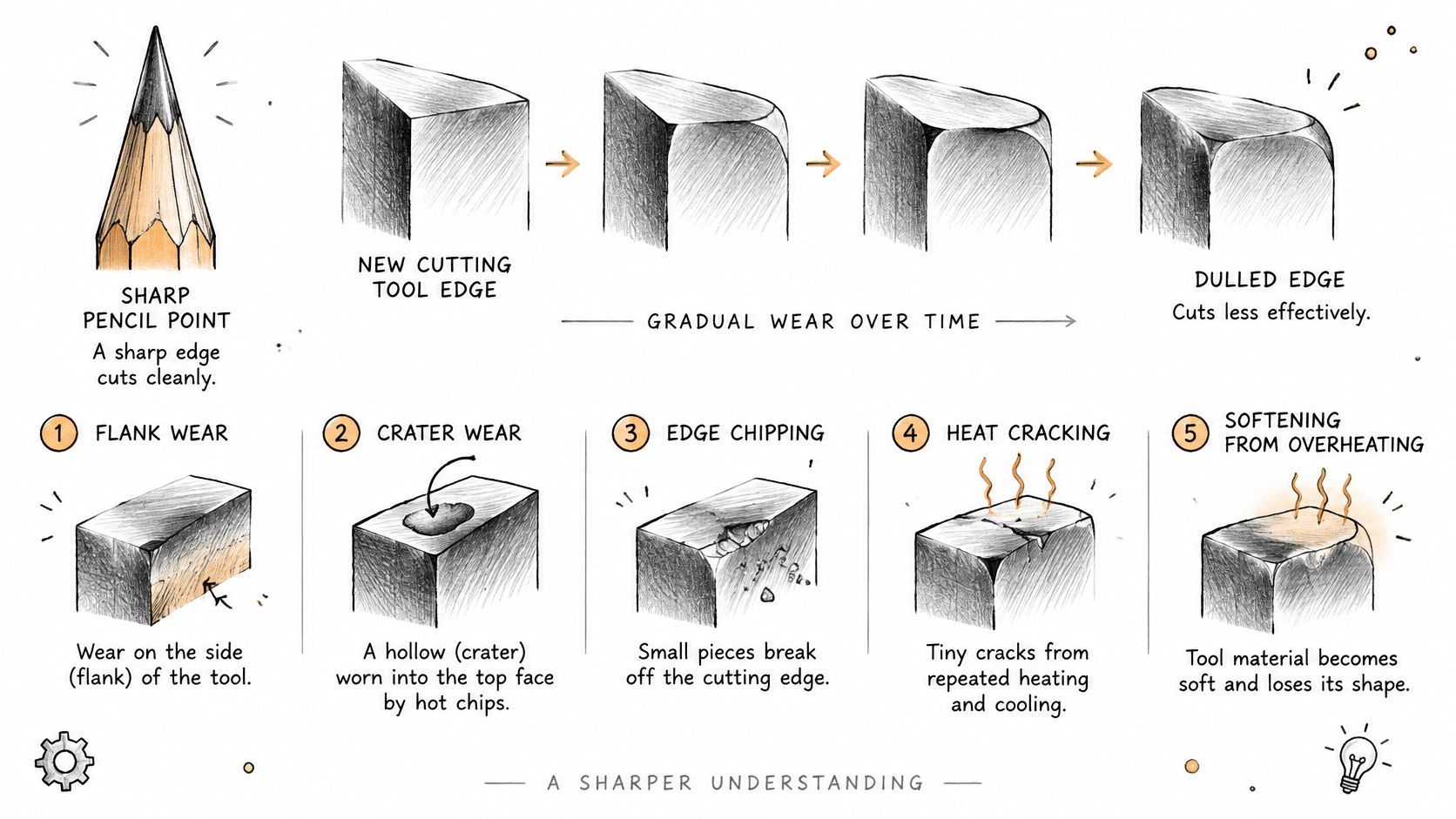
Flank wear is abrasion on the clearance face, the slow honest wear you expect. Crater wear bites into the rake face where the chip drags hot metal across the steel. Chipping comes from interrupted cuts, heavy feeds, a flexing setup or a hard spot in the workpiece. Built-up edge forms when a sticky workpiece welds to the edge at low speed, breaks away and takes tool material with it. Thermal softening is the quiet one: the edge loses hardness as it heats, wear accelerates, and the tool dies long before its time.
Adhesion and diffusion wear are the chemical half of the story. At temperature, workpiece material welds to the tool and later diffuses into it, so the edge loses material with no visible abrasion to explain the loss.
Tool life is a system outcome, not a property of the steel alone. A University of Manchester study of minimum quantity lubrication in high speed milling on hardened steel reported a 50 per cent increase in tool life from moving the MQL nozzle towards the rake face, with no change to the tool material at all.
What the symptoms tell you
Symptom | Likely cause | First fix |
|---|---|---|
Edge chips at entry | interrupted cut or heavy feed | lower feed and check edge geometry |
Flank wear faster than expected | surface speed above what the grade tolerates | reduce speed and check coolant delivery |
Blue or straw discolouration near the edge | overheating | slow the cut and improve cooling |
Built-up edge on steel | low speed on a sticky material | raise speed slightly and sharpen the geometry |
Edge dulls quickly in hard material | heat softening near the hot-hardness limit | slow down and reconsider the grade |
Look at the wear land and the chips before you change a single parameter. The wear pattern tells you which of the five modes you're fighting, and each one has a different cure.
The same symptom on a carbide tool often points somewhere else, because carbide fails by fracture far more readily than by softening. Our notes on carbide cutting tools cover that difference.
What Does Cryogenic Treatment Change in HSS Tools?
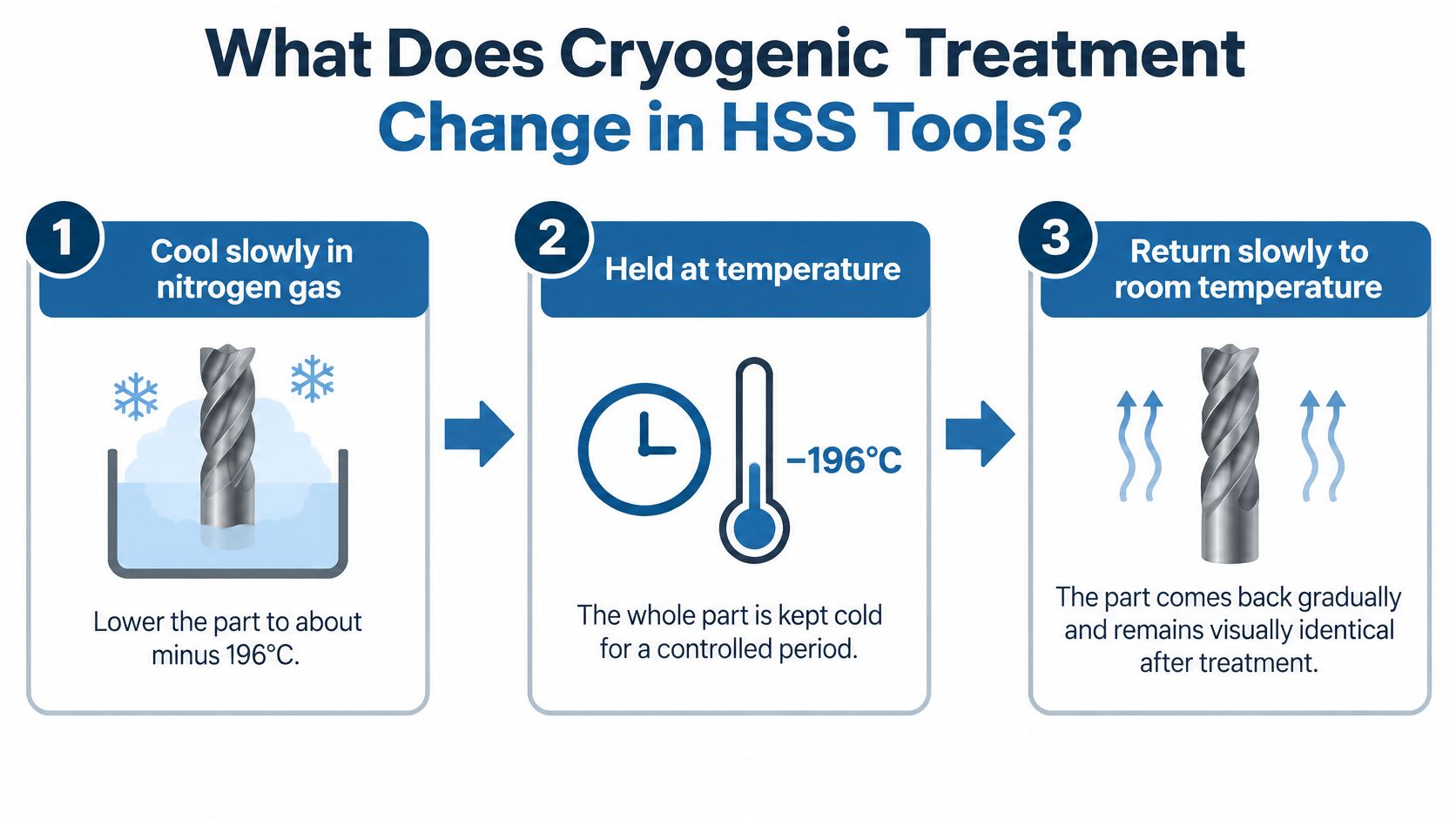
Parts are cooled slowly in nitrogen gas to around minus 196°C, held there, then brought back to room temperature just as slowly. The cycle is computer controlled, and the gradual temperature changes avoid thermal shock. The step by step process guide covers the cycle in full.
Two different things share the word cryogenic. Cryogenic processing treats the finished tool as part of its manufacturing route. Cryogenic machining uses a cryogen as coolant while the tool is cutting, cooling the tool, the workpiece or both, as a University of Manchester review of cryogenic machining and processing sets out. This section is about the first.
A University of Bath review of cryogenic treatment research reports HSS tool life improvements of up to 126 per cent across the literature it cites, and a further 49 per cent where tools were tempered after treatment. It also points to better resistance to chipping at higher cutting speeds and reduced chemical reactivity, which lowers adhesion and diffusion wear. Those are literature results from specific grades, heat-treatment sequences, geometries and test conditions. No single figure transfers to your tool.
Judge the claims by failure mode. Reduced adhesion and diffusion wear speaks to the edge that dulls steadily through a long production run. Better chip resistance speaks to the edge that micro-chips at entry on an interrupted cut. Neither mechanism addresses an edge softening past its grade's temperature limit, and neither stops a tool snapping in a bad setup. Where treatment has a plausible case, it is on the wear modes that start in the steel's microstructure.
In steels, we describe the change as retained austenite converting to martensite, with fine carbides forming. That mechanism is still debated in the literature, and study results vary widely by grade and treatment route. For many steels the treatment works best as an extra stage after conventional heat treatment, and it is usually best done after machining, because machining leaves its own stresses in the part. Treated parts come back dimensionally unchanged and visually identical, with no coating or added surface layer.
Our own customer experience sits in a different category. It isn't a research finding and it isn't a measured result, and we don't present it as either.
When Will Cryogenic Treatment Not Help or Is It Not Worth It?
Treatment doesn't repair a chipped edge, and it doesn't change the grade of steel. Those two sentences rule out most of the disappointing cases before they start.
A damaged tool. Anything already chipped, cracked or blunt needs replacing or regrinding, not a three-day cycle. Cold doesn't weld cracks shut.
A badly heat treated tool. If austenitising or tempering left the hardness short, treatment won't make up the difference. Fix the heat treatment first.
A tool run too fast. Push the edge past the temperature its grade tolerates and it will soften regardless of what happened in the chamber.
A job that fails by breakage. If tools snap because of a wrong setup, poor clamping or a flexing machine, cure the setup. Wear isn't the limit, so wear resistance won't help.
A cheap disposable drill. A tool with a short life and a low replacement cost rarely justifies the wait or the processing charge.
A one-off short run. Where tool cost is trivial against the job, the process time is the expensive part.
Sometimes the honest answer is a different grade. A powder metallurgy HSS or a carbide tool may suit the work better than treating what you have. If you want to know whether treatment earns its place on your tools, run a controlled trial: treated and untreated tools from the same batch, same workpiece, same parameters, life recorded against a defined wear limit. For background on what the process does and doesn't do, our guide to deep cryogenic treatment is the place to start.
How Do You Decide Which HSS Tools to Treat?
Start with the failure mode, because that is what treatment can or cannot change. Cryogenic processing is a wear-resistance play. If gradual edge wear is what ends a tool's useful life, it is a candidate. If the tool chips, snaps or softens, the problem sits elsewhere and no amount of time in the chamber fixes it. After that judgement, five questions settle the rest.
Is the failure wear? Edges that dull progressively suit treatment. Chipping and breakage point at toughness, setup or geometry instead.
Is the heat treatment sound? A tool with a hardness shortfall needs its heat treatment reviewed, not a cold cycle.
Does the job repeat? Long runs and recurring batches reward any gain. One-offs rarely do.
Is the tool worth the wait and the cost? A premium broach, yes. A budget jobber drill, probably not.
Is the cutting speed inside the grade's limit? Treatment doesn't buy you a higher surface speed.
Then ask your supplier the right questions. Independent materials research on powder metallurgy HSS found performance depends strongly on carbide size, morphology and distribution within the tempered martensitic matrix, with fine, uniform carbides improving hardness, transverse rupture strength and isotropy, as reported in this study of PM-HSS microstructure. Coarse or segregated carbides can act as crack-initiation sites. Request the exact grade, manufacturing route, heat-treatment condition and hardness, plus transverse rupture strength (the bending stress the steel takes before it breaks) where it's available. Nominal chemistry alone won't predict edge reliability. Treat that published research and a processor's own reported results as different kinds of evidence, and weigh them separately.
Sending tools for treatment
Keep tools separate and don't torque them together. Lightly oil bare ferrous surfaces that could corrode in transit, and remove pressed-in bearings where you can. Single items are fine, because orders are pooled into one chamber run alongside other customers' parts on the next scheduled run. The next processing date is listed on the Cryogenix website. Machining customers can find the full service detail on our machining page.
What Else Do Machinists Ask About HSS Tools?
Does treatment change a tool's size? Treated parts come back dimensionally unchanged and visually identical. No coating, no plating, no growth.
Should tools be treated before or after machining? After. Machining can introduce additional stresses into the material, so in most cases treatment works best on finished tools. For many steels it is most effective as an extra stage after conventional heat treatment in any case.
How long does it take? The cycle runs about three days, with slow, computer-controlled temperature changes that avoid thermal shock on the way down and back up.
Is this a coating or a heat treatment? It is a sub-zero stage that follows conventional hardening and tempering. Nothing is added to the surface, and it does not replace the heat treatment that gave the tool its hardness in the first place.
Is the benefit proven? Published studies report everything from large gains in wear life to little measurable change, and the underlying mechanism is still debated. The sensible test is failure mode: abrasive wear and premature edge failure are plausible targets, while the published evidence and workshop experience should be weighed separately rather than blended into one claim.
References
Podgornik and others (2016), Deep cryogenic treatment of tool steels, Journal of Materials Processing Technology 229
Jurči and Dlouhý (2024), Cryogenic Treatment of Martensitic Steels, Materials review
Baldissera and Delprete (2008), Deep cryogenic treatment: a bibliographic review, The Open Mechanical Engineering Journal
More answers sit on our frequently asked questions page, and the source papers are indexed in the Cryogenix academic research library.
Cryogenix Ltd runs deep cryogenic treatment for high speed steel tooling, from drills and end mills to reamers, broaches, slitting saws and form tools, alongside the carbide tips and guillotine blades that share the same wear problem. Parts are cooled slowly in nitrogen gas, held, and returned to room temperature over a cycle of about three days, and results vary with material, prior heat treatment and application. Weigh the parts and ask for a quote at info@cryogenix-uk.com or through our contact page, and check the next processing date at Cryogenix Ltd before you box anything up.
Comments