


Performance Brake Discs: Does Cryogenic Treatment Help?
Brake defects are a recurring cause of MOT failures in Great Britain, yet the disc is still the part many drivers ignore until pedal feel, noise or vibration gives it away.
Whether cryogenic treatment helps a performance brake disc depends on three things: the disc's material and grade, the duty cycle it sees, and the evidence you are prepared to accept. Laboratory work on grey cast iron reports wear gains, and Cryogenix customers report longer disc life. Neither result is a public road trial, and neither guarantees an outcome on your car.
That gap matters more for a performance disc than a standard one. It has to absorb repeated high heat loads, then survive wet, salted road use and storage between events. Heat drives cracking and fade; corrosion and low-temperature road duty attack the same casting in a different way. Judge the treatment as a thermo-mechanical claim, not a badge.
Table of Contents
What Are Performance Brake Discs Made From? - Why grey cast iron still wins - Reading a spec sheet before you buy
How Do Heat and Wear Break a Brake Disc? - The trade-off nobody puts in the brochure - Reading a crack like evidence
How Do UK Road Use and Rules Affect Disc Choice? - Low use is its own failure mode - Approval is a separate question from design
What Does the Published Research Show About Cryogenic Treatment? - Where the evidence stops
How Can You Test a Treated Disc on Your Own Car? - Why one disc proves nothing
What Are Performance Brake Discs Made From?
Performance brake discs are grey cast iron or alloyed cast iron in almost every case, with stainless steel, aluminium-matrix composite and carbon-ceramic appearing in specialist applications. The material fixes heat capacity, thermal conductivity, weight, cost and how the disc behaves before it has any heat in it at all.
Four terms cover most of what matters. The friction ring is the doughnut of metal the pads clamp. The swept area is the band the pads rub, and it's the only part doing braking work. The hat, or bell, is the centre section that bolts to the hub. The vanes are the internal ribs between the two friction faces that pump air through the disc and carry heat out of the ring.
A disc is an energy converter, not a clamp. It turns the kinetic energy of a moving car into heat at the friction ring, then relies on airflow through the vanes, conduction into the hat and radiation to shed it.
Why grey cast iron still wins
Grey cast iron is chosen for a high melting point, good thermal conductivity and low cost. It casts well, machines predictably and takes a pad bed easily. Its weakness is weight, and it will crack under repeated thermal cycling if the vane design, thickness or cooling airflow is wrong.
Material | Where it is used | Strengths | Trade-offs |
|---|---|---|---|
Grey cast iron | Standard road discs and most race discs | High melting point, good thermal conductivity, low cost | Heavy; cracks can start under repeated heat if design or cooling is poor |
Alloyed or high-carbon cast iron | Performance road and track discs | Grade can be tuned for hardness and wear | Grade and heat treatment vary by maker, so check the specification |
Stainless steel | Some race and specialist discs | Corrosion resistance, useful where use is low or conditions are wet | Different thermal behaviour from cast iron; check pad compatibility |
Aluminium-matrix composite | Specialist high performance and lightweight applications | Low mass | Heat and wear behaviour depend on the composite; check the maker's data |
Carbon-ceramic | High end track cars | Very light and stable at high temperature | Costly, needs heat to work well and performs differently when cold |
Reading a spec sheet before you buy
Two questions do more work than any marketing claim. What grade is it, and has it been heat treated? A high-carbon or alloyed iron with a stated heat treatment behaves differently from a generic casting, and the difference shows up after a season, not on the first lap. Then ask for the part number and the approval mark. Those tell you whether the disc was tested as a road replacement or built for the paddock only.
The other half of the story is what happens to the metal after casting, and how sub-zero treatment changes a cast structure covers the thermal side of that.
How Do Heat and Wear Break a Brake Disc?
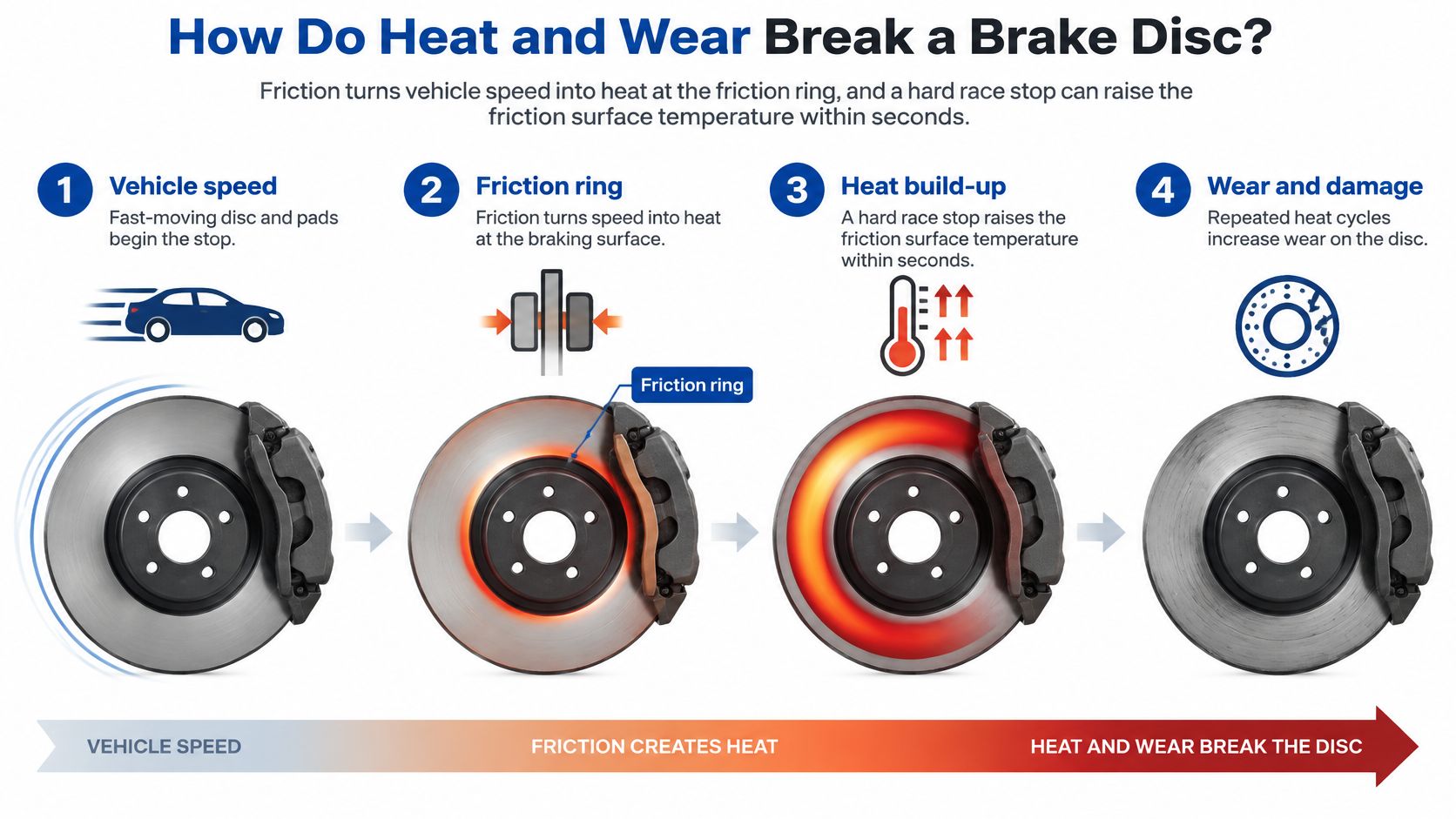
Friction braking is a one-way energy conversion. Speed becomes heat in a narrow band of metal, and everything else in the disc exists to survive the consequences.
A hard stop converts kinetic energy into heat. A heavy car arriving at a hairpin has to dump nearly all of it into two friction rings in a few seconds.
The friction surface heats within seconds. The swept band can run far hotter than the metal a few millimetres behind it.
The hot surface wants to expand and the cooler metal restrains it. That mismatch is thermal stress, and it peaks at the surface.
Repeated cycles push the surface past its elastic limit. Plastic deformation builds cycle by cycle rather than in one event.
Micro-cracks start where stress concentrates. Hole edges, slot roots and the transition into the hat are the usual sites.
Cracks grow under further loading. A crack is itself a stress raiser, so every heat cycle opens it a little more.
A University of Sunderland engineering study describes this as a thermo-mechanical problem rather than simple wear: the surface expands against cooler material, and repeated cycles produce plastic deformation and surface cracking, especially where local geometry concentrates stress (design and analysis of a disc brake rotor).
A 2024 thermo-mechanical finite-element study from Teesside University put numbers on the geometry question. In the model, triangular-drilled discs reached 206.85°C at 3.5 seconds while solid discs reached 238.97°C at the same moment. The triangular-drilled design also produced the lowest reported von Mises stress at 320 MPa, and solid discs showed the greatest displacement across the analysed intervals (Teesside University research).
Von Mises stress is the single value engineers use to compare a complex three-dimensional stress state against a material's yield point. Lower is better, but only if the part still has enough mass to absorb the heat.
The trade-off nobody puts in the brochure
Faster heat removal from holes and slots comes with edge stress around the openings. Geometry that cools the ring also interrupts the path the heat would otherwise take. That's why hole size, spacing, edge quality and vane design change the answer, and why "drilled is better" isn't a rule.
The Teesside results come from modelling, not from a disc that ran a season. Pad compound, contact pressure, disc mass, airflow, cooling duct layout, manufacturing defects, thermal cycling and the temperature-dependent properties of cast iron all move real behaviour away from the model. Use the study to choose what to measure, not to predict a life.
Reading a crack like evidence
Where a crack starts tells you what to fix. A crack in the wrong place, treated as random bad luck, will reappear on the replacement disc.
Crack location | Likely contributor | What to check |
|---|---|---|
Around cross-drilled holes | Edge stress concentration and hole finish | Hole edges for burrs, and whether cracks run from the holes |
Around slots | Slot root stress and vane geometry | Slot ends and vane transitions |
Outer friction track | Thermal gradient and pad contact | Pad bedding, pad compound and disc temperature |
Hub or mounting bell | Mounting stress and runout | Bolt torque, runout and cracks near fixings |
Judge temperature, stress and displacement together, then confirm the design with instrumented testing and a crack inspection routine that runs to a schedule rather than to a hunch. A general vehicle inspection checkpoints for brakes and tires list covers the checks that don't need a micrometer.
How Do UK Road Use and Rules Affect Disc Choice?
UK MOT data for 2025 records 246,780 car test failures caused by a brake-disc defect, which is 0.78 per cent of car tests, or roughly one failure in every 130, according to HowReliable's analysis of MOT results. Of those, 174,859 (71 per cent) were logged because discs were "significantly and obviously worn", and 70,111 (28 per cent) involved discs that were seriously weakened.
Group | Brake-disc failure rate |
|---|---|
All car tests | 0.78 per cent (246,780 failures, about 1 in 130 tests) |
Below 30,000 miles | 0.26 per cent |
30,000 to 60,000 miles | 0.60 per cent |
60,000 to 90,000 miles | 0.91 per cent |
90,000 to 120,000 miles | 1.10 per cent |
Above 120,000 miles | 1.10 per cent |
Registered 2005 | 0.97 per cent |
Registered 2022 | 0.18 per cent |
Two failure modes dominate that table: wear and weakening. A performance disc has to resist both, and it has to do it on a car that also does the school run.
Low use is its own failure mode
Reduced use of the friction brakes lets corrosion develop on the disc. When braking resumes, the corroded surface can slow bedding-in, reduce braking force and increase wear, which is why a government review of PM2.5 reduction technologies for on-road transport lists corrosion-resistant coatings and deliberate regular brake use as mitigations.
Separate the two kinds of rust. A brown bloom on the hat edge, the unswept ring or the vane area after a wet week is cosmetic and clears with use. Pitting or flaking inside the swept area that survives several normal stops is not cosmetic, and it needs the disc measured and inspected rather than driven through.
Approval is a separate question from design
UNECE Regulation No. 90 requires integrity testing under high load and thermal fatigue. The pass mark for that part of the test is completion of at least 150 cycles without damage or failure, as set out in the Regulation No. 90 text. Each part number is approved individually, friction performance must stay within plus or minus 15 per cent of the original equipment specification, and batch traceability markings must be present under the Vehicle Certification Agency approval framework. Race-only parts may carry none of it.
Before a track day, work through the disc itself: visible pitting in the swept area, even pad contact across both faces, whether the pads are bedded, free caliper movement, the age of the brake fluid, and whether the two sides of the axle are matched.
What Does the Published Research Show About Cryogenic Treatment?
The honest summary fits in one sentence: some laboratory tests show real wear gains, the mechanism is still argued about, and almost none of the studies ran an actual brake disc.
That last part matters more than the headline. A performance disc is grey cast iron, a material that works like concrete seeded with graphite flakes: hard particles in a softer matrix, chosen for thermal mass and damping rather than raw hardness. Most cryogenic research was done on hardened tool and martensitic steels, where the proposed mechanism, converting retained austenite and precipitating fine carbides, has no direct equivalent in cast iron. The studies below are relevant but indirect.
Source | What was tested | Reported finding | Limit |
|---|---|---|---|
Thornton, Slatter, Jones and Lewis (2011) | Grey cast iron brake discs in pin on disc wear tests | Wear rate improvements of 9.1 to 81.4 per cent, with no significant change in bulk hardness | Laboratory test, not a road or race disc life study |
Thornton (2014), PhD thesis, University of Sheffield | Detailed method and results from the same line of work | Fuller method and results from the same Sheffield programme | Thesis, not a peer reviewed paper |
Jurči and Dlouhý (2024), review | Martensitic steels | Retained austenite converts to martensite and fine carbides form | Steels, not grey cast iron; mechanism still debated |
Baldissera and Delprete (2008), review | Deep cryogenic treatment across many studies | Results vary widely between studies | Review, not a single brake disc test |
Podgornik and others (2016) | Tool steels | Wear and hardness effects in deep cryogenically treated tool steels | Tool steels, not brake discs |
The closest thing to direct evidence is the pin on disc study by Thornton, Slatter, Jones and Lewis (2011) in Wear 271, which rubbed a loaded pin against grey cast iron brake disc material rather than running a full disc on a car. It reported wear rate improvements of 9.1 to 81.4 per cent with no significant change in bulk hardness (Sheffield Hallam repository). Read that spread carefully. The 81.4 per cent sits at the top of a range across test conditions, it is not a floor you can bank on, and a wear rate measured on a small coupon does not convert into a disc life multiple on a real car.
Where the evidence stops
Jurči and Dlouhý (2024) review martensitic steels and the conversion of retained austenite to martensite with fine carbide formation (PubMed Central). Baldissera and Delprete (2008) survey deep cryogenic treatment across a wide field and find results that vary widely between studies (The Open Mechanical Engineering Journal). Podgornik and others (2016) worked on tool steels (Journal of Materials Processing Technology 229). Thornton's doctoral work is available in full for readers who want the method rather than the headline (White Rose eTheses).
The pattern across the wider literature is wide scatter: different steels, different cycles, different test rigs, different results. Extending any of it to a grey cast iron disc under repeated thermal cycling is an extrapolation, and it should be priced as one.
Cryogenix's own evidence sits in a different category from the published work. In 2021 the company ran a regular pair of Brembo discs bought from a popular auto parts retailer for a full season, one treated disc on the left front and one untreated on the right front, and at season's end the treated disc showed significantly less small-crack propagation and no large cracks at all. That is a real-world observation on one car and one pair of discs, so read it as company experience alongside the papers rather than a controlled study.
The process behind the claim is short to describe. Parts are cooled using liquid nitrogen to around minus 196°C, then brought back to room temperature. Treated parts come back dimensionally unchanged and visually identical, with no coating, plating or added surface layer. The step by step explanation of deep cryogenic treatment walks through the cycle, and the Cryogenix research library collects the papers worth reading.
How Can You Test a Treated Disc on Your Own Car?
The published work is laboratory based, and we have no independently verified road trial to hand you, so if you want evidence on your own car you have to generate it. Here's a log you can keep.
Record the baseline. Before fitting, measure disc thickness with a micrometer at four or more points around the friction track, and check runout with a dial gauge on the hub.
Photograph with a scale in shot. The friction track, plus the hole and slot edges. A ruler in the frame makes later comparison possible.
Log the variables. Pad compound, bedding procedure, fluid change dates and mileage at fitting.
Repeat at fixed mileage intervals. Same thickness points, same runout check, same photographs. Inspect hole and slot edges with a magnifier, and use dye penetrant if you suspect a crack.
Record the trend, not just the number. Wear per thousand miles, plus any change in pedal feel, noise or vibration.
Measurement matters most in the first hundred miles after fitting, when bedding behaviour tells you whether the pad and disc are working together. Installers who want that stage spelled out can follow this break-in advice for DIY installers.
Why one disc proves nothing
Normal disc to disc variation is large enough to swamp a modest treatment effect. To separate the two you need a matched pair on the same axle, run under the same conditions, measured the same way, with the treated and untreated sides swapped or alternated between events if you can arrange it. One disc on one car, measured once, tells you nothing you can act on.
Whatever your log shows, read it against the published work rather than instead of it. Don't claim an outcome before the data supports it, including to yourself.
When Will Cryogenic Treatment Not Help?
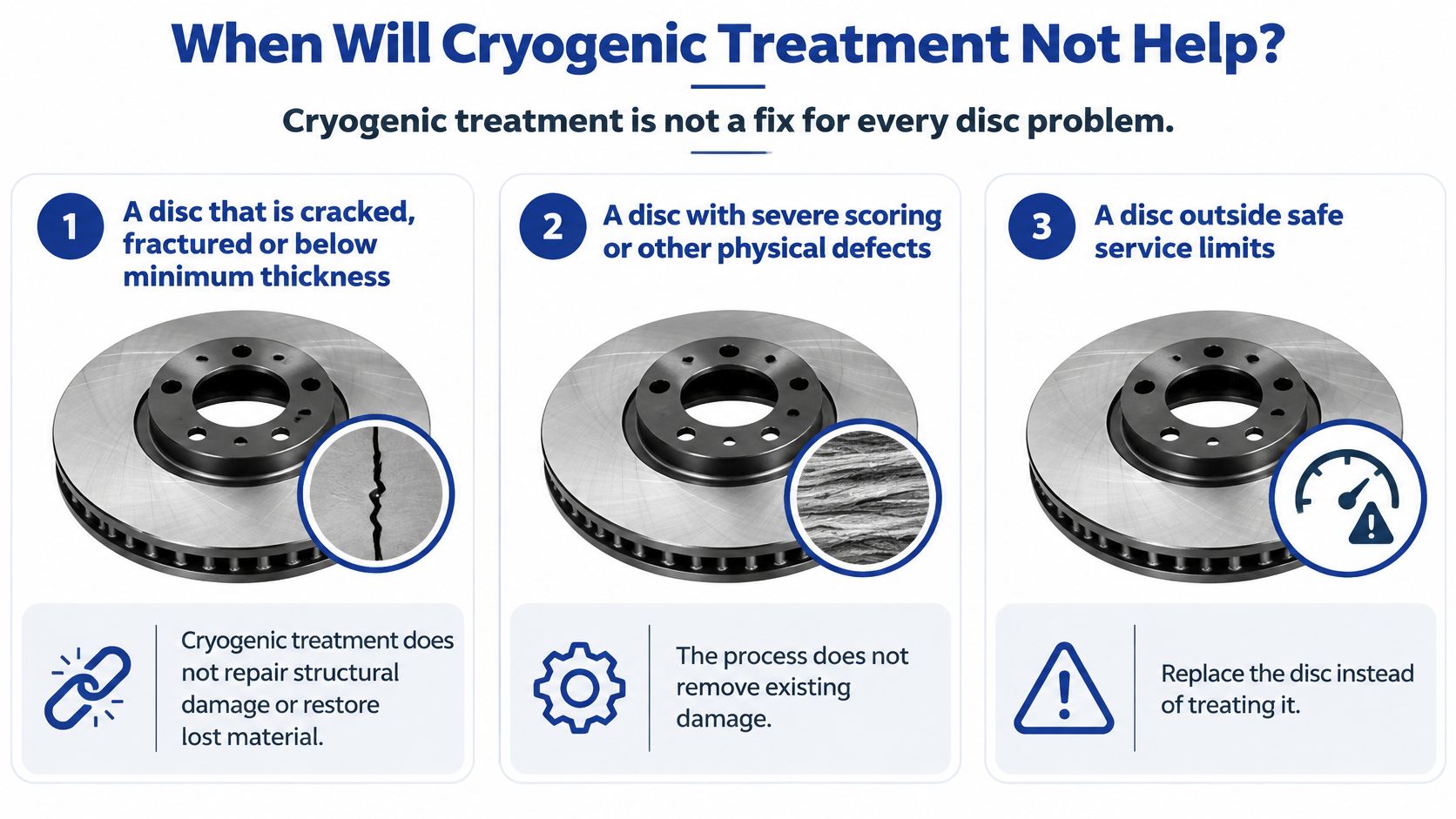
Cryogenic treatment is not a fix for every disc problem, and the cases where it can't help are easier to list than the cases where it can.
A cracked, fractured or under-thickness disc. Treatment does not repair cracked or damaged parts. Replace it.
A disc worn past its service limit. The process doesn't restore lost material.
The wrong disc for the job. A poor design or an unsuitable grade will still fail, because treatment doesn't change geometry, vane count or mass.
Worn pads, old fluid or a sticking caliper. Those are the weak link, and treating the disc won't fix them.
Rust in the swept area. Clean it or replace the disc. Treatment doesn't remove corrosion.
Cracks with no known cause. Find the cause with the crack-location table before spending anything.
An expectation of a guaranteed gain. Results vary by material, prior heat treatment and application, and we won't promise an outcome.
The narrow case where treatment is worth discussing is a sound disc, inside its limits, in repeated heavy use, where the owner has a clear reason to expect a wear benefit and will run a fitted inspection routine so they can see whether they got one. If that's you, the frequently asked questions about the process answer the practical ones first.
Should You Send Your Brake Discs for Treatment?
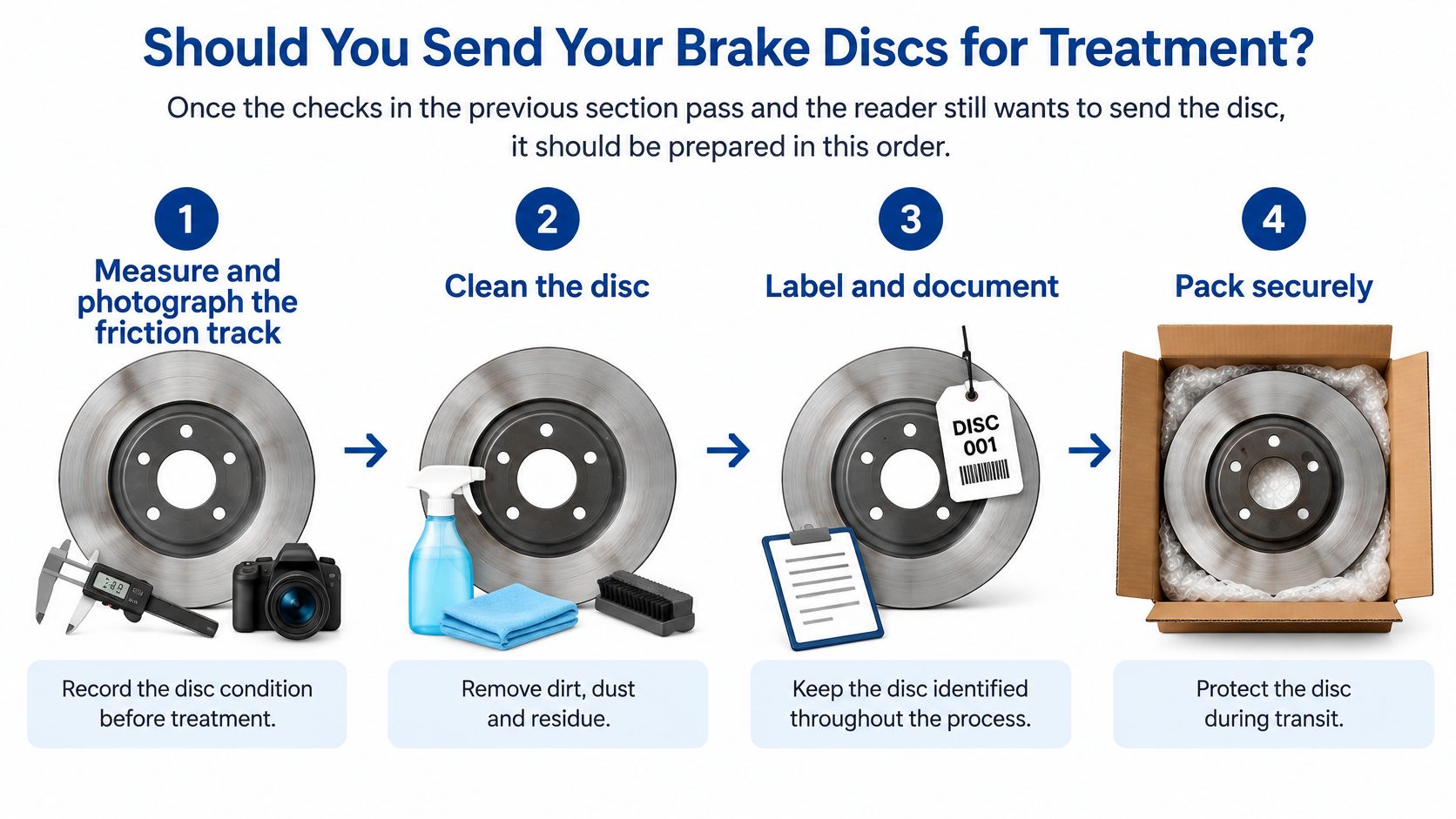
Once a disc has passed the checks, sending it for treatment is straightforward, but the order of the steps matters. A disc that arrives corroded, distorted or undocumented loses some of the value the test could have given you, and the before-measurement is the part you can never redo.
Measure and photograph first. Thickness at four points, plus photographs of the friction track and the hole or slot edges. That's your before record, and it's the only one you'll have.
Clean off loose dust and debris. Leave the friction ring as it is; don't machine it or try to polish it.
Don't bolt discs together. Bolting pairs face to face traps moisture and can distort thin sections.
Strip anything that shouldn't travel. Remove pressed-in bearings where possible, and lightly oil ferrous parts that could corrode in transit.
Post it or drop it off. Parts can be shipped from anywhere in the UK, and handing them over in person is welcome.
What should you expect back? Cryogenix's own experience with customers is that treated brake discs typically last two, three or four times longer than untreated ones. That figure comes from the company's customer work rather than published research, and results vary by material, prior heat treatment and application. Your own before-and-after measurements are the only way to know which end of that range a given disc lands on.
Pricing is by quote, and particularly heavy orders such as complete engines may qualify for more cost-effective pricing. Single items are accepted and go into the chamber alongside other customers' parts on the next scheduled run, so the next processing date page tells you which run yours would join.
A short film of the process makes the cycle easier to picture than a description does.
If you're weighing up several suppliers before sending anything, the questions in how to choose a cryogenic treatment company give you a structured way to compare them.
What Else Do Race Teams Ask About Treated Brake Discs?
Will treatment change the disc's dimensions or appearance? No. Parts come back dimensionally unchanged and visually identical, with no coating, plating or added surface layer. That matters in classes that demand a standard-looking part, since a treated disc passes a scrutineer's visual check exactly as an untreated one would.
Can I send a disc that's already done a season? Yes, provided it's sound and inside its thickness limit. Measure it first. Treatment slows the wear and crack propagation that end a disc's life, yet it cannot close a crack, restore lost material or rescue a disc that overheating has already written off.
Is it worth treating discs on a road car that rarely gets hot? Less clear, and honesty matters here. The case for treatment rests on repeated heavy use: heat cycles that grow cracks, friction that thins the ring. A lightly used road car loses its discs to corrosion long before either becomes relevant, so a coated standard disc may serve you better than a treated performance one.
What about two-piece discs with aluminium bells? Aluminium alloys such as 7075 and 6082 show improved dimensional stability and wear resistance after treatment, while the cast iron friction ring is the part the published wear research measured. Bobbins and any plastic hardware in the assembly come through the cycle without permanent negative effects. Keep the before-and-after measurements separate for each material, so you can see what changed where.
References
Thornton, Slatter, Jones and Lewis (2011), The effects of cryogenic processing on the wear resistance of grey cast iron brake discs, Wear 271.
Thornton (2014), PhD thesis, University of Sheffield.
Jurči and Dlouhý (2024), Cryogenic Treatment of Martensitic Steels, review.
Baldissera and Delprete (2008), Deep cryogenic treatment: a bibliographic review, The Open Mechanical Engineering Journal.
Podgornik and others (2016), Deep cryogenic treatment of tool steels, Journal of Materials Processing Technology 229.
Cryogenix treats brake discs alongside crankshafts, gear sets and cutting tools, and single items go into the chamber with other customers' parts on the next scheduled run. That scheduling point matters for planning, so check the next processing date on the Cryogenix website before you box anything up.
Prepare the discs the same way you would any ferrous part: do not torque assemblies together, lightly oil surfaces that could corrode in transit, and remove pressed-in bearings where possible. Weigh and measure each disc first, because your own thickness and mass figures are what turn a treated pair into a usable comparison on your car. Parts can be shipped from anywhere in the UK or dropped off in person, and you can request a quote through our contact page.
Comments