


Nitriding Services: What They Do and How Cryogenic Differs
Ask ten engineers what to do about a worn gear flank and most give the same answer: make the surface harder. That answer is half right, and the half it misses costs money. Hardness is one property. Where the hardness sits in the part, and whether the job needed a harder skin at all or a more stable core, decides which process you should book.
Nitriding services harden the surface of a suitable steel by diffusing nitrogen into it at roughly 480 to 530°C, leaving the core as it was. Deep cryogenic treatment does something different. It cools the whole part to around minus 196°C to change its structure, and it adds no hard layer at all.
Table of Contents
How does nitriding differ from cryogenic treatment? - What published research reports - What our own customers report
What do buyers ask about these treatments? - Does nitriding change the size of a part? - Is a nitrided cutting tool always better? - Can cryogenic treatment replace nitriding on a gear flank? - Do audio parts gain from cryogenic treatment?
What does a nitriding service do to steel?
Nitriding is a diffusion process. Diffusion means the nitrogen atoms travel into the steel rather than sitting on top of it. Nothing is deposited, plated or painted on, so there's no layer to flake off later.
The sequence is straightforward:
Clean and load. Parts go into a sealed furnace, arranged so gas reaches every surface that needs treating.
Heat. The furnace climbs to the nitriding temperature in a controlled nitrogen-bearing atmosphere.
Hold. Hours pass while nitrogen soaks inwards and reacts with the alloying elements to form hard nitrides.
Cool. The furnace cools under atmosphere. There's no quench, which is why distortion is usually low on finished parts.
Think of nitrogen entering steel the way water enters a sponge. It goes in gradually, it travels further with more time and more heat, and the deepest penetration sits below the surface rather than on it. A sponge is also a fair reminder that the water is inside the material, not coating it.
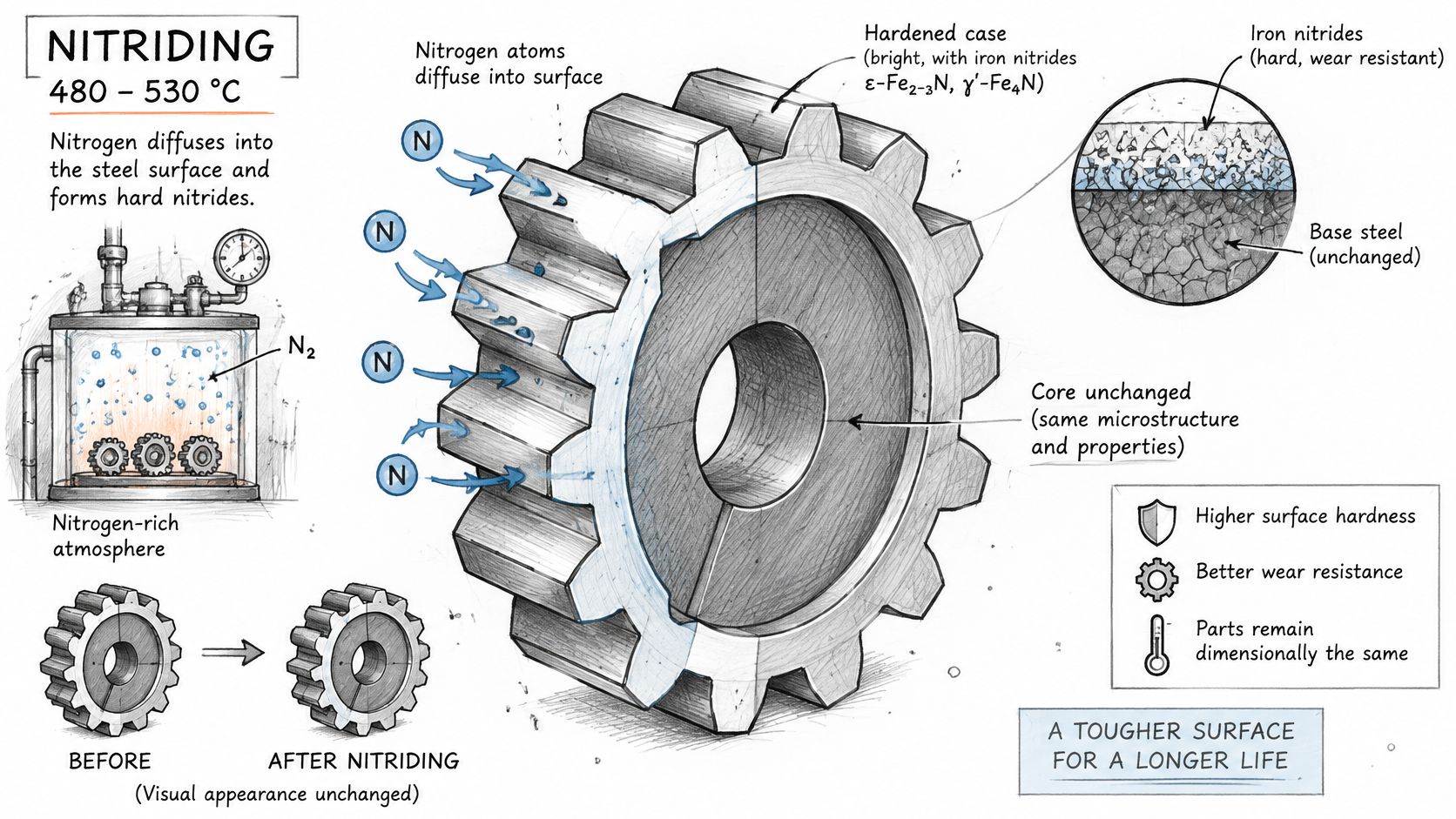
The result has two distinct zones. At the surface sits the compound layer, a thin, very hard region of iron nitrides. Beneath it is the diffusion layer, where fine alloy nitrides harden the steel and that hardness falls away gradually towards the untouched core.
UK practice has described this in formal terms for decades. BS EN 10052:1993, the UK adoption of the European vocabulary standard for ferrous heat treatment, defines depth of nitriding as the distance from the surface to a specified boundary marking the nitrogen-enriched layer, as the published text of BS EN 10052 records. Low distortion is not zero distortion, and the boundary is what gets measured.
Your first decision is therefore simple. Do you need a wear-resistant surface on a suitable steel, or a change to the behaviour of the whole part?
How does nitriding differ from cryogenic treatment?
A camshaft flank wearing through and a brake disc losing stability under repeated heat cycles are different failures, and they point to different treatments. Nitriding builds a hard skin on a suitable steel. Cryogenic treatment changes the structure of the whole part and sends it back dimensionally unchanged, visually identical, with nothing added to the surface.
Aspect | Nitriding | Deep cryogenic treatment |
|---|---|---|
Main purpose | Adds a hard nitrided surface layer to a suitable steel | Changes the structure of the whole part; not a coating |
Temperature | About 480 to 530°C for gas nitriding | Slow cooling to around minus 196°C, a hold, then a controlled return to room temperature |
Typical time | Often 20 to 80 hours for EN40B-type steel | Runs as a scheduled chamber cycle covering cooling, hold and return; single items join the next batch |
Effect on hardness | Raises surface hardness; the core keeps its earlier heat-treatment properties | Bulk hardness not significantly changed in the cited study; the effect is on wear and structure |
Layer or coating | Compound layer and diffusion layer formed by nitrogen diffusion | No coating, plating or added surface layer |
Dimensional change | Usually small because there is no quench; still needs checking on tight tolerances | Parts come back dimensionally unchanged and visually identical |
Suited to | Steels with nitride-forming elements, such as chromium-bearing EN40B | Steels and non-ferrous metals, with stress relief and a more stable structure |
Standard measurement | Nitriding hardness depth and compound-layer thickness | Not applicable; no case is formed |
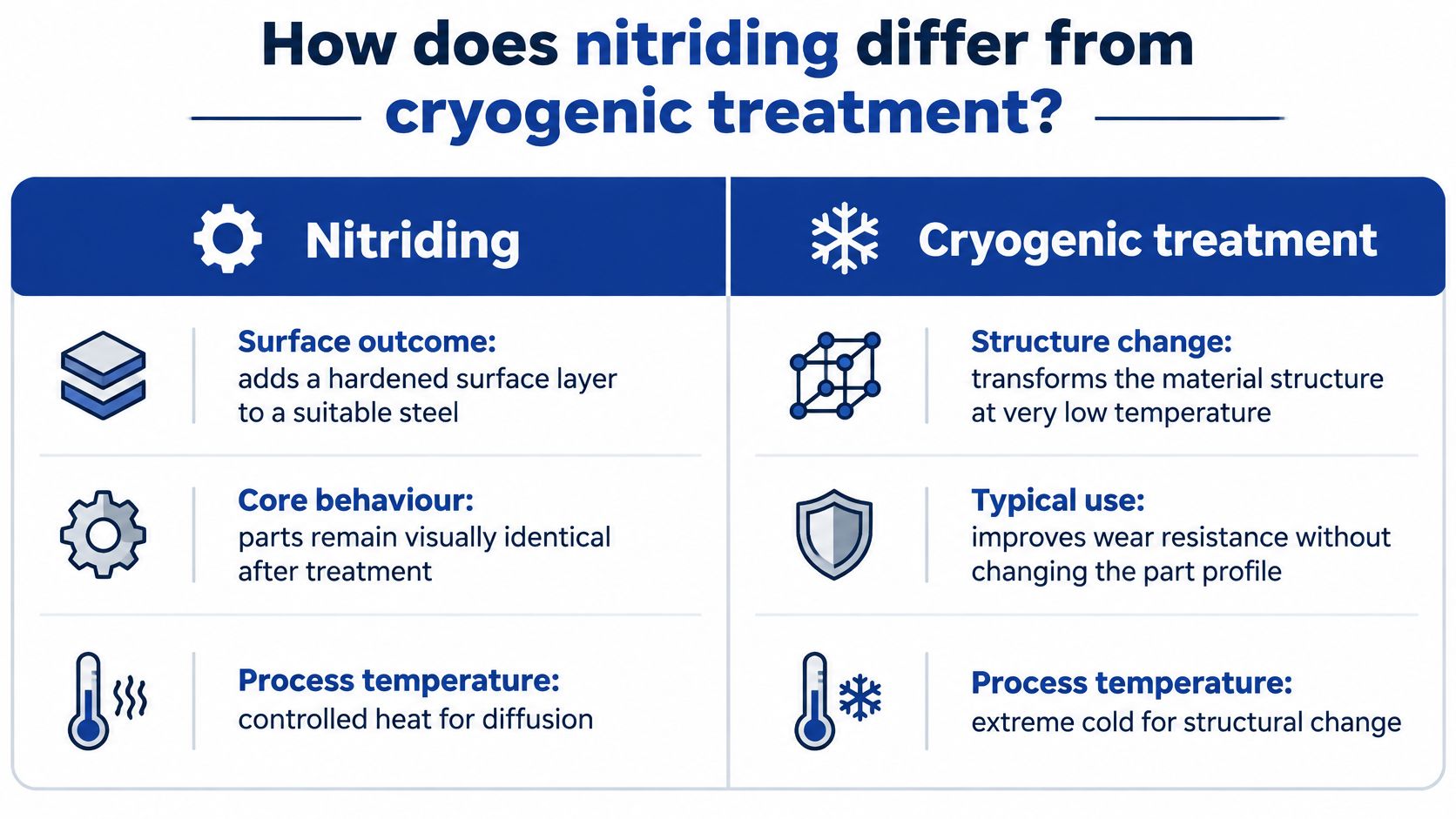
The two rows engineers ask about most are hardness and dimensional change. Nitriding does raise surface hardness. Cryogenic treatment does not, and that single fact means the processes are not interchangeable on a worn flank. If the failure is surface wear, the fix has to put hardness at the surface. If the failure is instability, residual stress or premature wear through the bulk of the part, a deeper structural change is what the job calls for.
The cycle cools parts slowly to around minus 196°C using nitrogen, holds them, then brings them back to room temperature in a controlled return. You can see the full sequence in how deep cryogenic treatment works step by step. The chamber only ever contains nitrogen gas, so parts never touch liquid nitrogen.
What changes inside the metal is structural. In steels, retained austenite converts to martensite and fine carbides form. Non-ferrous metals gain stress relief and a more stable structure. For many steels the treatment works best as an additional stage after conventional heat treatment rather than a replacement for it. Sub zero treatment sits in a similar family, and how sub zero treatment compares is worth a read if your part needs a colder stabilising step rather than a hardened skin.
What published research reports
Thornton, Slatter, Jones and Lewis (2011) ran a pin on disc study on grey cast iron brake discs and reported wear rate improvements of 9.1 to 81.4 per cent with no significant change in bulk hardness, published in Wear 271 and held in Sheffield Hallam's research archive. That is a wear rate range from a laboratory rig, which measures material loss under controlled sliding rather than service life on a vehicle.
The wider picture is still open. Jurči and Dlouhý (2024) reviewed cryogenic treatment of martensitic steels and noted the mechanism remains debated. Baldissera and Delprete (2008) produced a bibliographic review that shows the same thing across the literature: outcomes vary widely with material and treatment route, so a strong result in one alloy says little about another.
What our own customers report
Treated brake discs can gain durability and wear resistance, and the size of the gain depends on the disc material, its earlier heat treatment and the duty it sees. That sits comfortably alongside the direction of the laboratory work, though a pin on disc percentage cannot be read straight onto the road. The published studies behind all of this are collected in the Cryogenix research library for anyone who wants to weigh the evidence directly.
Match the process to the failure in front of you. Surface wear and scuffing on a suitable steel point to nitriding. Unstable dimensions, residual stress or bulk wear life point to cryogenic treatment.
How are nitrided layers measured and specified?
A single hardness number only describes the point under the indenter. The nitrided layer is a gradient: nitrogen is richest near the surface and fades towards the core, so inspection has to fix both the size of that gradient and the boundary that counts as the end of treatment.
Term | Where It Is Defined | |
|---|---|---|
Depth of nitriding | Distance from the surface to a specified boundary of the nitrogen-enriched layer | BS EN 10052:1993 |
Nitriding hardness depth (NHD) | Depth of the nitrided hardness profile, measured as the standard specifies | BS ISO 15787:2016 and BS EN ISO 18203:2022 |
Compound-layer thickness (CLT) | Thickness of the compound layer at the surface | BS ISO 15787:2016 |
Total surface-hardening thickness | Overall thickness of the hardened zone, by the measurement method in the standard | BS EN ISO 18203:2022 |
BS ISO 15787:2016 was adopted as a British Standard on 30 September 2016 and carries provisions for specifying nitriding and nitrocarburizing, including NHD and CLT, as the BSI preview of BS ISO 15787 sets out. BS EN ISO 18203:2022 covers the measurement of nitriding hardness depth and related surface-hardening thicknesses, giving the inspector a method rather than a slogan.
That changes what a purchase order should say. "Wear resistant, case hardened" cannot be checked because no depth, boundary or test route is named. "NHD 0.4 to 0.5 mm, CLT no more than 15 µm, measured to BS EN ISO 18203" can be checked, accepted or rejected.
Cryogenic treatment is specified differently because there is no nitrided case to bound, so NHD and CLT have no meaning on a cryo-only job. If the failure mode is surface wear or contact fatigue, the measurable layer belongs to nitriding. If the part already has the right surface but loses life in the bulk material, the specification should not ask for a case depth it cannot inspect.
Which steels and parts suit nitriding?
The steel decides most of the outcome. BS EN 10085:2001 sets the technical delivery requirements for nitriding steels supplied as bars, rods, wide flats, strip, plate and forgings, as Intertek's entry for BS EN 10085 shows. It applies to the material as supplied, before anyone treats it, so the grade and delivery condition belong on the specification.
EN 40B, also designated 722M24 or 31CrMo12, is a standard gas nitriding steel because its chromium content supports nitride formation. On EN40B-type steel, reported gas nitriding conditions of roughly 500 to 530°C for 20 to 80 hours produce a typical case of about 0.15 to 0.6 mm with dimensional change below 0.01 mm on suitable precision parts, per Parkside Steel's EN40B data. Typical surface hardness lands at 700 to 850 HV according to the same supplier's technical FAQ.
Property | EN40B typical value | Status |
|---|---|---|
Gas nitriding temperature | 500 to 530°C | Typical value, not a research finding |
Cycle time | 20 to 80 hours | Typical value, not a research finding |
Nitrided case depth | 0.15 to 0.6 mm | Typical value; depends on grade, geometry and cycle control |
Surface hardness | 700 to 850 HV | Typical value after nitriding |
Dimensional change | Below 0.01 mm for suitable precision parts | Reported; depends on grade, geometry and preparation |
Treat those numbers as a starting point for a conversation, not a promise. Your part's geometry, its prior heat treatment and the furnace cycle decide where it lands.
What is the steel grade and delivery condition? Without it, nobody knows whether the alloy can form a useful case.
Has the part been quenched and tempered, and at what temperature? A part tempered below the nitriding temperature can lose core hardness during the cycle.
Does the alloy contain nitride-forming elements? Chromium, molybdenum, vanadium and aluminium do the work. Plain carbon steel gives you very little.
What case depth and compound-layer result do you need? The target sets the cycle time and the acceptance criteria.
Which areas must stay soft? Threads, seal faces and fine bores often need masking, and masking is planned before loading.
How much dimensional change is allowable? Give the tolerance the drawing permits, not a hope.
What inspection will confirm the result? Name the hardness traverse, the depth measurement and the report you expect back.
Where does each treatment fit in real parts?
Start in a machine shop. A high-speed steel tool keeps chipping at the nose, and the buyer is told to nitride it. A University of Plymouth thesis on salt-bath nitriding of high-speed-steel cutting tools, held in the Plymouth electron archive, reports that the treatment added about 1% to the cost of a finished tool and improved tool performance across a range of cutting conditions. The work measured cutting forces and tool temperatures during cutting and examined the mechanisms behind catastrophic failure at the tool nose. Judge that by measured performance, not by the fact that the surface got harder.
Now a race car. A gear flank that scuffs and wears in service is a surface problem, and nitriding is the process aimed at it. A question about stability across a crank, cam or differential is a whole-part question, and that's where cryogenic treatment fits. The motorsport parts we treat include crankshafts, camshafts, pistons, connecting rods, cylinder liners, bearings, valve assemblies, flywheels, gearbox internals and differentials, and the answer for any one of them depends on material, prior heat treatment and application.
Third case: copper and other non-ferrous parts. Nitriding's standards are written around ferrous products, so a copper conductor or an aluminium housing isn't a nitriding job. Cryogenic treatment covers both steels and non-ferrous metals, and it's also what we apply to guillotine blades, slitters, perforation tools, disc cutters, band saw blades and carbide tips. Our machining page and motorsport page set out where each fits. For brake discs specifically, performance brake discs covers the failure patterns worth understanding before you spend anything.
When will nitriding or cryogenic treatment not help?
The most common misconception is that either process rescues a bad material choice. Neither does.
Where nitriding won't deliver:
A steel without nitride-forming elements. You get little useful case, so change grade or look at nitrocarburising instead.
A part tempered at or below the planned nitriding temperature. The cycle can alter core properties, so re-specify the temper or choose another route.
A case depth beyond what the process reaches. Deep cases belong with carburising, which is built for that depth range.
Tolerances with no room for movement. Distortion is low without a quench, but low isn't zero.
Where cryogenic treatment won't deliver:
A surface that needs to be harder. Bulk hardness didn't change significantly in the Thornton study, so it can't stand in for a surface hardening process.
A cracked or damaged part. It doesn't repair cracks, and nothing about the process reverses damage already done.
A design fault, wrong material or misuse. Those failures repeat after treatment.
Any expectation of a guaranteed gain. Results vary by material, prior heat treatment and application, and the mechanism is still debated in the literature.
What should you check before sending parts?
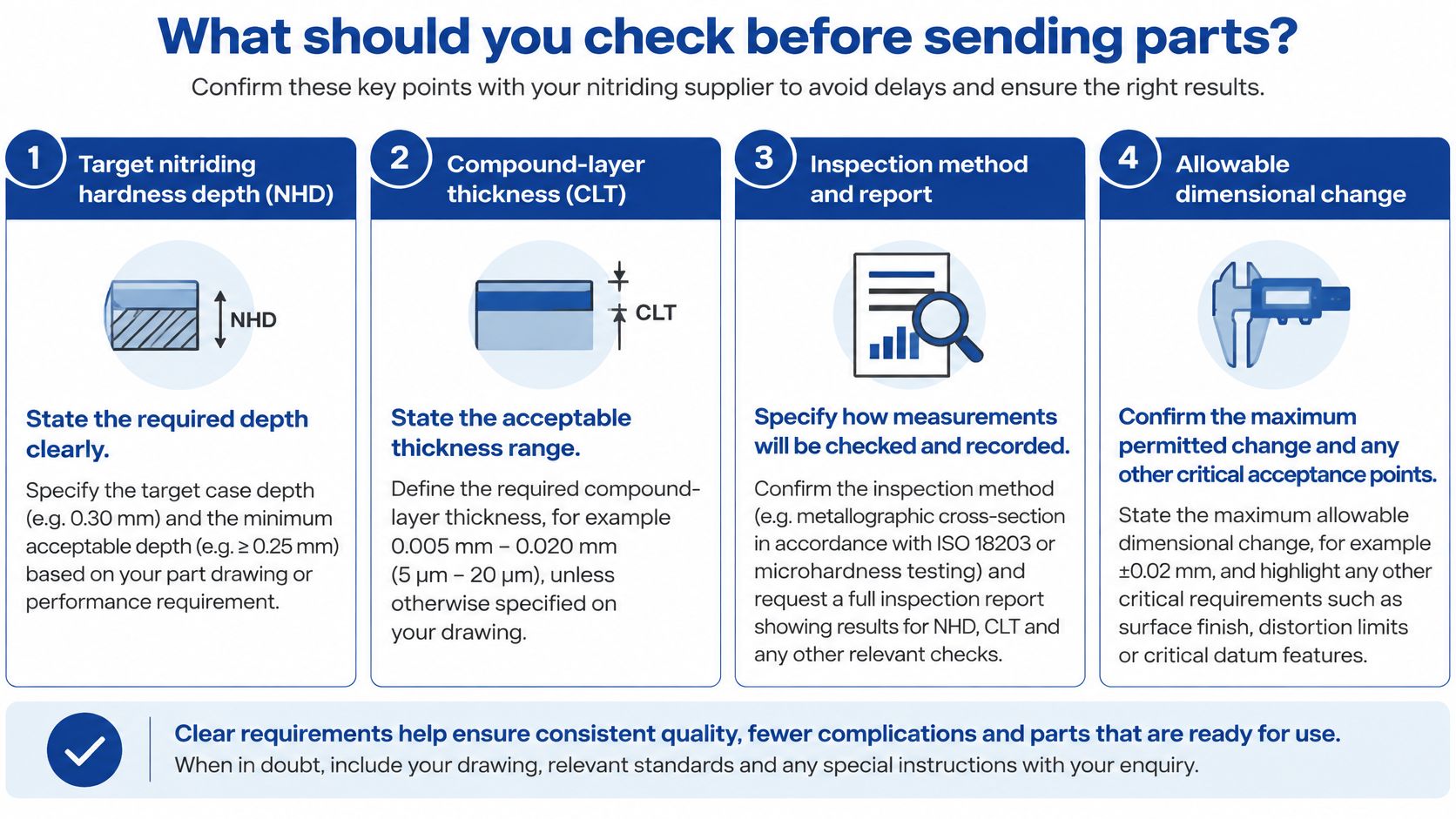
A good nitriding purchase order reads like an engineering drawing: every requirement has a number, a method and a pass or fail limit. Write the order as measurable acceptance points, not adjectives:
Target nitriding hardness depth. State the NHD range you will accept and the method used to check it.
Compound-layer thickness. Give an acceptable band for CLT, or state that a compound layer must be removed by grinding afterwards.
Inspection method and report. Agree the hardness traverse, the depth measurement and what the paperwork contains before the furnace runs.
Allowable dimensional change. Confirm the maximum permitted movement and any areas that must be masked.
Then ask any nitriding provider three things: which process they run, how the cycle is controlled, and what the inspection record contains. Vague answers on any of the three are a reason to walk.
Our own service is deep cryogenic treatment; send nitriding work to a heat treatment provider. We cover motorsport, audio, machining and aerospace parts, and if you're weighing a cryogenic supplier, how to choose a cryogenic treatment company lists the questions worth asking. For cryogenic work, confirm the chamber holds only gas so parts never contact liquid nitrogen, ask how cooling and warming are controlled, and confirm no coating, plating or added surface layer is part of the job. Treated parts should come back dimensionally unchanged and visually identical.
Logistics are simple. Parts can be shipped from anywhere in the UK or dropped off and collected in person. Single items are accepted and go into the chamber alongside other customers' parts on the next scheduled run, so check the next processing date on the Cryogenix website before you send anything.
What do buyers ask about these treatments?
Does nitriding change the size of a part?
Usually very little, because there's no quench. The reported change is below 0.01 mm for suitable precision parts, but it depends on grade, geometry and cycle control, so check it against your tolerance rather than assuming it.
Is a nitrided cutting tool always better?
No. The Plymouth thesis on salt-bath nitriding of high-speed-steel tools reported about 1% added cost and improved performance across a range of cutting conditions, judged on cutting forces, tool temperatures and failure behaviour. Judge your own tools the same way, on measured performance.
Can cryogenic treatment replace nitriding on a gear flank?
No. Bulk hardness didn't change significantly in the cited study, so cryogenic treatment forms no hardened surface layer and can't stand in for a surface hardening process.
Do audio parts gain from cryogenic treatment?
Customers report changes in sound from treated copper cables and components. Those are listener reports, not measured results, and results vary by material and application.
Where can you check the evidence?
Thornton, Slatter, Jones and Lewis (2011), The effects of cryogenic processing on the wear resistance of grey cast iron brake discs, Wear 271.
Jurči and Dlouhý (2024), Cryogenic Treatment of Martensitic Steels, review, available at PubMed Central.
Baldissera and Delprete (2008), Deep cryogenic treatment: a bibliographic review, The Open Mechanical Engineering Journal, available at Bentham Open.
British Standards are cited by number in the text above: BS EN 10052:1993, BS EN 10085:2001, BS ISO 15787:2016 and BS EN ISO 18203:2022.
Weigh your parts and ask for a quote at info@cryogenix-uk.com or through the contact page, and check the next processing date.
Cryogenix Ltd runs deep cryogenic treatment cycles for motorsport, machining, audio and aerospace parts from its base in Yaxley, Peterborough, and it is a different process from the nitriding work described here. Parts are cooled slowly to around minus 196°C in a nitrogen gas chamber, held, then warmed back to room temperature over about three days, and they come back dimensionally unchanged. Visit Cryogenix Ltd to see whether that fits the part you're already sending for surface treatment.
Comments