


Sub Zero Treatment Explained: What It Is and What It Does
Sub zero treatment is controlled cooling of metal to well below freezing, held and returned slowly to room temperature, and the term covers both shallow and deep processes. That single label is where most confusion starts, because people use it for work at very different temperatures and then compare results as if the process were the same.
Popular advice says colder is automatically better and that any metal part will gain the same benefit. That isn't a safe way to buy the service. Temperature, cooling medium, cycle control, material and prior heat treatment all change what can happen inside the part. A sound claim names those details. A vague claim leaves you unable to test whether you got what you paid for.
Table of Contents
How Shallow and Deep Sub Zero Treatment Differ - Shallow and Deep Sub Zero Treatment Compared
What Changes Inside the Metal During Treatment - The Claimed Change in Steel - What Is Still Debated
Why Slow Cooling and Processing Order Matter - Why Speed Matters - Put Treatment in the Right Order
Which Materials Respond and What the Evidence Supports - Materials, Expected Changes and Evidence Strength - Alloy and Tool Steels - Grey Cast Iron Brake Discs - Cutting Inserts - Aluminium, Copper and Audio Parts - Our Own Results, Kept Separate
Decide Whether Your Parts Are Worth Treating - Frequently Asked Questions - References
What Sub Zero Treatment Means for Metal Parts
Sub zero treatment is controlled cooling of metal to well below freezing, held for a set time and returned slowly to room temperature, to change the metal's internal structure rather than its surface. The phrase covers shallow treatment at about minus 80°C and deep cryogenic treatment at about minus 196°C.
Cryogenic means temperatures colder than minus 150°C. Shallow work normally uses refrigeration or dry ice. Deep work uses nitrogen gas. Think of shallow treatment as leaving a cake in the freezer for an hour. The outside gets cold quickly, but the centre takes longer to follow. A deep treatment is a slow, planned cold soak. The whole part is given time to reach temperature, stay there, and come back without a sudden shock.
Say you send two identical gear sets for quotes. One supplier means a short chill at minus 80°C. Another means a computer controlled cycle to minus 196°C. Both may call it sub zero treatment, but they aren't offering the same process or the same likely effect.
It's not a coating, not surface hardening and not a heat treatment in its own right. In steels it's normally run alongside conventional heat treatment. Your first question to any supplier is simple. Which temperature and cycle do you mean.
How Shallow and Deep Sub Zero Treatment Differ
Shallow and Deep Sub Zero Treatment Compared
Feature | Shallow sub zero | Deep cryogenic treatment |
|---|---|---|
Target temperature | About minus 80°C | About minus 196°C |
Cooling medium | Refrigeration or dry ice | Nitrogen gas in a sealed chamber |
Typical cycle | Shorter chill set by the provider's equipment and part size | About three days, with slow descent, hold and slow return |
Effect in steels | Partial cold treatment, with the provider to state the target phase change | Retained austenite converts to martensite and fine carbides form |
Typical use | Lighter cold treatment in some workshops | Motorsport parts, cutting tools, gear sets, steel, aluminium and copper stock |
Choose the temperature first, because it drives the cooling medium, cycle control and effect. Deep cryogenic treatment is the process we run. Cycle time, ramp rate and hold time aren't standard across providers, so ask for the cycle record before you commit.
There's also a third meaning. Cryogenic machining uses liquid nitrogen to cool the cutting zone during a cut. In a University of Bath study on Ti-6Al-4V titanium, cryogenic cooling at approximately minus 197°C reduced surface roughness by as much as 39% compared with dry machining and 31% compared with flood cooling. That acts during the cut, not on a finished part.
Practical rule: If the claim is about the finished part, it's a deep treatment question. If it's about the cut, it's a machining question.
What Changes Inside the Metal During Treatment
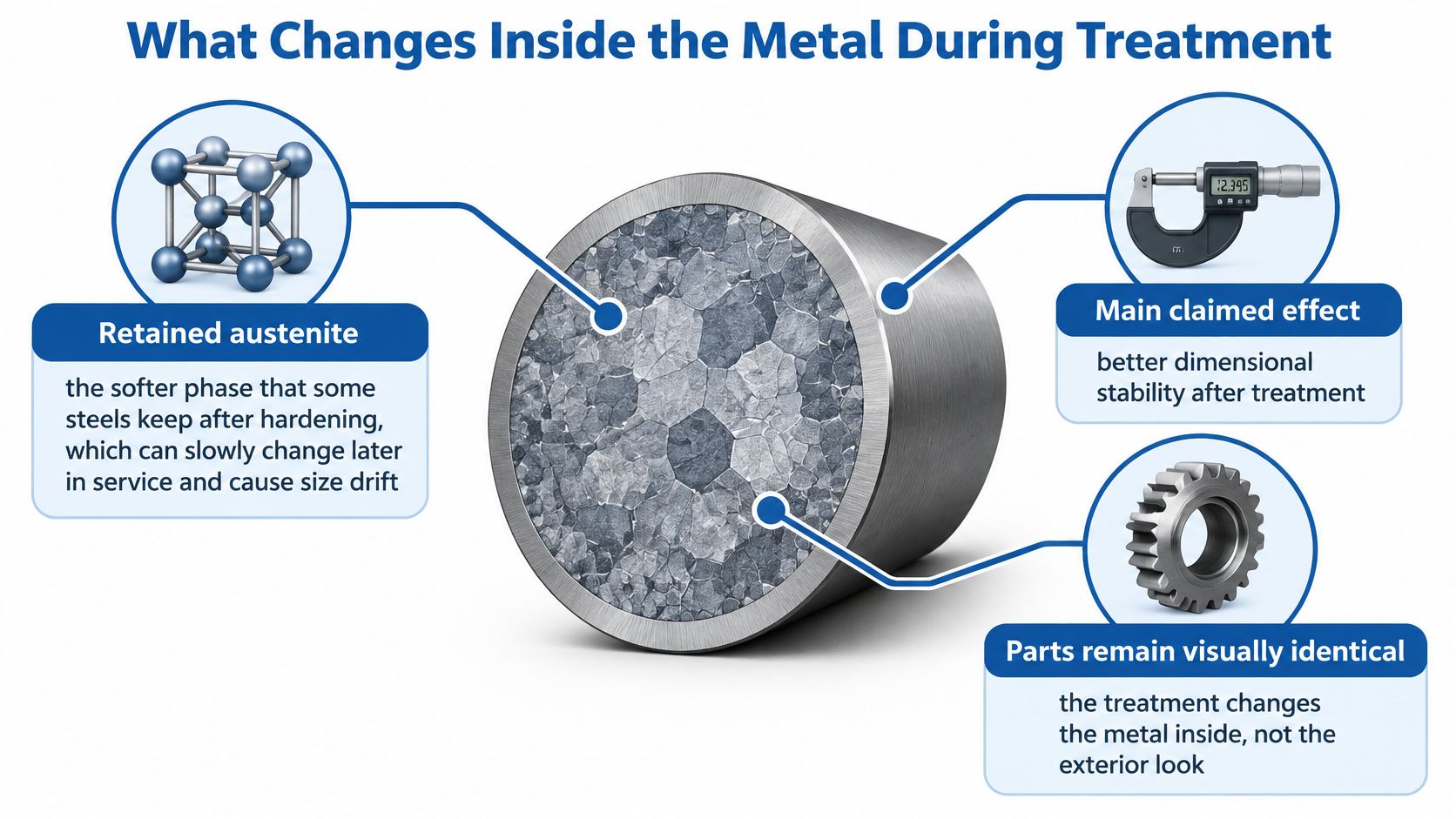
Start with steel, because that's where the mechanism is clearest. Retained austenite is the softer phase that some steels keep after hardening, which can slowly change later in service and cause size drift. A part can measure correctly on the bench, then move slightly after heat cycles or load.
The diagram below sets out that internal change and why size stability matters.
The Claimed Change in Steel
The main claimed effect is conversion of retained austenite into harder martensite. In some steels, fine carbides also form or redistribute. Think of a spring that hasn't finished settling. While the structure remains unsettled, the part can keep moving a little. Completing the change before service aims to make its behaviour more predictable.
That matters for brake discs, crankshafts and cutting tools. These parts must hold size, shape and cutting performance through repeated heat and load. Treatment affects the whole part, not just the surface. Parts remain dimensionally unchanged and visually identical, with no coating or added layer.
For non-ferrous metals such as aluminium and copper, there is no equivalent steel phase conversion to rely on. The reported effect is stress relief and a more stable structure. That is a different claim, so it needs testing on the exact alloy and temper you use.
The short video below gives a useful visual explanation of the controlled cold cycle.
What Is Still Debated
We're candid about the limits. The mechanism is still debated in the literature, and results vary widely with alloy, prior heat treatment and cycle. Jurči and Dlouhý (2024) reviewed cryogenic treatment of martensitic steels, while Baldissera and Delprete (2008) reviewed the wider deep cryogenic treatment literature. Together they show a broad field, not a settled recipe for every steel.
Accept this position. The mechanism is credible for steels, the detail isn't settled, and any result must be tested on your own material.
Why Slow Cooling and Processing Order Matter
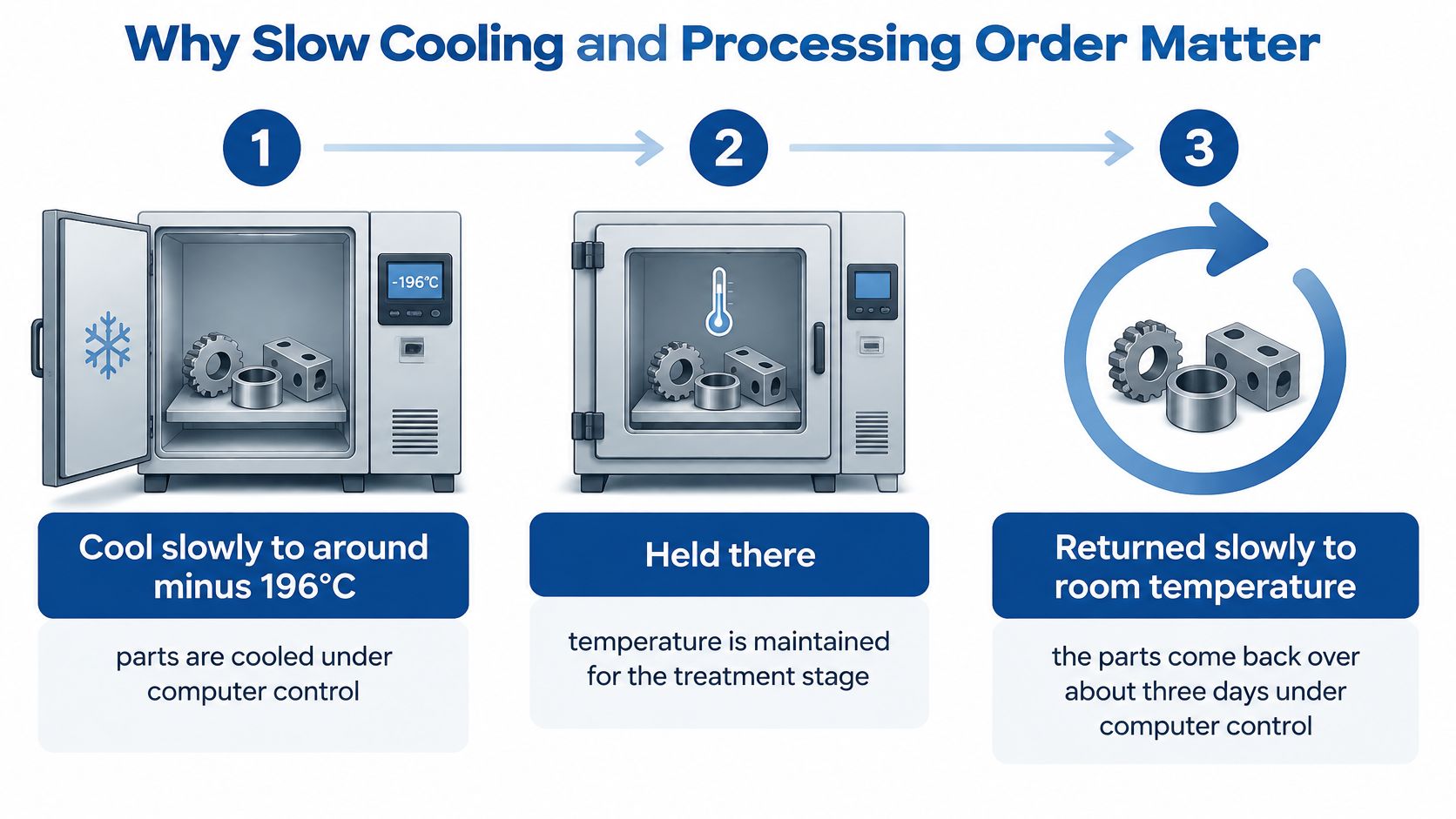
Parts are cooled slowly to around minus 196°C using nitrogen, held, then returned slowly to room temperature. The cycle is computer controlled and takes about three days. You can read the full sequence in how deep cryogenic treatment works step by step.
The three stages below show why the return journey matters as much as the descent.
Why Speed Matters
Fast cooling lets the surface reach temperature before the core. That creates thermal gradients, meaning different parts of the component are contracting at different rates. The resulting stress can crack a part. Slow, even ramp rates reduce that risk and avoid thermal shock.
Our chamber only ever contains nitrogen gas. Parts never touch liquid nitrogen. That distinction matters because direct immersion would cool surfaces far more aggressively than a controlled gas cycle.
Put Treatment in the Right Order
For many steels, cryogenic treatment is most effective as an additional stage after conventional heat treatment. In most cases, treatment is best carried out after machining, because machining can introduce additional stresses into the material. A practical sequence looks like this.
Heat treat first: Complete the specified hardening route for the steel.
Machine close to size: Remove the bulk of the material and its machining stress before treatment.
Deep treat: Run the full controlled cycle on the nearly finished part.
Finish and inspect: Complete final sizing, then check dimensions against your drawing.
The treatment is permanent and survives regrinding, so finishing afterwards is normal. Any further tempering depends on the material specification. Don't assume one order suits every component. Agree it for each material, particularly for cutting tools covered by our machining treatment service.
Which Materials Respond and What the Evidence Supports
Read enough claims about sub zero treatment and they start to contradict each other. Most of that confusion comes from mixing three different things: shallow cold treatment, full deep cryogenic treatment down to around -196°C, and cryogenic cooling applied during machining, where nitrogen cools the cut itself rather than permanently changing the part. A wear figure from one says little about the others. With those categories kept separate, the evidence sorts cleanly by material.
Materials, Expected Changes and Evidence Strength
Material | Expected change | Evidence and caution |
|---|---|---|
Alloy and tool steels | Retained austenite converts to martensite, fine carbides form | Most published work sits here; results still vary by grade and prior heat treatment |
Grey cast iron brake discs | Lower wear rate in pin-on-disc testing | Laboratory wear result rather than a road or circuit life multiple |
Cobalt-bonded tungsten carbide cutting inserts | Higher hardness and better abrasive wear resistance in one deep-cycle study | Possible toughness loss; shock and interrupted cuts need testing |
Aluminium | Stress relief and a more stable structure | Reported effect for non-ferrous metals; test the specific alloy and temper |
Copper, including audio cable and components | Stress relief and a more stable structure | Customers report changes in sound; listener reports rather than measured data |
Polymers, composites and bonded assemblies | Not a treatment target | Cold changes their behaviour; screen before treating |
Alloy and Tool Steels
Alloy and tool steels carry the most published work on retained austenite conversion and fine carbide formation, and Podgornik and others (2016) is a useful starting point. A grade name alone predicts nothing, because the result depends on prior heat treatment and application. Cryogenix helped support a recent paper on PVD TiN coated AISI M2 high speed steel, published on a university website, and it sits in this same category: a defined material, a defined cycle, measured outcomes.
Give the provider the hardness condition and heat treatment history before treatment. If you are still selecting stock for a test batch, engineering material choices for prototype runs can help you compare machinability and application before spending on treatment. Keep the test narrow: change the treatment only, never the grade, geometry and process settings at the same time.
Grey Cast Iron Brake Discs
Thornton, Slatter, Jones and Lewis (2011) ran pin-on-disc tests on grey cast iron brake discs and reported wear rate improvements of 9.1 to 81.4 per cent with no significant change in bulk hardness. Read that range correctly: a pin-on-disc rig is a controlled laboratory wear test, so it cannot be converted into a disc life multiple on road or circuit. Thornton (2014), a PhD thesis at the University of Sheffield, extends the work.
Our motorsport component treatment covers the racing parts we handle, and the service exists to improve durability and reduce replacements. That is a service description, separate from the published wear result.
Cutting Inserts
A University of Warwick study of H13A cobalt-bonded tungsten-carbide cutting inserts treated at 93 K (approximately minus 180°C) and tested in wet turning of AISI 1045 steel measured a 9.2% increase in hardness, improved abrasive-wear resistance and a possible reduction in toughness. Note the temperature: 93 K sits well above the roughly -196°C of a full deep cycle, so its outcome does not automatically transfer to parts treated colder.
Higher hardness helps under steady abrasive loading; lower toughness raises sensitivity to shock, interrupted cuts and edge chipping. That trade-off applies to the tooling sent for treatment too: guillotine blades, slitters, perforation tools, disc cutters, band saw blades and carbide tips all see a mix of abrasion and impact. Test with identical insert grades and geometries at matched speed, feed, depth of cut and coolant, and measure flank wear, crater wear, edge failure and cutting forces separately.
Aluminium, Copper and Audio Parts
For aluminium and copper the reported effect is stress relief and a more stable structure rather than a steel-style phase change, so the specific alloy and temper set the starting condition. We treat steel and aluminium stock plus a range of copper components: HT leads, spark plugs, transformers, wiring looms, battery cables and Hi-Fi cables.
For audio, customers report improvements in the sound of treated copper cable. Those are listener reports rather than laboratory measurements, and we present them that way. Plastic parts inside a component come through the cycle without permanent change, but bonded joints, adhesives and composite structures need individual screening because cold changes how they behave.
Our Own Results, Kept Separate
Cryogenix's motorsport treatment is intended to improve component durability and reduce replacements, and results vary by material and prior heat treatment. In 2021 we ran a direct comparison on a single car: one cryo-treated brake disc on the left front, one untreated disc on the right front. At the end of the trial the treated disc showed significantly less propagation of small cracks, and no large cracks developed at all.
That is one matched pair on one vehicle, useful as a signal rather than a guaranteed outcome. Run your own matched untreated control before changing a race programme or production process. The wider published material sits in the Cryogenix research library.
When Sub Zero Treatment Is Not Worth Doing
Treatment does not repair cracked, chipped or otherwise damaged parts. Only sound parts should go in. If a brake disc has a crack or a tool edge has chipped, cold treatment will not restore missing material or close the defect.
Bonded assemblies, adhesives, seals, coatings, electronics, polymers and composites need screening too. Cold can change how composites and bonded joints behave, so screen any structure containing them before treatment and do not assume a steel cycle is safe for it. Slow, computer controlled cooling avoids thermal shock in a uniform part, but it cannot stop two different materials in a joint contracting at different rates. That mismatch puts stress on the joint even when each material alone would be unharmed.
Skip treatment where the failure mode is not driven by wear, fatigue or dimensional drift. Skip it where replacement is cheap and quick, where you have no untreated control, or where the heat treatment history is unknown and the result cannot be predicted. A supplier who cannot say which process they mean, shallow or deep, adds to that uncertainty, because the two are not interchangeable.
A supplier who promises a fixed percentage gain, or cannot name the temperature and cycle, should be questioned.
Use this checklist before spending money.
Identify polymers and adhesives: List every non-metal part of the assembly.
Map dissimilar materials: Check joints where materials contract at different rates.
Inspect for defects: Reject cracked, chipped or damaged parts.
Define permissible change: Set the dimensional limit before treatment.
Agree verification: Decide how dimensions or condition will be checked afterwards.
Decide Whether Your Parts Are Worth Treating
Run four checks. Is the material one that responds. Does the part fail through wear, fatigue or drift that treatment targets. Do you have a matched untreated control. Can you test the result before committing a batch. Our guide on how to choose a cryogenic treatment company helps you compare providers.
Frequently Asked Questions
Is shallow sub zero treatment the same as deep cryogenic treatment. No. The temperature, cooling medium and likely results differ.
Can treatment repair a cracked brake disc. No. It doesn't repair cracked or damaged parts.
How long does a deep cycle take. About three days in our process, including slow cooling, hold and slow return.
References
Baldissera and Delprete (2008), Deep cryogenic treatment, a bibliographic review
Podgornik and others (2016), Deep cryogenic treatment of tool steels
Thornton, Slatter, Jones and Lewis (2011), The effects of cryogenic processing on grey cast iron brake discs
Jurči and Dlouhý (2024), Cryogenic Treatment of Martensitic Steels
Weigh the parts and ask for a quote at info@cryogenix-uk.com or our contact page, and check the next processing date.
If your parts pass those checks, we can advise on material, processing order and a matched control before you commit to sub zero treatment. Visit Cryogenix Ltd to review the service and send your part weights for a quote.
Comments