


Machining Titanium: Why Tools Wear and How to Slow It
Titanium-alloy components can require removal of up to 95% of their original bulk material, making machining and tooling the most expensive manufacturing stage in some applications, according to the University of Sheffield. When machining titanium, we'd establish stable cutting conditions before considering specialist treatment. Cooling the cut, treating the tool and selecting cutting data are different interventions.
Table of Contents
Why Does Titanium Wear Cutting Edges So Quickly? - What should you inspect?
Can Deep Cryogenic Treatment of Tools Help? - What does the steel evidence establish? - What can we say separately?
When Will Cryogenic Treatment Not Help or Not Justify a Trial? - What should you eliminate first?
What Should I Check Before Changing Tools or Sending Any for Treatment?
What Do Shops Ask Next About Titanium Tool Life? - References
What Cutting Speed Gives Usable Tool Life on Titanium?
In turning trials on 11 titanium materials, the Advanced Manufacturing Research Centre with Boeing found that every material achieved at least 15 minutes of carbide-tool life at cutting speeds above 50 m/min.
That's a useful benchmark, not a universal setting. Cutting speed is the surface speed where the workpiece meets the tool, rather than spindle revolutions alone. Connecting it to a defined tool-life criterion gives a planner something more useful than a maximum speed: a basis for scheduling replacements and estimating tooling cost per part.
The tested materials didn't form a single machinability category. Your alloy, insert grade, coolant delivery and machine rigidity still determine whether a particular setting is usable.
Practical rule: Treat a published cutting speed as a trial condition, not permission to run unattended.
Start with the tooling supplier's recommendation for your specific grade and operation. Run a controlled trial, inspect the edge and record actual cutting time before increasing speed. A turning benchmark doesn't establish a milling parameter window, where interrupted engagement changes the loading.
The target is predictable useful life, not the fastest cut that survives briefly.
Why Does Titanium Wear Cutting Edges So Quickly?
Titanium conducts heat poorly, so heat remains concentrated near the tool tip. Think of a thin pan over a strong flame: the local hot spot matters more than the average temperature. At the tool interface, that concentration encourages damaging interactions between titanium and the tool.
The cause chain is straightforward.
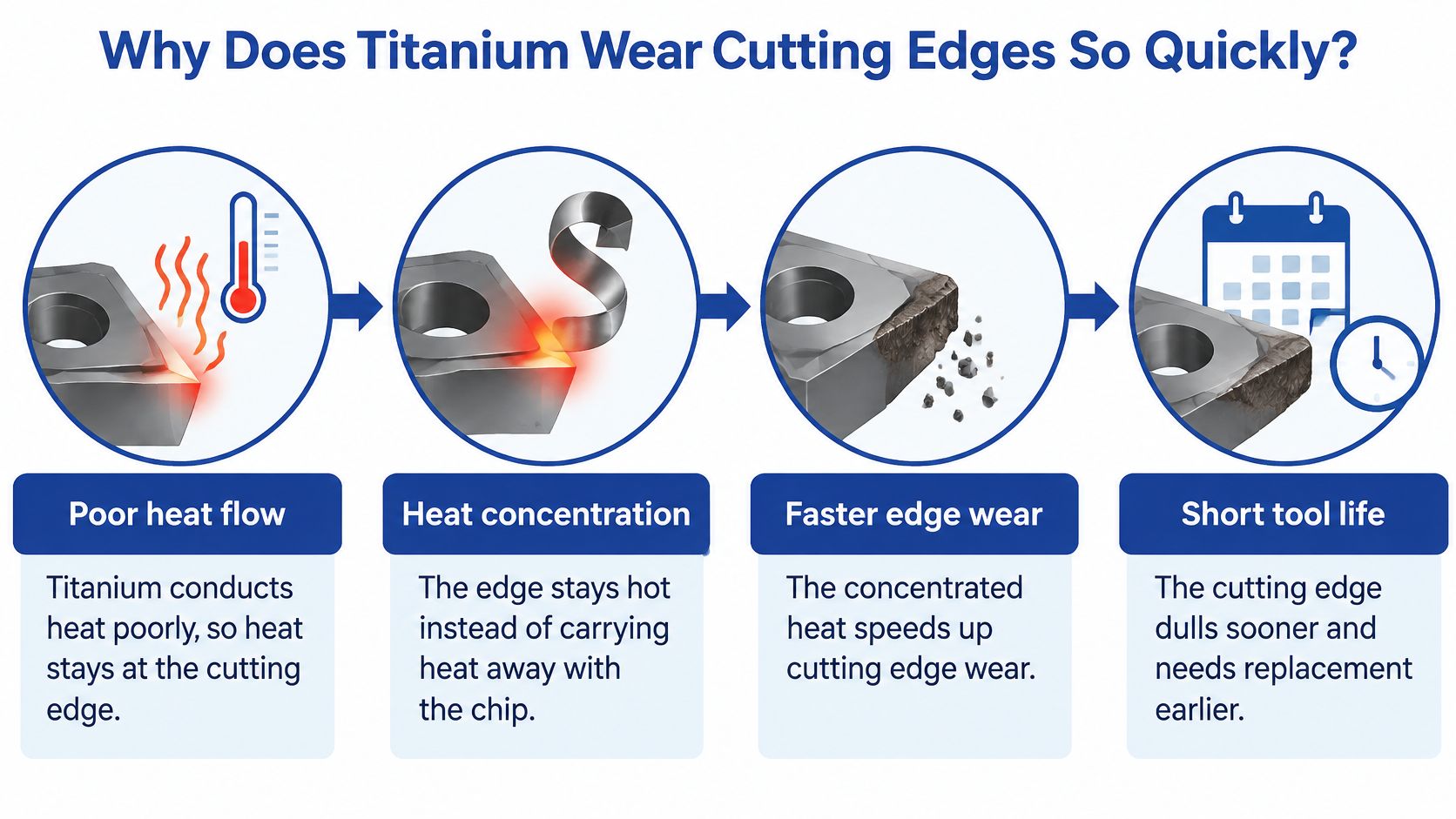
Hot titanium can adhere to the edge. As attached material moves away, it can remove tool material; chemical interaction can also contribute to wear. If the edge rubs rather than forming a proper chip, friction adds heat and the worked surface becomes harder to cut cleanly.
Sheffield's tool-wear work also describes an awkward warning pattern: tools can deteriorate rapidly with little visible wear before sudden failure. Don't assume a small wear mark means ample life remains.
What should you inspect?
Edge damage: Look for chipping, a rounded corner and a notch at the depth-of-cut line.
Process changes: Investigate a different cutting sound, rising load or deteriorating finish.
Wear location: Distinguish gradual flank wear, on the tool surface facing the workpiece, from local fracture.
Our explanation of carbide cutting tools gives further tooling context. Diagnose the failure mode before deciding whether another insert, different engagement or treatment is a sensible experiment.
How Do I Stop Chatter and Keep Titanium Cuts Stable?
A ringing cut and regularly spaced surface marks warrant investigation. Chatter is self-excited vibration arising from the interaction between the cutting process and the machine, tool and workpiece. Slowing the spindle doesn't necessarily identify a stable condition.
This diagram contrasts unstable vibration with a controlled cut.
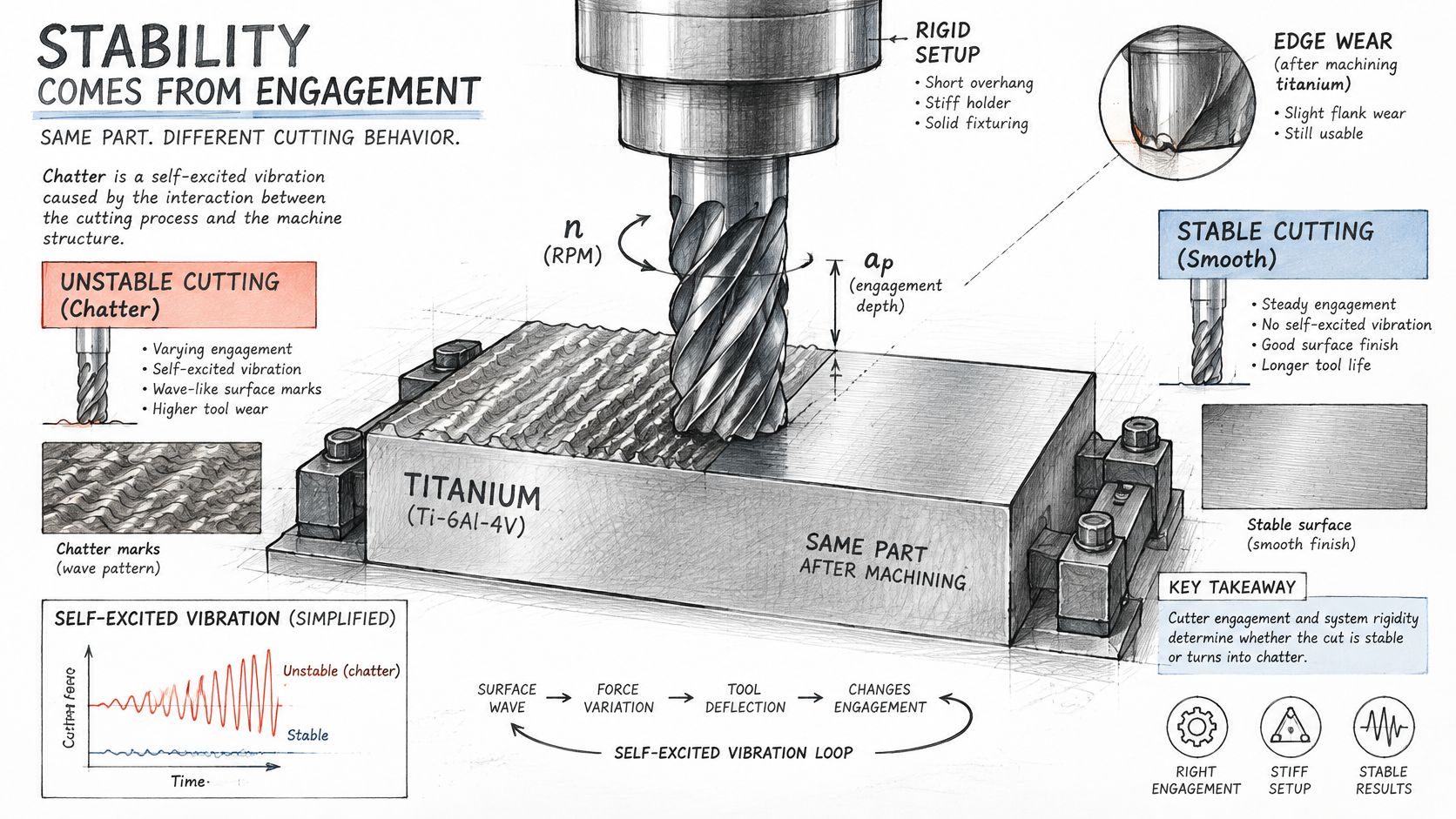
Radial immersion is the share of cutter diameter engaged with the workpiece. Full-width pocketing and abrupt corner engagement can load an edge much harder than the programmed feed suggests. A University of Sheffield doctoral study developed pocketing strategies that controlled radial immersion to optimise tool life and productivity.
Use that principle deliberately:
Reduce radial engagement while maintaining enough chip thickness to cut rather than rub.
Choose constant-engagement pocketing paths to limit sudden load changes.
Avoid dwelling in corners, where engagement can increase sharply.
Shorten tool overhang and secure clamping before experimenting with parameters.
Review feed and engagement first, then test spindle-speed changes systematically rather than making several adjustments together.
Record sound, finish and cutting force where measurement is available. The stable window belongs to the particular machine and setup, not titanium generally.
The accompanying video provides additional machining context.
Which Cooling Strategy Reduces Titanium Tool Wear?
The comparison below concerns Ti-6Al-4V turning at 60 m/min, not all titanium operations. The Birmingham City University study published in 2025 reported 23% less tool wear with cryogenic machining than dry machining, and 12% less than wet machining, under its tested conditions.
Coolant strategies and tool wear at 60 m/min
Cooling strategy | Tool wear at 60 m/min | Notes |
|---|---|---|
Dry turning | Reference point | Baseline for the comparison |
Wet flood coolant turning | Higher than cryogenic cooling | Wet comparison condition |
Cryogenic cooling at the cut | Lower than dry and wet | Cools the cutting zone; doesn't pre-treat the tool |
Supercritical CO2 with minimum quantity lubrication | No directly comparable value established here | Requires a separate evaluation |
The same study identified cutting speed as the strongest tested influence on wear, with an analysis-of-variance contribution of 52.96%. Microscopy identified adhesion and diffusion dissolution, meaning attachment between materials and transfer of tool constituents through chemical interaction, as principal wear mechanisms.
Wet coolant remains a practical candidate where delivery reaches the working interface reliably. Dry cutting removes fluid management but shouldn't be selected without checking its tooling penalty.
The AMRC cooling programme investigated supercritical carbon dioxide combined with minimum quantity lubrication, the controlled delivery of a small lubricant supply. That establishes research relevance, not equivalence to the turning comparison.
Our cryogenic machining explanation concerns cooling during cutting. Compare tool life, finish, fluid waste and cost per acceptable part, not coolant temperature alone.
Can Deep Cryogenic Treatment of Tools Help?
Parts are cooled slowly to around minus 196°C in nitrogen gas, held, then returned slowly to room temperature; they never touch liquid nitrogen. The step-by-step process explanation describes this separately from coolant delivery during machining.
The answer depends first on what the tool is made from. Published work includes Baldissera and Delprete's bibliographic review, Podgornik and colleagues' tool-steel study, and Jurči and Dlouhý's martensitic-steel review, listed below. These aren't direct proof of longer carbide-tool life while cutting titanium.
What does the steel evidence establish?
In suitable steels, retained austenite, a steel microstructure that remains after hardening, can convert to martensite, a harder structure. Fine carbide particles can also form. For many steels, treatment is most effective as an additional stage after conventional heat treatment.
However, mechanisms remain debated and study results vary widely. Benefits depend on material, prior heat treatment and application. Carbide tools aren't tool steels, and the evidence presented here is insufficient to assign them a titanium-machining life improvement.
A successful steel treatment study doesn't establish a performance gain for a carbide end mill.
What can we say separately?
Our customers report treated cutting tools staying sharper for longer. That's customer experience, not a controlled titanium-machining result, and outcomes vary by material, prior heat treatment and application.
Our deep cryogenic treatment overview explains the treatment category, while the academic research library provides further reading. Treated parts return dimensionally unchanged and visually identical, without a coating, plating or added surface layer.
When Will Cryogenic Treatment Not Help or Not Justify a Trial?
An excessive cutting speed is a process fault, not a reason to expect treatment to rescue the tool. If the edge overheats or fails under unsuitable loading, establish workable cutting conditions before spending money on a specialist intervention.
The same applies to poor rigidity, excessive overhang, loose clamping and coolant that misses the working interface. Treatment doesn't correct the mechanical arrangement or redirect the fluid.
A chipped edge needs assessment for regrinding or replacement. A damaged coating won't be restored by deep cryogenic treatment, and cracked or broken tools aren't candidates for repair through this process.
For a short job that already finishes comfortably within normal tool life, organising a comparison may cost more than it could save. Routine consumables aren't automatically worth treating either: the relevant calculation is avoidable tooling and interruption cost.
What should you eliminate first?
Cutting conditions: Check speed, feed and engagement.
Mechanical weakness: Check rigidity, overhang and clamping.
Fluid delivery: Confirm coolant reaches the cut.
Failure mode: Consider a treatment trial for repeatable gradual wear, rather than unexplained fracture.
What Should I Check Before Changing Tools or Sending Any for Treatment?
Record the baseline: Write down speed, feed, radial engagement, coolant and current useful tool life.
Isolate adjustments: Change one variable at a time, initially reviewing feed and engagement.
Match the tools: Compare treated and untreated tools from the same batch under equivalent conditions.
Inspect consistently: Record wear and surface finish at predetermined cutting-time intervals.
Judge the outcome: Require a repeatable difference that matters economically, rather than relying on one exceptional tool.
For our machining treatment service, the full computer-controlled cycle takes around three days. Treatment affects the whole part, is permanent and survives regrinding.
For workpieces, treatment is generally best carried out after machining because machining can introduce additional stresses. That sequencing advice isn't an instruction to wait until a cutting tool is worn out.
Before sending parts, don't torque them together. Lightly oil ferrous metals that could corrode and remove pressed-in bearings where possible; identify tool materials and coatings so the proposed comparison is meaningful.
What Do Shops Ask Next About Titanium Tool Life?
How often should an operator check a titanium edge?
During initial trials, inspect after each part, or at a fixed cutting-time interval within a long operation. Shorten the interval if load, sound or finish changes; appearance alone isn't a dependable remaining-life indicator.
Can cryogenic treatment repair a chipped or cracked tool?
No. Have the tool assessed for professional regrinding or replace it, rather than treating an already damaged edge.
Will a treated tool last longer on every titanium job?
No universal gain can be promised. Results vary by material, prior heat treatment and application, so a matched trial on your own operation is the useful test.
References
Podgornik and others (2016), Deep cryogenic treatment of tool steels, Journal of Materials Processing Technology 229.
Jurči and Dlouhý (2024), Cryogenic Treatment of Martensitic Steels, review.
Baldissera and Delprete (2008), Deep cryogenic treatment: a bibliographic review, The Open Mechanical Engineering Journal.
We offer deep cryogenic treatment of cutting tools at Cryogenix Ltd, with single items accepted for pooled processing. Weigh your parts and ask for a quote at info@cryogenix-uk.com, then check the next processing date before planning your titanium-tooling trial.
Comments