


Aircraft Wing Components: What Each Part Does
Aircraft wing components form a load path, the route forces take through spars, ribs, skins, stringers, control surfaces and fittings into the fuselage, rather than a collection ranked by size. A labelled diagram helps you identify parts, but metal and composite structures need different material controls, damage assessments and inspection methods.
Table of Contents
Why Attachments Fail Before the Skin Does - What should a workshop preserve?
Where Cryogenic Treatment Can Apply to Wing Metals - What does the evidence establish?
When Cryogenic Treatment Will Not Help a Wing Part - When should you stop?
How UK Wing Building Is Changing the Parts - Which hardware remains?
Questions to Settle Before You Send a Part - When is the next run? - What does a quote need? - How should you prepare the hardware? - Which items avoid the flight-component approval question?
Which Parts Make Up an Aircraft Wing
An aircraft wing includes the centre section, outer panels, internal structure, skins, movable surfaces and their attachments. Primary structure carries loads whose loss could threaten structural integrity. Spars, ribs, structural skins, stringers and primary joints belong in that group; aerodynamic fairings are generally secondary.
Aircraft wing components and what they do
Component | Job in the wing | Usual material family | Main demand |
|---|---|---|---|
Front and rear spars | Carry wing bending | Aluminium alloy or carbon-fibre spar caps | Fatigue and buckling |
Ribs | Hold aerofoil shape and pass loads to spars | Aluminium sheet or composite | Fastener holes and stability |
Skins | Carry torsion and air pressure, maintain surface shape | Aluminium sheet or carbon-fibre laminate | Fatigue, corrosion or impact damage |
Stringers | Stiffen skin against buckling | Aluminium extrusions or composite | Compression stability |
Centre-section joints and spar fittings | Transfer wing loads into the fuselage | High-strength aluminium or steel | Stress concentration and inspection access |
Flaps, slats and ailerons | High-lift and roll control | Aluminium or composite with metal hinges | Hinge and actuator loads |
Spoilers | Dump lift and assist roll | Aluminium or composite | Attachment and actuator loads |
Flap actuation parts | Extend and retract flaps | Steel, aluminium and bearings | Wear and fatigue |
Wing pins, main bolts and hinge brackets | Join panels, folding joints or control surfaces | High-strength steel or aluminium | Fretting, corrosion and crack detection |
Start with air pressure acting on the skins. Ribs preserve the aerofoil, the wing's cross-sectional shape, while transferring loads into the supporting structure. Spars resist bending; skins and stringers work together against twisting and compression buckling. Centre-section connections then transfer those loads into the fuselage.
The Civil Aviation Authority's maintenance guidance calls for checks covering corrosion, distortion, skin deterioration, insecure attachments, wear, excessive play and damaged wing pins or main bolts.
Practical rule: Judge a component by the load it carries and the consequences of failure, not its size.
For organising assemblies and their constituent hardware, SIX ERP on bill of materials provides useful background. A parts list doesn't establish repair permission: approved maintenance data and damage limits determine what can be repaired, replaced or formally assessed.
What Materials Must Each Wing Part Withstand
Material choice changes both the failure mechanism and the inspection task. Fatigue means damage caused by repeated loading, potentially at stresses below those that would break an undamaged part in a single application.
Wing material families and what they must survive
Material family | Typical wing use | What it handles well | Damage to watch |
|---|---|---|---|
Aluminium alloy | Ribs, skins, stringers, many fittings | Low mass, forming and machining | Fatigue, corrosion, overheating |
High-strength steel | Pins, bolts, hinges, actuator parts | Strength in a small section, wear | Cracks at radii, fretting, corrosion |
Carbon-fibre reinforced plastic | Skins, spar caps, control surfaces | Low mass, no metallic corrosion | Impact, delamination, disbond, moisture |
Aluminium can be formed, machined and mechanically fastened, but overheating during manufacture or repair can alter its material condition. Steel suits compact, highly loaded hardware, although threads, holes and changes in section need careful attention. Fretting is surface damage caused by small movements between contacting parts.
The illustration gives a broad material overview, not a substitute for the aircraft's material specification.
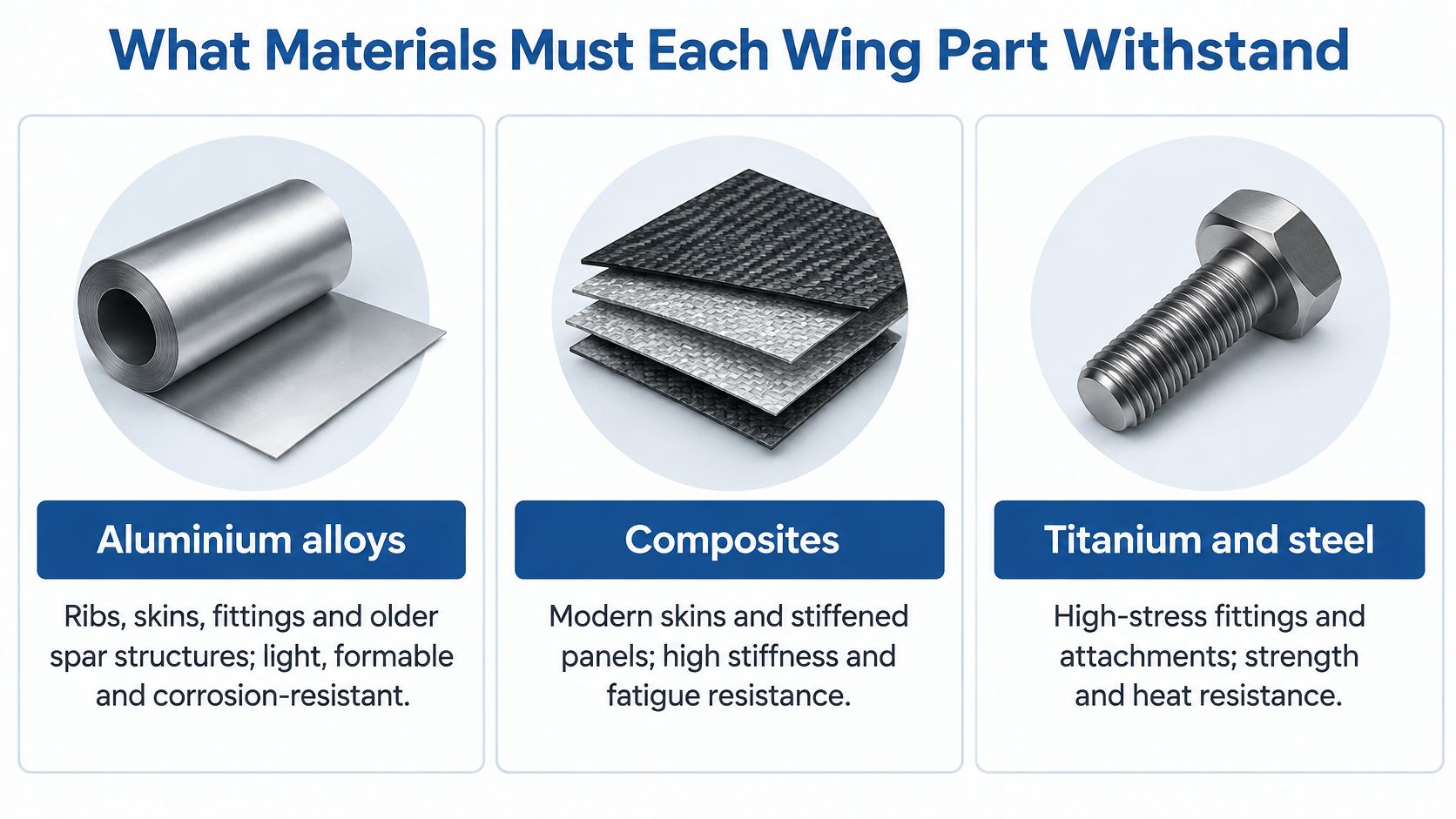
Carbon-fibre reinforced plastic combines reinforcing fibres with a polymer matrix. Delamination separates laminate layers; a disbond separates an adhesive interface. Neither should be assessed as though it were corrosion in sheet metal.
The Aerospace Technology Institute's Engineering Growth strategy reports UK-manufactured aerostructures worth $3.3 billion annually in 2025, with a projected pathway to $9.7 billion by 2050, and identifies composite tooling and high-rate manufacturing as priorities for higher-aspect-ratio wings.
Traceability matters alongside material selection. Resources such as DPPWare's passport software for metal component suppliers address material-information management, not airworthiness approval. Our aerospace components and brakes discussion provides related context: a composite component isn't maintained like a metal one.
Why Attachments Fail Before the Skin Does
The Air Accidents Investigation Branch's Edge 540 report describes fatigue cracking in the corner radii of two L-shaped centre-hinge brackets associated with a composite wing and full-span ailerons, and a recommendation to remove hinge assemblies at every 100-hour or annual inspection for dye-penetrant examination.
The attachment geometry explains why looking only at the wing skin misses a critical inspection task.
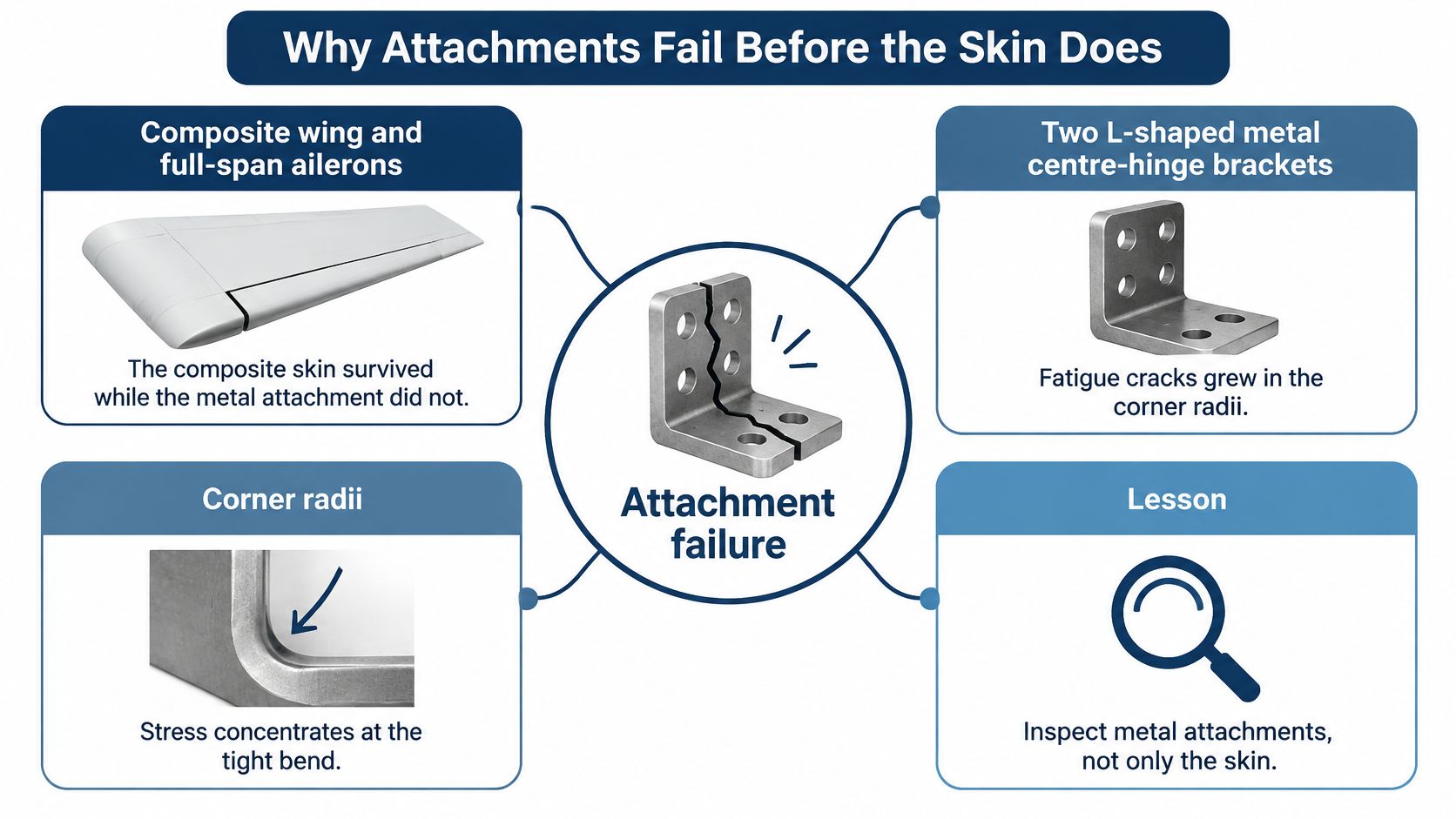
A stress concentration is a local increase in stress around a geometric feature. Tight corner radii, lug holes and section changes can concentrate load into a small region. A composite wing therefore doesn't eliminate metallic fatigue: the fitting connecting its control surface can still be critical.
The Ministry of Defence's structural-airworthiness guidance identifies wing structures and primary joints as potentially susceptible to widespread fatigue damage, involving multiple cracking sites or elements. Continued airworthiness combines fatigue testing, calculations, sampling, inspection and teardown examination.
What should a workshop preserve?
Geometry: Preserve specified edge radii and hole condition. Don't introduce sharp tool marks.
Material condition: Avoid local overheating and record the material specification and processing history.
Inspectability: Plan qualified non-destructive inspection, meaning examination without damaging the component, after an authorised process that could affect crack detection.
Teardown examination also checks corrosion, wear, distortion, delamination, disbonding, moisture ingress and damaged protective finishes.
The accompanying video provides additional visual context.
Where Cryogenic Treatment Can Apply to Wing Metals
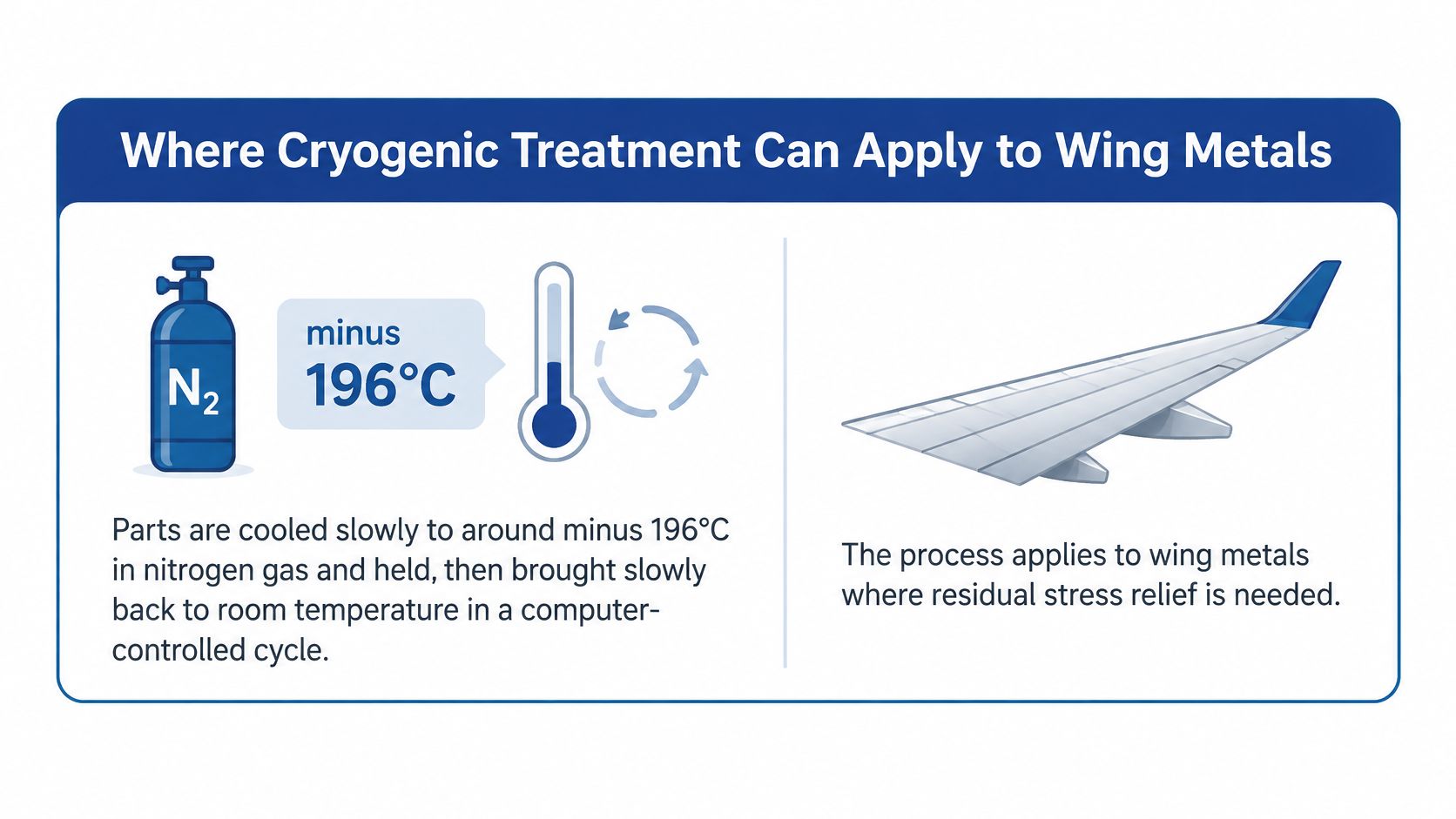
Parts are cooled slowly to around minus 196°C in nitrogen gas, held, then returned slowly to room temperature in a computer-controlled cycle taking about three days. Parts never touch liquid nitrogen; our step-by-step process explanation covers the sequence.
Treatment affects the whole part, isn't a coating or conventional heat treatment, and is permanent and survives regrinding. Parts remain dimensionally unchanged and visually identical, but that does not establish permission to process a flight component.
What does the evidence establish?
In steels, retained austenite can convert to martensite, a different crystal structure, and fine carbides can form. For non-ferrous metals, stress relief and structural stability are the relevant potential effects. Results vary by material, prior heat treatment and application.
Thornton, Slatter, Jones and Lewis (2011), in Wear, reported wear-rate improvements of 9.1 to 81.4 per cent, without a significant change in bulk hardness, in a pin-on-disc study of grey cast iron brake discs. That is brake-iron research, not evidence of wing-fitting life or an approved aerospace process.
Jurči and Dlouhý's 2024 review of martensitic steels and Baldissera and Delprete's 2008 review in The Open Mechanical Engineering Journal provide broader research context. Mechanisms remain debated and study results vary widely; we don't present these publications as Cryogenix customer experience.
A plausible metallurgical effect is not an airworthiness approval.
Potential candidates include steel fittings, hinge hardware and actuator parts only where the responsible design authority permits the process. Tooling and aluminium machining stock are separate considerations, discussed further in our aerospace components manufacturers article.
When Cryogenic Treatment Will Not Help a Wing Part
Cryogenic treatment will not repair a crack, rebuild a worn hinge or replace metal lost to corrosion. It won't reconnect delaminated layers or restore a disbonded composite joint. Those defects need assessment against a permitted repair scheme or replacement requirement.
A carbon-fibre skin, bonded stiffener or painted fairing isn't a candidate just because it belongs to a wing. Plastic details aren't the purpose of this metal-processing approach.
When should you stop?
No process permission: Don't send a certified flight item unless approved data and the responsible design authority allow treatment.
An uncertain inspection baseline: Stop if a proposed process could invalidate dye-penetrant, eddy-current or dimensional acceptance criteria.
An exhausted service limit: Treatment doesn't reset an approved component life.
No worthwhile engineering objective: A low-stress fairing with no relevant material problem is a poor place to spend money.
A shallow cold cycle, rapid immersion or direct liquid contact shouldn't be treated as equivalent to the controlled gas process described in our deep cryogenic treatment overview.
Keep the decision tied to a defined material problem, an authorised process and an acceptance method.
For non-flight applications, our motorsport and machining pages describe relevant uses. Neither provides evidence for extending an aircraft component's approved service life.
How UK Wing Building Is Changing the Parts
UK wing capability encompasses design, development, production and integration, as documented in a House of Commons trade and industry submission. The practical point is that changing materials changes the manufacturing system, not just the finished component.
This factory illustration places individual parts within wing-box assembly.
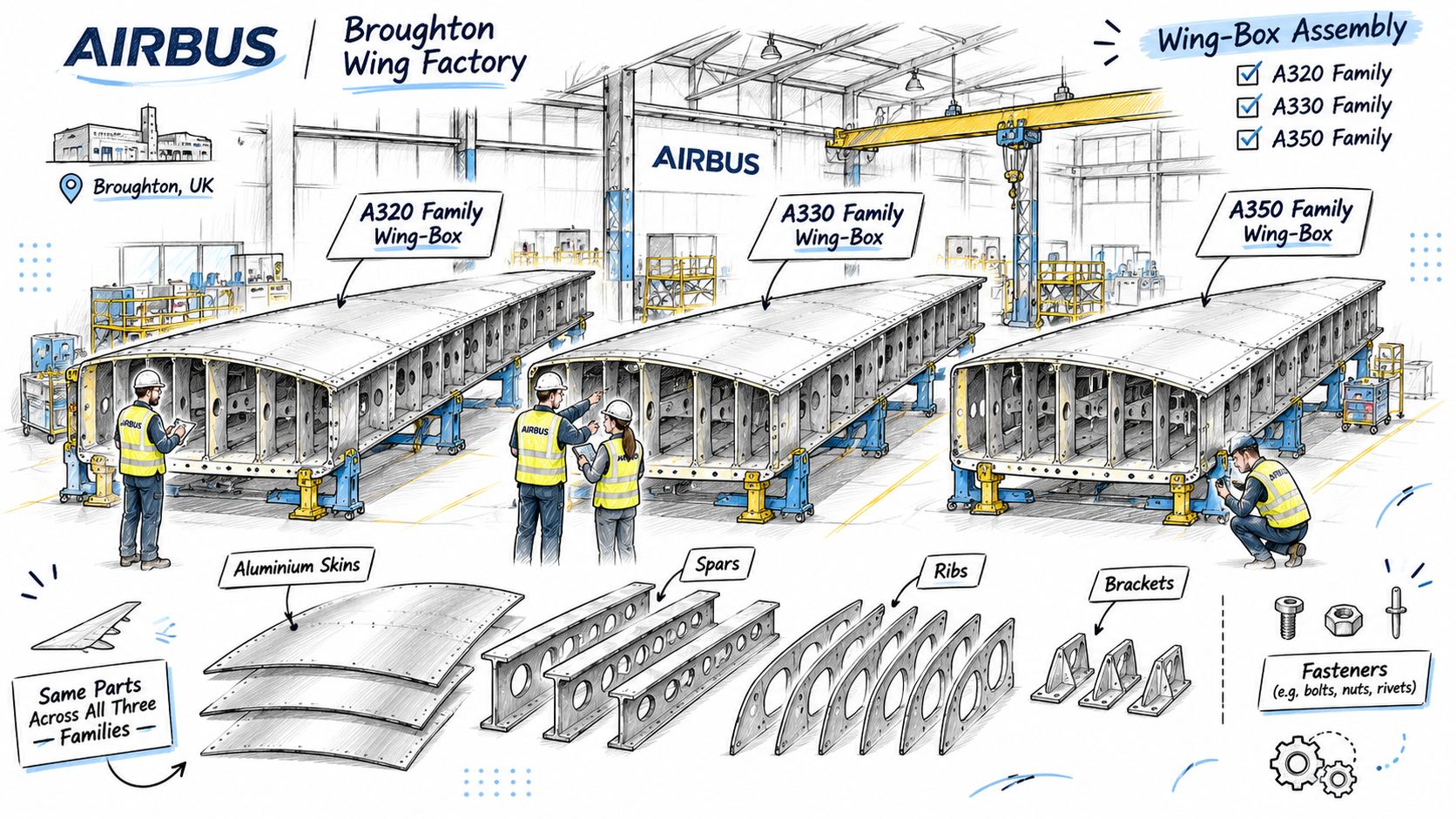
Airbus states that Broughton handles wing skins through wing-box assembly for the A320, A330 and A350 families. The wing box is the principal structural assembly formed around spars and structural covers.
A UK Government funding programme allocated £200 million in Aerospace Technology Institute grants, matched by industry, for work including efficient assembly, systems installation, digital design and folding wing tips.
Which hardware remains?
The Government's 2023 XWING BETA announcement describes longer wings and a folding mechanism intended to retain airport compatibility. Folding adds joints, pins and actuation rather than removing structural connections.
The Aerospace Sector Deal records Boeing Sheffield making more than 100 different actuation-system components for the 737 and 767, using UK-sourced raw materials in that programme.
Higher production rates demand accurate tooling, controlled bonds, traceability and inspection. For a metal-processing workshop, fittings and machining tools remain distinct from the laminate itself.
Questions to Settle Before You Send a Part
When is the next run?
Check the next processing date before planning around a treatment cycle. Cryogenix accepts single items, which are processed alongside other customers' parts on the next scheduled run.
What does a quote need?
Quotes depend on the items you submit. Describe the parts and materials when asking Cryogenix for a quote; single-item orders can join a shared processing cycle.
How should you prepare the hardware?
Lightly oil ferrous metals that could corrode, do not torque parts together, and remove pressed-in bearings where possible. Bulky items, such as engine blocks or stacks of blades, are often easiest to drop off in person at the Yaxley site.
Which items avoid the flight-component approval question?
Shop drills, end mills and machining stock are not installed flight hardware. For pins, bolts and hinges intended for an aircraft, check the applicable process requirements before treatment. Cryogenic treatment is not a repair or an aerospace approval.
Further references: Cryogenix's academic research library collects literature for readers assessing material-specific evidence. Read research within the limits of the materials and tests it covers.
Cryogenix Ltd provides deep cryogenic treatment for compatible metal parts and tooling. Describe your proposed items when requesting a quote at info@cryogenix-uk.com, then check the next processing date before arranging the work.
Comments