


Aerospace Components Manufacturers and Cryogenic Treatment
The popular advice is to treat anything metal and expect it to last longer. Cryogenic treatment changes how some metals behave, most reliably steels, but it won't fix a crack, it won't change a dimension, and it won't turn an unproven alloy into a qualified one. The grade and the prior heat treatment decide whether a trial is worth running at all.
Table of Contents
Does Cryogenic Treatment Help Aerospace Components?
A treated part and an untreated part look identical, weigh the same and measure the same. That is why the honest answer to this question is "sometimes, and only on the bench."
Deep cryogenic treatment cools a part slowly with nitrogen gas to around minus 196°C, holds it there, then returns it to room temperature over roughly three days. The step by step deep cryogenic treatment process covers ramp rates and chamber practice; the short version is a slow, controlled settling period, and parts touch only the gas, never liquid nitrogen.
The treatment acts through the whole section of the material, not just at the surface. It adds no coating and replaces no heat treatment. What it can deliver, depending on the alloy and its prior processing, is stress relief, a more stable structure and better wear behaviour.
That conditional matters more in aerospace than almost anywhere else, because buyers judge a process, not a single impressive part. UK aerospace manufacturers carry that burden across international supply chains: the sector turned over £30.5 billion in 2023 and exported £20 billion, roughly 66% of turnover, according to ADS Group's 2024 sector outlook. One good result on one coupon proves very little to an auditor.
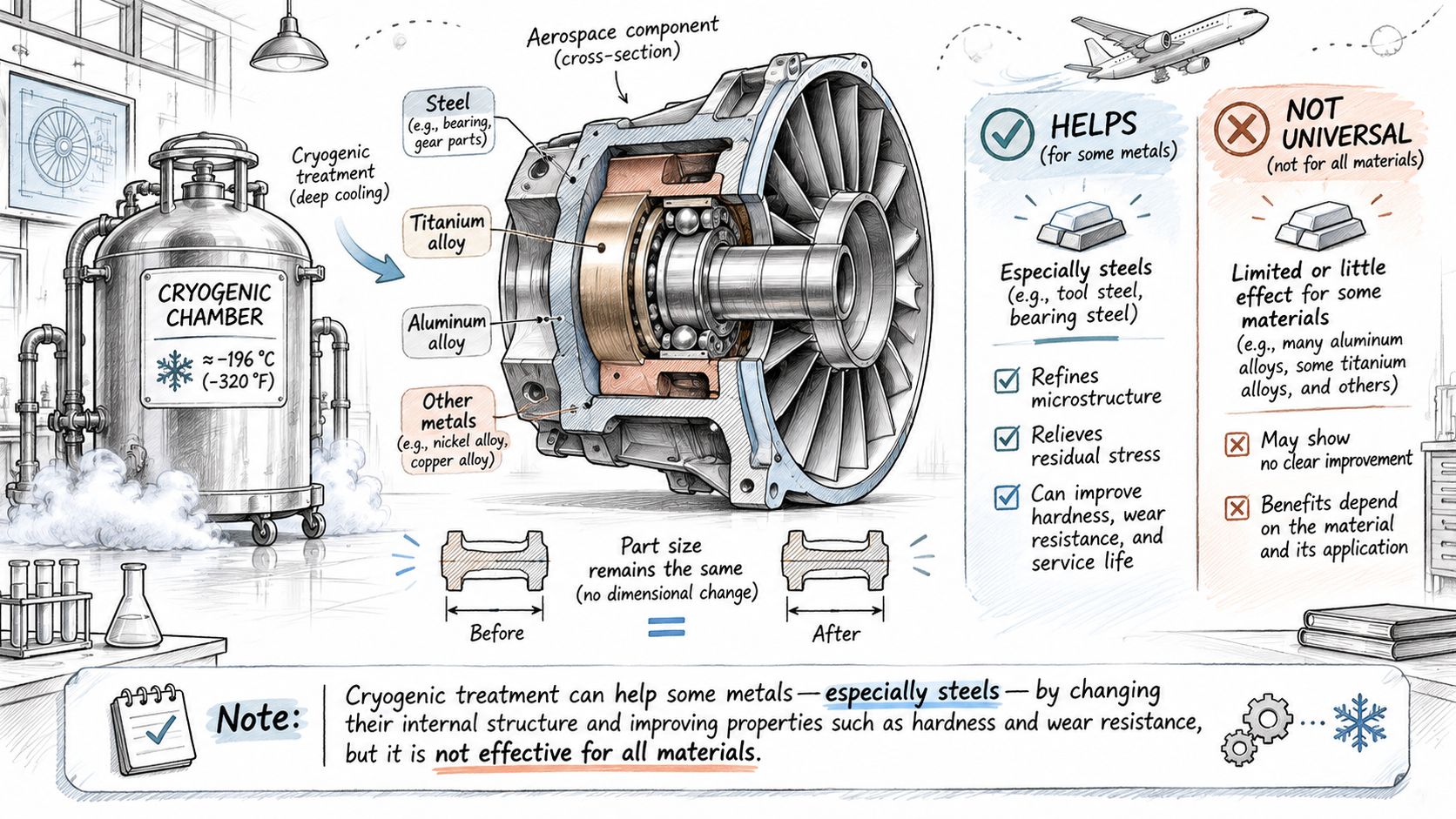
So does it help? On the right grade, with the right prior heat treatment, the evidence and the workshop record both say yes often enough to justify a controlled trial. On the wrong alloy, or as a rescue for a poorly specified part, it spends money and proves nothing. The material and its history decide which side a given component falls on.
Which Aerospace Materials Respond to Cryogenic Treatment
Ask which aerospace materials respond and the honest answer is a short list. Steels sit at the top, backed by published research. Aluminium alloys such as 7075 and 6082 show improved dimensional stability and wear resistance in Cryogenix's own processing, and copper shows promising results, but for both the public evidence is thin. For titanium, nickel alloys and stainless steel, a response should never be assumed before a test proves one.
The table below keeps two tiers separate: what published research supports, and what Cryogenix's own processing has shown. No row was tested on a flying part. Confidence follows the grade and its prior heat treatment, not the material family name on the drawing.
Material groups and the evidence behind treatment
Material group | Typical aerospace examples | What the evidence supports | Confidence and next step |
|---|---|---|---|
Martensitic and tool steels | Gears, shafts, fasteners, cutting tools | Published reviews cover martensitic steels (Jurči and Dlouhý, 2024) and tool steels (Podgornik and others, 2016); the transformation mechanism behind the response is well documented | Highest. Confirm the alloy grade and prior heat treatment first |
Aluminium 7075 and 6082 | Structural brackets, fittings, machined housings | Cryogenix processing shows improved dimensional stability and wear resistance in these grades; published research on cryogenic treatment of aluminium remains limited | Moderate. Run controlled coupons and measure the result |
Copper | Wiring and bonding conductors | Cryogenix reports interesting results on copper components; there is no aerospace-specific published data to draw on | Low for aerospace. Trial before any use |
Carbide cutting tips | Machining tooling for hard alloys | Cryogenix treats carbide tips and sees gains in tool life; published cryogenic research on carbide is limited, so treat it as unproven until measured | Unverified in print. Compare tool life on your own work |
Titanium, nickel alloys and stainless steel | Engine and airframe structures | Published cryogenic research on these alloys is limited, so a response should not be assumed | Unverified. Test the specific grade before trusting it |
Rule of thumb: if the drawing doesn't state the heat treatment condition, stop. You can't compare two parts you can't describe.
That last point decides more trials than the material name does. Two steels with the same designation can arrive in different conditions and respond differently, so grade and prior heat treatment come before any coupon goes in the chamber. For the tooling side, the tool steel types we see most often are worth reading before you pick a test coupon, since the right comparison part is one you can describe completely.
What the Evidence Shows and What It Does Not
Tier one, published research. Thornton, Slatter, Jones and Lewis (2011) ran a pin on disc study on grey cast iron brake discs and reported wear rate improvements of 9.1 to 81.4 per cent with no significant change in bulk hardness, as recorded in the University of Sheffield repository. That is a laboratory sliding-wear result, not a service-life result, and it does not predict how an aerospace component will behave.
Jurči and Dlouhý (2024) review martensitic steels, Podgornik and others (2016) cover tool steels, and Baldissera and Delprete (2008) survey the wider field. Across these papers, results vary with alloy grade, prior heat treatment, treatment route and test method. Before accepting a study as support for a part, check that its material condition and measured outcome match the failure mode under review. This guide to systematic literature review steps explained sets out how to search, screen and score studies so one favourable paper cannot carry a claim.
Tier two, supplier experience. Cryogenix treats motorsport parts such as brake discs to improve performance and extend their longevity. Motorsport use does not carry over to aerospace parts without testing.
Tier three, the open question. The mechanism is still debated, and results differ enough between studies that no single explanation accounts for every material or treatment route. Cryogenix's academic research library collects papers relevant to the process and the materials studied.
Use published wear data as a reason to run a trial. Never as proof that a part will meet its life requirement.
When Is Cryogenic Treatment Not Worth Testing?
Treatment changes a material's internal structure, so it cannot correct geometry, damage, or a heat treatment that was never done. The table gives a verdict per situation.
Situations where treatment is not worth testing
Situation | Worth testing? | Why |
|---|---|---|
Cracked, fatigued or damaged part | No | Treatment does not repair cracks or damage |
Part needing a dimensional change | No | Treated parts stay dimensionally unchanged, so size is not corrected |
Titanium, nickel alloy or stainless steel | Only as a controlled trial | No supporting source reviewed; don't assume a response |
Process change needing re-approval with no trial data | Not yet | Approval holder and customer review come first |
Surface finish or coating as the main requirement | Ask first | Treatment is not a coating and doesn't replace a surface treatment |
If what you need is a harder surface, that's a different job entirely: nitriding and other surface treatments add or diffuse a layer, which cryogenic treatment does not do.
A trial is also not worth the cost in three common cases. Short-life parts replaced on schedule anyway have nothing to gain. Very low volumes can cost more to test properly than the likely benefit returns. And parts whose main failure mode is neither wear nor fatigue in the steel family sit outside the evidence entirely. Deep cryogenic treatment is not heat treatment and does not replace one.
A neutral result is still a result. It tells you where not to spend next time.
Results vary by material, prior heat treatment and application, so a trial that shows nothing has still bought you a decision.
How Do I Test Treatment on a Specific Part?
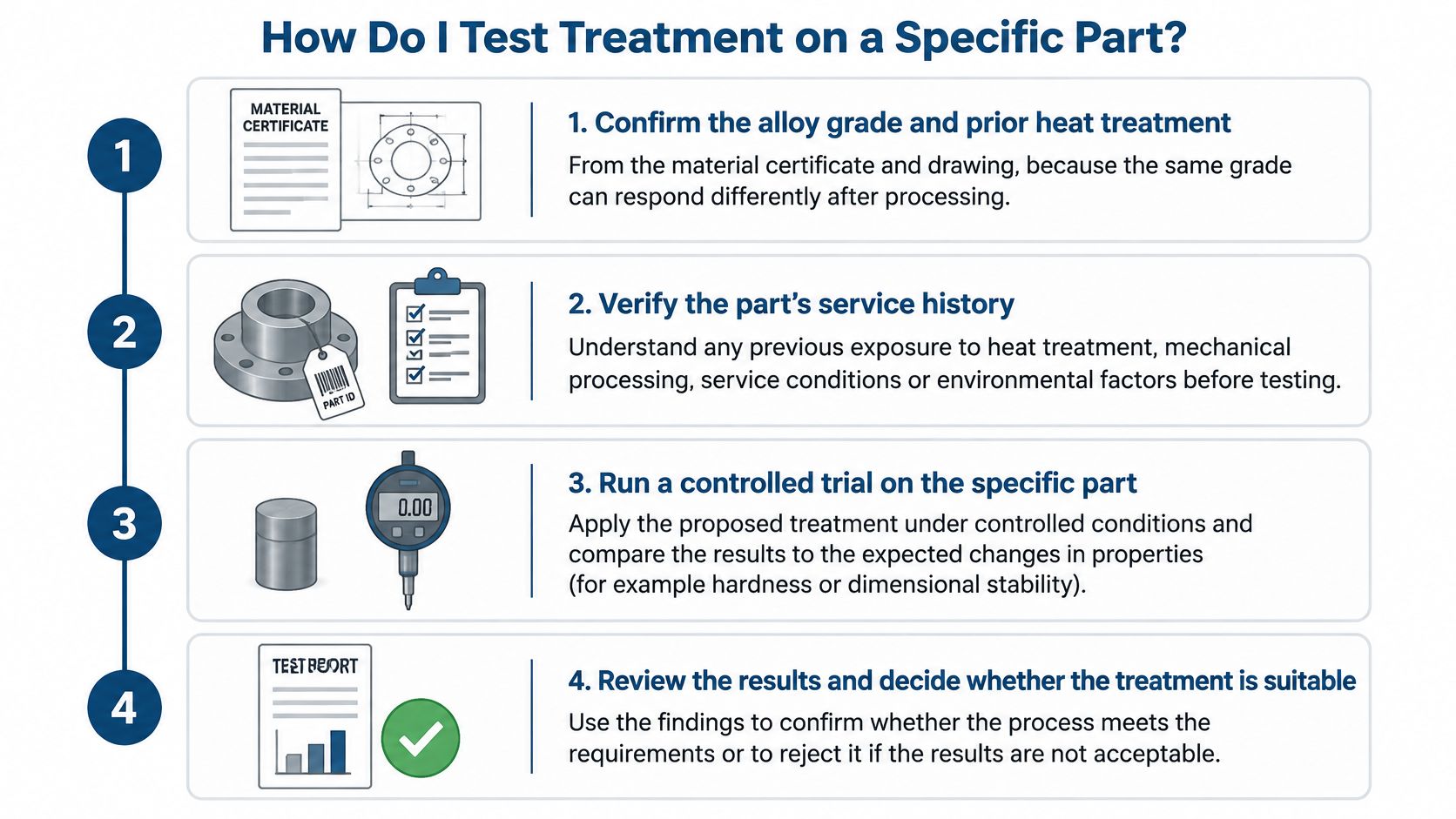
Confirm the alloy grade and prior heat treatment from the material certificate and the drawing. The same grade can respond differently after different tempering or case conditions, so an unverified grade makes every later measurement meaningless.
Check the material family against the table above. Steels have the strongest evidence base. Aluminium, copper and carbide sit lower, and titanium, nickel alloys and stainless steel have none.
Define the role the treatment must improve and the measure for each one: wear rate, dimensional stability, tool life, or hardness. Pick the measurement before the parts leave, not after.
Set aside untreated control parts and record hardness, dimensions and any wear markers on them. Without controls you're comparing a treated part to a memory.
Agree packing, labelling and handling in writing. Before sending, don't torque parts together, lightly oil ferrous metals that could corrode, and remove pressed-in bearings where possible.
Treat matched batches alongside the controls, keeping batch records and traceability for every part so each result links back to a specific component.
Compare against acceptance criteria set in advance, not against a feeling about how the part looks.
Step seven is where aerospace buyers separate from everyone else. UK aerospace exports were reported at approximately £23.2 billion in 2024, according to ADS facts and figures, and export exposure means a customer expects process consistency across a supply chain rather than one conforming part. Use a batch large enough to show a pattern.
Decide to adopt, retest or reject, then route any change through your quality system before it reaches an approved product. The approval section below explains why that order matters.
What a usable result looks like: treated and control parts, the same measurements on both, and a batch record that ties every part to the run.
Do Approval Rules Change a Treatment Trial?
A successful trial can create a programme problem. If treatment changes how a part is produced, the approval holder, the design authority and the customer may all need to review it before a treated part enters an approved product.
The regulatory frame matters. A UK company manufacturing Part 21 aircraft products, parts or appliances generally needs to demonstrate production capability under the applicable Part 21 requirements and may apply to the Civil Aviation Authority for a UK Part 21 Subpart G Production Organisation Approval. The CAA guidance on Subpart G approval states that applicants should have their principal place of business in the UK, that correctly completed applications are processed for investigation within 10 working days, that certificates are intended to be raised within 20 working days of an airworthiness recommendation, and that approval continues only with a recommendation every 24 months following a satisfactory audit programme.
Treat those numbers as a measure of how tightly production control, traceability and audit readiness are wired into daily operation. Equipment-related projects can carry a further layer of design and production approval, and the work has to sit inside the approved scope of the organisations involved.
The approval question belongs in the same decision as material grade and prior heat treatment. A part that responds well to treatment still fails commercially if the change cannot be adopted. A treatment provider replaces none of those approvals, and we claim none for cryogenic processing. Run the metallurgical trial, then route the adoption decision through your quality system and check current requirements directly with the CAA before a treated part reaches a product.
What Should I Know Before Sending Parts?
Single parts are accepted and processed alongside other customers' items in the next scheduled run. Orders are pooled, keeping small-volume work competitively priced. Pricing is quoted on request; particularly heavy orders may qualify for more cost-effective pricing.
Most customers have their parts back within a week to ten days of a scheduled run, including shipping time at each end. Check the next processing date before booking. If a race date or production deadline is fixed, mention it when you book so Cryogenix can do what it can to accommodate it.
Treated parts return dimensionally unchanged and visually identical, with no coating, plating or added surface layer. For a trial, compare measurements and performance against untreated controls rather than expecting a visible change.
Keep each trial specific to the material grade and its prior heat treatment. Results from one part do not establish how a different alloy or processing history will respond. The frequently asked questions about cryogenic treatment cover common preparation and process questions.
Before sending parts, do not torque them together. Lightly oil ferrous metals that could corrode, and remove pressed-in bearings where possible. FedEx next day is recommended because it is trackable. Drop-off and collection in person are also welcome at Cryogenix's Yaxley site; parts can be shipped from anywhere in the UK.
References
Thornton, Slatter, Jones and Lewis (2011), “The effects of cryogenic processing on the wear resistance of grey cast iron brake discs,” Wear 271.
Thornton (2014), PhD thesis, University of Sheffield, full thesis
Jurči and Dlouhý (2024), “Cryogenic Treatment of Martensitic Steels,” published review
Baldissera and Delprete (2008), “Deep cryogenic treatment: a bibliographic review,” The Open Mechanical Engineering Journal, journal article
Podgornik and others (2016), “Deep cryogenic treatment of tool steels,” Journal of Materials Processing Technology 229, journal article
For booking and pricing, use the Cryogenix contact page.
Comments